. 2021 May 11;11(1):10039.
doi: 10.1038/s41598-021-89409-8.

Reduced competence to arboviruses following the sustainable invasion of Wolbachia into native Aedes aegypti from Southeastern Brazil

Affiliations

Reduced competence to arboviruses following the sustainable invasion of Wolbachia into native Aedes aegypti from Southeastern Brazil

João Silveira Moledo Gesto et al. Sci Rep. .

Abstract

Field release of Wolbachia-infected Aedes aegypti has emerged as a promising solution to manage the transmission of dengue, Zika and chikungunya in endemic areas across the globe. Through an efficient self-dispersing mechanism, and the ability to induce virus-blocking properties, Wolbachia offers an unmatched potential to gradually modify wild Ae. aegypti populations turning them unsuitable disease vectors. Here we describe a proof-of-concept field trial carried out in a small community of Niterói, greater Rio de Janeiro, Brazil. Following the release of Wolbachia-infected eggs, we report here a successful invasion and long-term establishment of the bacterium across the territory, as denoted by stable high-infection indexes (> 80%). We have also demonstrated that refractoriness to dengue and Zika viruses, either thorough oral-feeding or intra-thoracic saliva challenging assays, was maintained over the adaptation to the natural environment of Southeastern Brazil. These findings further support Wolbachia's ability to invade local Ae. aegypti populations and impair disease transmission, and will pave the way for future epidemiological and economic impact assessments.


Conflict of interest statement

The authors declare no competing interests.

Figures
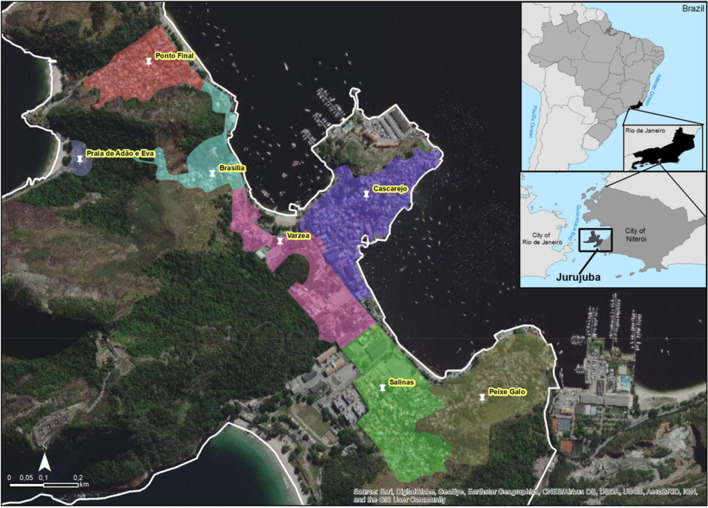
Figure 1
Figure 1
Map of Jurujuba release areas. Satellite view of Jurujuba, a suburban neighborhood of Niterói (RJ). With an estimated population of 2797 in 2.53 km2, Jurujuba was divided into seven release areas (highlighted) according to local sectors: Ponto Final, Várzea, Brasília, Cascarejo, Praia de Adão e Eva, Peixe-Galo and Salinas. Map was created with ArcGIS Desktop 10.7 (Esri Inc., https://www.esri.com/en-us/arcgis/products/arcgis-desktop/overview) using Google Earth (Google LLC) source code, under the license and in accordance with the fair use described in ‘https://about.google/brand-resource-center/products-and-services/geo-guidelines’.
Figure 2
Figure 2
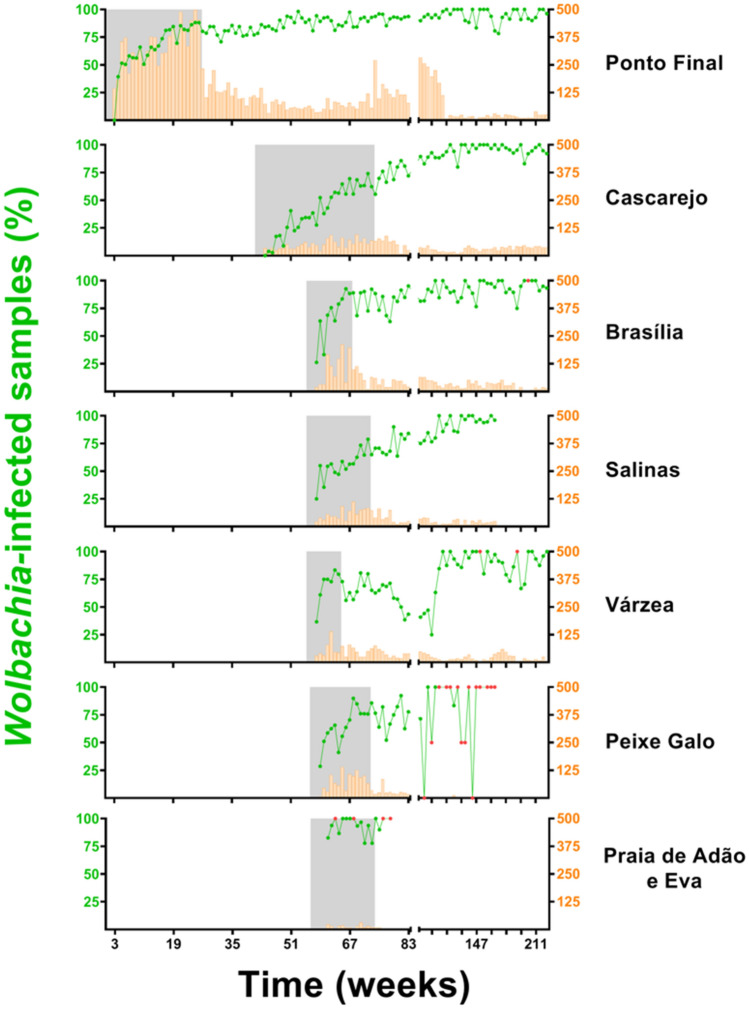
Wolbachia’s spread across Niteroi’s suburb Jurujuba. Over a period spanning 73 weeks, wMel-infected eggs were gradually released across all sectors of Jurujuba: Ponto Final, Cascarejo, Brasília, Salinas, Várzea, Peixe Galo and Praia de Adão e Eva (release interventions depicted under grey shaded areas). Infection indexes (%) are plotted as line-connected dots (green), following the vertical left axis, whereas the sample sizes are plotted as histograms (orange), following the vertical right axis. Small-sized samples (N < 5) were marked in red. The horizontal axis represents time, in number of weeks, since the beginning of egg-releases in Ponto final (August 2015) until more recent days (December 2019). Note that the horizontal axis is split into two fragments, in which the data account for 1-week (left fragment) or 4-week bins (right fragment). Ticks are scaled accordingly to represent a 16-week bin. Graphs were created with GraphPad Prism 8 (https://www.graphpad.com).
Figure 3
Figure 3
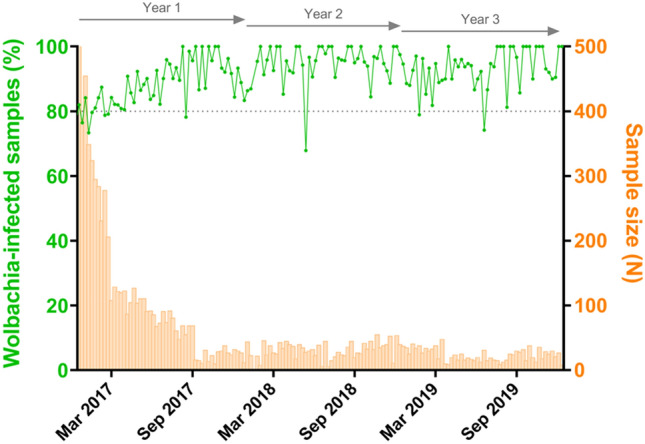
Post-release establishment of Wolbachia in Jurujuba. Following egg-release cessation in Jurujuba, Wolbachia-infection was monitored over the following three years, during which a self-sustained field establishment was observed. Infection indexes (%) are observed as line-connected dots (green), following the vertical left axis, whereas the sample sizes are plotted as histograms (orange), following the vertical right axis. The horizontal axis denotes time (weeks), with ticks scaled for 6-month bins. Top arrows mark yearly post-release periods. The dashed line, positioned at the 80% index mark, denotes a threshold for high-percent infection. This graph was generated in GraphPad Prism 8 (https://www.graphpad.com).
Figure 4
Figure 4
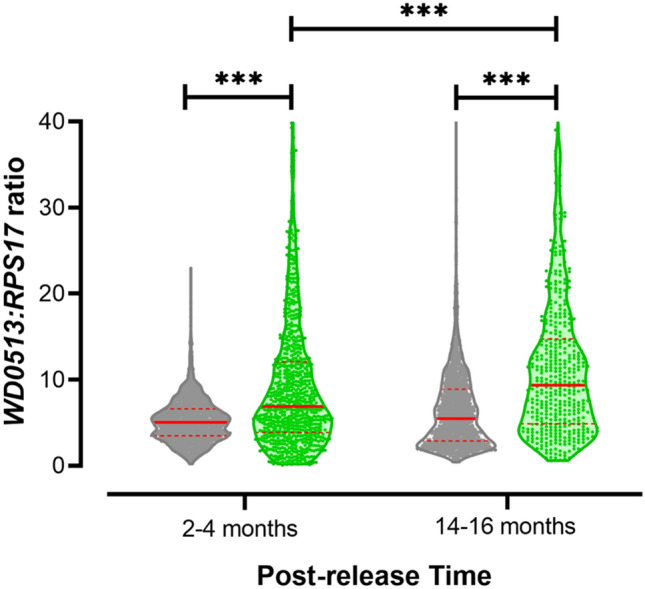
Wolbachia whole-body density increases subsequent to field establishment. Wolbachia whole-body density was molecularly assayed in whole-body extracts from colony (grey) and Jurujuba samples (green), collected over the post-release phase. Density or titration levels (vertical axis) are relative quantification indexes, reflecting the copy number ratio between wMel WD0513 and the endogenous ribosomal maker RPS17. Data were aggregated in 12-weeks pools and represented by violin plots, with medians and quartiles in solid and dashed red lines, respectively. Statistical inferences were performed by the non-parametric Kruskal–Wallis test followed by Dunn’s post-hoc multiple comparisons. Asterisks highlight differences between groups, considering a significance level (α) equal to 0.05, and its numbers reflects probability ranges: *P < 0.05, **P < 0.01, ***P < 0.001. Graph and statistics were made with GraphPad Prism 8 (https://www.graphpad.com).
Figure 5
Figure 5
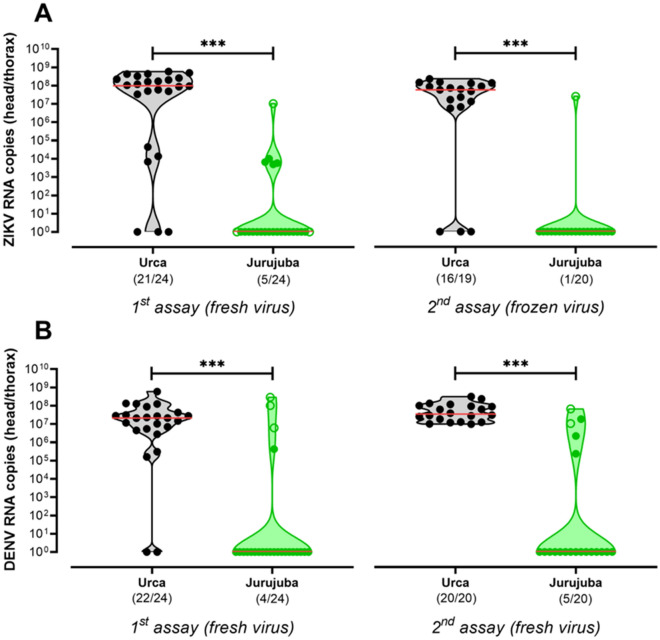
Wolbachia inhibits ZIKV and DENV tissue replication following oral-infection of field samples. Following the long-term establishment of Wolbachia in Jurujuba, field samples were brough to the laboratory and orally challenged with ZIKV and DENV, either fresh or frozen. Wolbachia-mediated inhibition of ZIKV and DENV replication was evaluated by comparing samples from Jurujuba (green) and Urca (grey), a Wolbachia-free non-targeted area in the suburbs of Rio de Janeiro. Violin plots represent absolute quantifications of (A) DENV and (B) ZIKV titers in head/thorax extracts, at 14 dpi. Median and quartiles are depicted in solid and dashed red lines, respectively. The proportion of infected individuals are shown as fractions underneath. Wolbachia Jurujuba individuals were flagged by empty dots. Non-parametric Mann–Whitney U test highlighted differences between Urca and Jurujuba. Asterisks denote significant effects, with α equal to 0.05, and levels varying according to probability ranges: *P < 0.05, **P < 0.01, ***P < 0.001. Graph and statistics were made with GraphPad Prism 8 (https://www.graphpad.com).
Figure 6
Figure 6
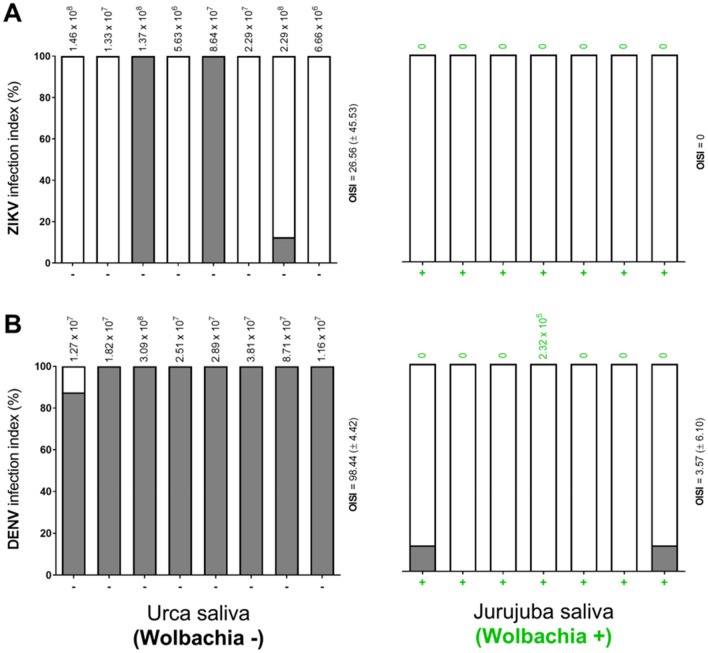
Wolbachia-harboring field samples impair saliva transmission of ZIKV and DENV. ZIKV and DENV transmission by the saliva is affected by the presence of Wolbachia in Jurujuba. Saliva harvested from WolbachiaUrca (grey) or Wolbachia+ Jurujuba samples (green), orally-challenged with ZIKV (A) or DENV (B), were intrathoracically injected into groups of naïve Urca individuals (n = 8) and consequent infection was determined at 5 dpi, for ZIKV, or at 7 dpi, for DENV. Groups are represented by stacked columns of infected (filled in grey) or non-infected individuals (clear), percent transformed. Viral titers of head/thorax extracts, of corresponding saliva samples, are shown at the top of each column. OISI, the overall saliva intrathoracic infection indexes (± SD) are represented at the right of each graph. Graphs were created and customized with GraphPad Prism 8 (https://www.graphpad.com).

References

    1. Kraemer MUG, et al. The global distribution of the arbovirus vectors Aedes aegypti and Ae. albopictus. Elife. 2015;4:e08347. doi: 10.7554/eLife.08347. - DOI - PMC - PubMed
    1. WHO . Global Vector Control Response 2017–2030. Geneva: World Health Organization; 2017.
    1. Brady OJ, et al. Refining the global spatial limits of dengue virus transmission by evidence-based consensus. PLoS Negl. Trop. Dis. 2012;6:e1760. doi: 10.1371/journal.pntd.0001760. - DOI - PMC - PubMed
    1. Bhatt S, et al. The global distribution and burden of dengue. Nature. 2013;496:504–507. doi: 10.1038/nature12060. - DOI - PMC - PubMed
    1. SVS. Boletim Epidemiológico 38. Secretaria de Vigilância em Saúde - Ministério da Saúde50, 9–39 (2019).

Publication types

LinkOut - more resources