. 2021 Oct;56(10):2367-2381.
doi: 10.1038/s41409-021-01286-x. Epub 2021 May 11.

Second allogeneic transplants for multiple myeloma: a report from the EBMT Chronic Malignancies Working Party

Affiliations

Second allogeneic transplants for multiple myeloma: a report from the EBMT Chronic Malignancies Working Party

Patrick J Hayden et al. Bone Marrow Transplant. 2021 Oct.

Abstract

The EBMT Chronic Malignancies Working Party performed a retrospective analysis of 215 patients who underwent a second allo-HCT for myeloma between 1994 and 2017, 159 for relapse and 56 for graft failure. In the relapse group, overall survival (OS) was 38% (30-46%) at 2 years and 25% (17-32%) at 5 years. Patients who had a HLA-identical sibling (HLAid-Sib) donor for their first and second transplants had superior OS (5 year OS: HLAid-Sib/HLAid-Sib: 35% (24-46%); Others 9% (0-17%), p < 0.001). There was a significantly higher incidence of acute grade II-IV GvHD in those patients who had also developed GvHD following their initial HLA-identical sibling allo-HCT (HLAid-Sib/HLAid-Sib: 50% (33-67%); Other 22% (8-36%), p = 0.03). More as opposed to fewer than 2 years between transplants was associated with superior 5-yr OS (31% (21-40%) vs. 10% (1-20%), P = 0.005). On multivariate analysis, consecutive HLA-identical sibling donor transplants conferred a significant OS advantage (0.4 (0.24-0.67), p < 0.001). In the graft failure group, OS was 41% at 2 years. In summary, a second allo-HCT using a HLA-identical sibling donor, if available, provides the best transplant outcomes for relapsed myeloma in this setting.


Conflict of interest statement

The authors declare no competing interests.

Figures
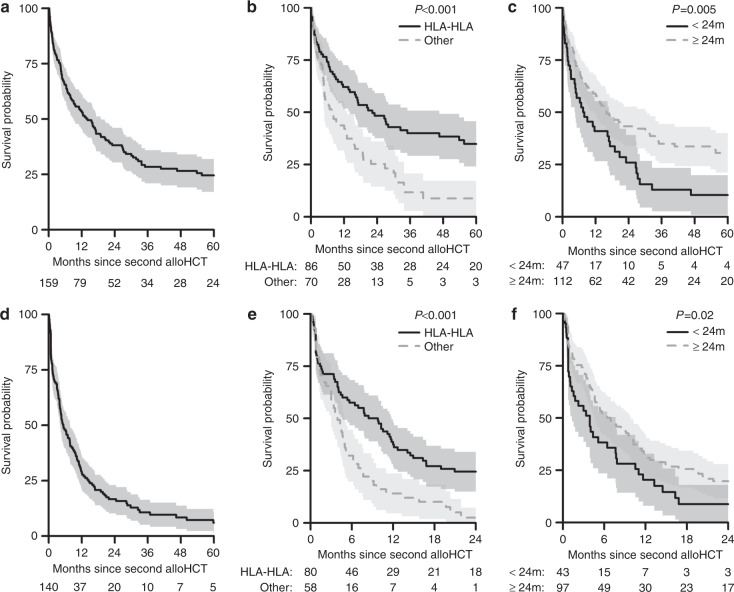
Fig. 1
Fig. 1. Overall and Progression-Free Survival following a second allogeneic transplant for relapsed myeloma and factors affecting these outcomes.
a Overall survival of patients who underwent a second allo-HCT for relapsed myeloma. b Overall survival of patients who had two consecutive HLA-identical sibling donor transplants (HLA-HLA) versus other donor types. c Overall survival of patients who underwent a second allo-HCT for relapsed myeloma based on time between first and second allo-HCT (2-year cut-off). d Progression-free survival of patients who underwent a second allo-HCT for relapsed myeloma. e Progression-free survival of patients who had two consecutive HLA-identical sibling donor transplants (HLA-HLA) versus other donor types. f Progression-free survival of patients who underwent a second allo-HCT for relapsed myeloma based on time between first and second allo-HCT (2-year cut-off).
Fig. 2
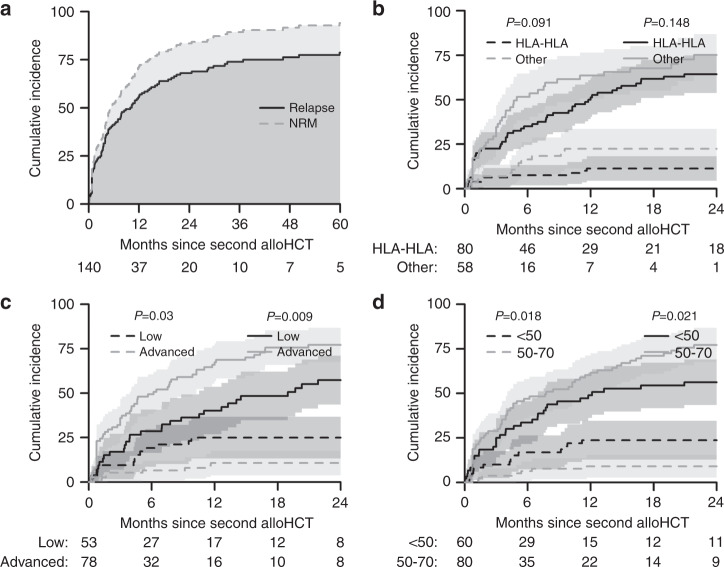
Fig. 2. Relapse incidence and NRM rates following a second allogeneic transplant for relapsed myeloma and factors affecting these outcomes.
a Cumulative incidence of relapse (solid line) and non-relapse mortality (dashed line) over 5 years in patients whose second allo-HCT was for relapsed myeloma. b Cumulative incidence of relapse (solid line) and non-relapse mortality (dashed line) over 5 years based on the type of stem cell donor (HLA-HLA) in patients whose second allo-HCT was for relapsed myeloma. c Cumulative incidence of relapse (solid line) and non-relapse mortality (dashed line) over 5 years based on Disease Stage (low or advanced) in patients whose second allo-HCT was for relapsed myeloma. d Cumulative incidence of relapse (solid line) and non-relapse mortality (dashed line) over 5 years based on age of transplant recipient in patients whose second allo-HCT was for relapsed myeloma.
Fig. 3
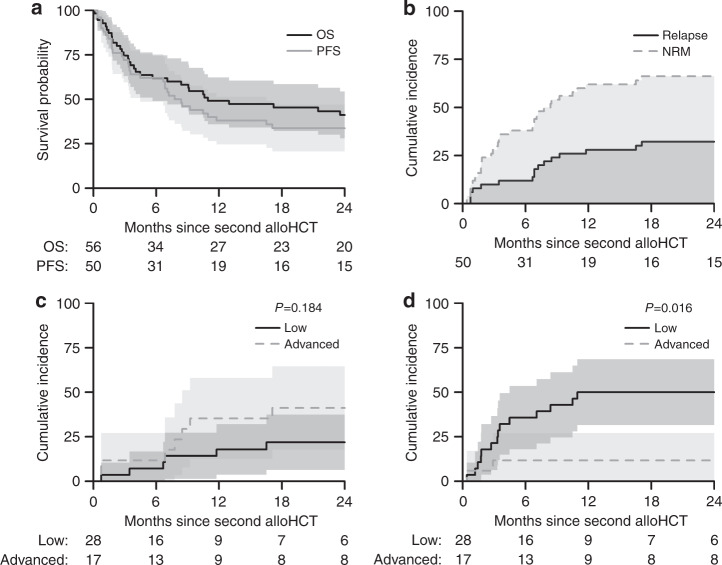
Fig. 3. Overall and Progression-Free Survival in patients with myeloma following a second allogeneic transplant for graft failure and factors affecting these outcomes.
a Two-year overall survival and progression-free survival of MM patients who underwent a second allo-HCT for graft failure. b Cumulative incidence of relapse (solid line) and non-relapse mortality (dashed line) over 2 years in MM patients whose second allo-HCT was for graft failure. c Two-year cumulative incidence of relapse based on disease stage (low or advanced) in MM patients whose second allo-HCT was for graft failure. d Two-Year cumulative incidence of non-relapse mortality based on disease stage (low or advanced) in MM patients whose second allo-HCT was for graft failure.

References

    1. Craddock C, Hoelzer D, Komanduri KV. Current status and future clinical directions in the prevention and treatment of relapse following hematopoietic transplantation for acute myeloid and lymphoblastic leukemia. Bone Marrow Transpl. 2019;54:6–16. doi: 10.1038/s41409-018-0203-8. - DOI - PubMed
    1. Sureda A, Dreger P, Bishop MR, Kroger N, Porter DL. Prevention and treatment of relapse after stem cell transplantation in lymphoid malignancies. Bone Marrow Transpl. 2019;54:17–25. doi: 10.1038/s41409-018-0214-5. - DOI - PubMed
    1. Chen YB, McCarthy PL, Hahn T, Holstein SA, Ueda M, Kroger N, et al. Methods to prevent and treat relapse after hematopoietic stem cell transplantation with tyrosine kinase inhibitors, immunomodulating drugs, deacetylase inhibitors, and hypomethylating agents. Bone Marrow Transpl. 2019;54:497–507. doi: 10.1038/s41409-018-0269-3. - DOI - PubMed
    1. Falkenburg F, Ruggiero E, Bonini C, Porter D, Miller J, Malard F, et al. Prevention and treatment of relapse after stem cell transplantation by cellular therapies. Bone Marrow Transpl. 2019;54:26–34. doi: 10.1038/s41409-018-0227-0. - DOI - PubMed
    1. Shaw BE, Mufti GJ, Mackinnon S, Cavenagh JD, Pearce RM, Towlson KE, et al. Outcome of second allogeneic transplants using reduced-intensity conditioning following relapse of haematological malignancy after an initial allogeneic transplant. Bone Marrow Transpl. 2008;42:783–9. doi: 10.1038/bmt.2008.255. - DOI - PubMed