


Visual and Refractive Outcomes and Patient Satisfaction Following Implantation of Monofocal IOL in One Eye and ERV IOL in the Contralateral Eye with Mini-Monovision
- PMID: 33976532
- PMCID: PMC8106467
- DOI: 10.2147/OPTH.S278648
Visual and Refractive Outcomes and Patient Satisfaction Following Implantation of Monofocal IOL in One Eye and ERV IOL in the Contralateral Eye with Mini-Monovision
Abstract
Title: Visual and refractive outcomes and patient satisfaction following implantation of monofocal intraocular lens in one eye and ERV intraocular lens in the contralateral eye with mini-monovision.
Purpose: To evaluate the outcomes following implantation of monofocal intraocular lens in one eye and ERV intraocular lens in the contralateral eye with mini-monovision.
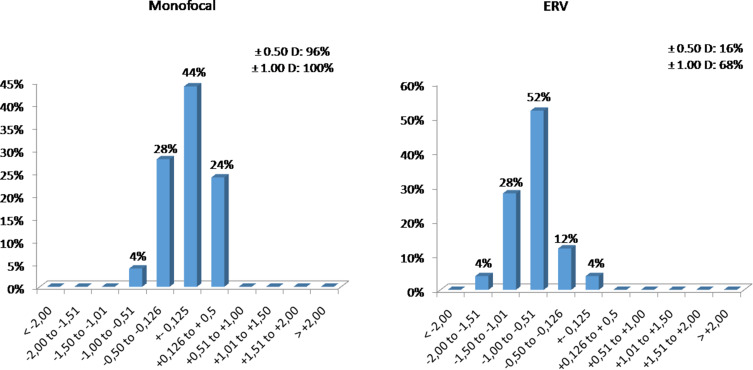
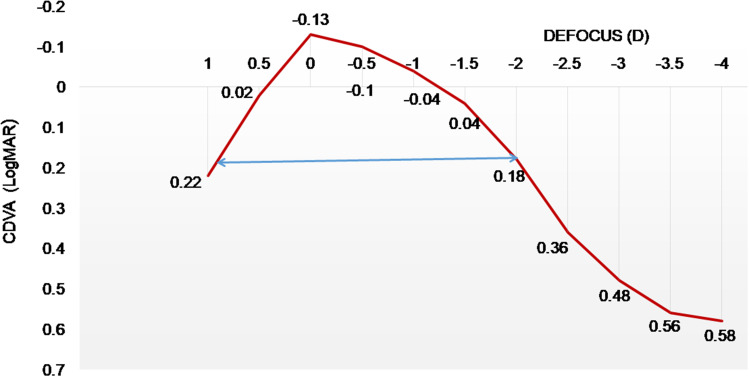
Methods: Twenty-five subjects underwent bilateral cataract surgery, wherein the dominant eye received monofocal Tecnis-1 IOL, while in the contralateral eye received the Tecnis Symphony ERV IOL. The dominant eye was targeted for emmetropia and the non-dominant eye for myopia of -0.50 to -0.75D. Binocular uncorrected and corrected distance (UDVA, CDVA), intermediate (UIVA, CIVA), and near (UNVA, DCNVA) visual acuity; reading speeds, defocus curve and contrast sensitivity were studied at 6 months post-operatively.
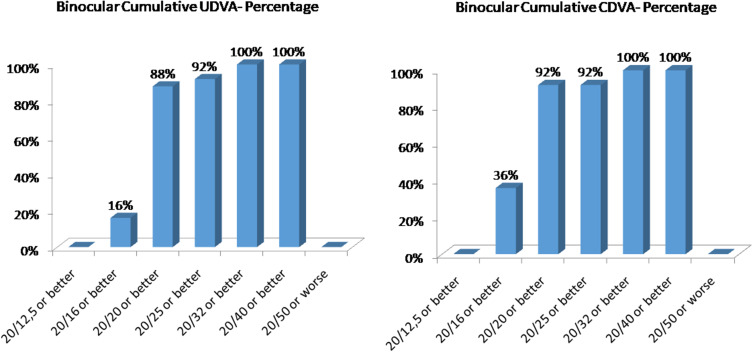
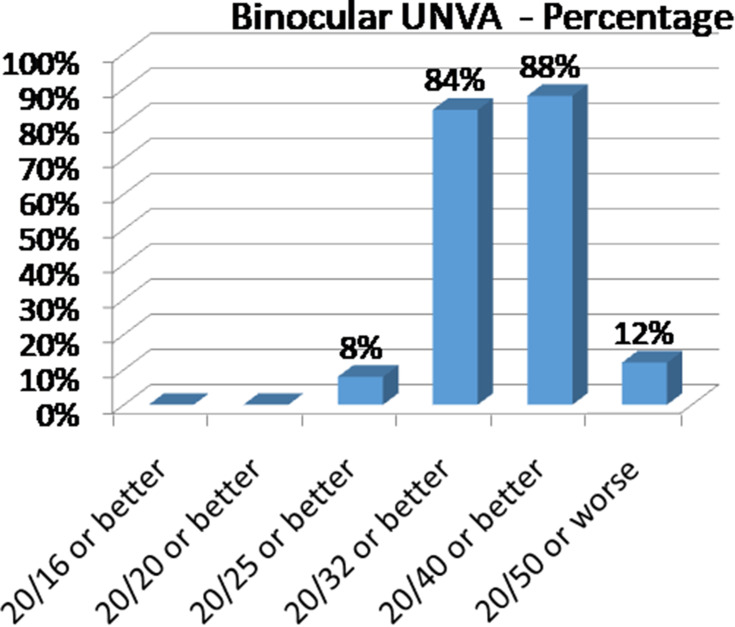
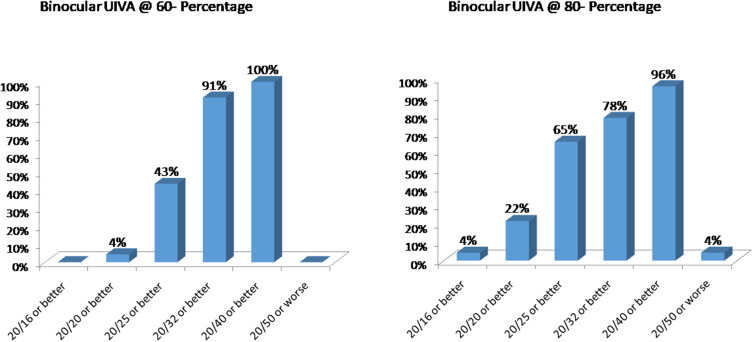
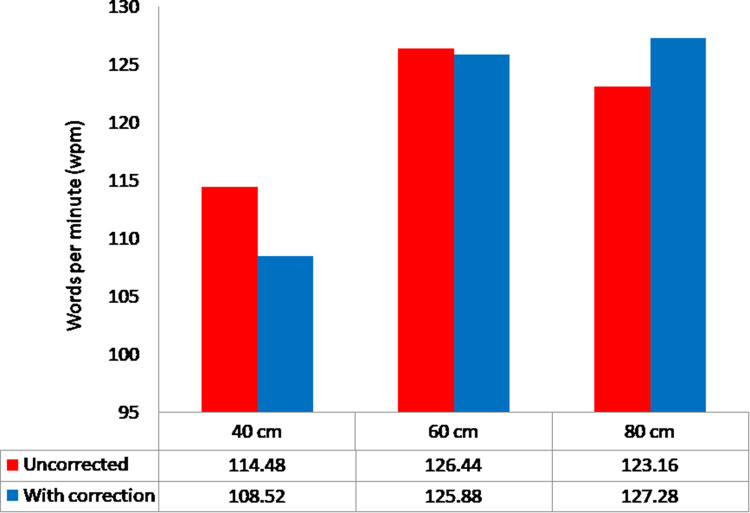
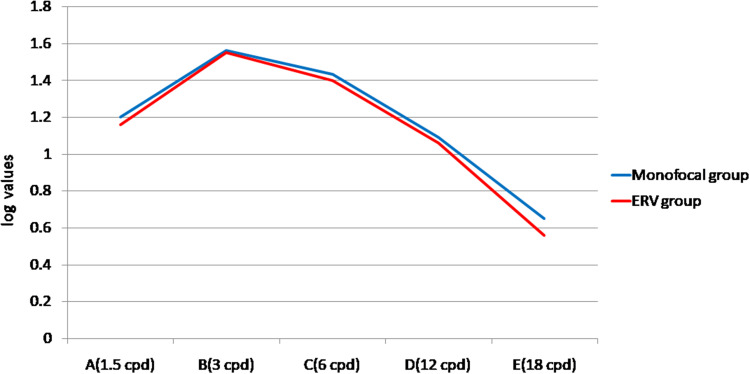
Results: At 6 months post-operatively the mean binocular UDVA, CDVA, UNVA and DCNVA were 0.007±0.07, -0.13±0.06, 0.26±0.09 and 0.44±0.10 LogMAR, respectively. Binocular UIVA and DCIVA at 60 cm were 0.22±0.10 and 0.18±0.08 LogMAR and at 80 cm was 0.16±0.11 and 0.15±0.10 LogMAR, respectively. Mean uncorrected reading speeds evaluated with SRD at 40, 60 and 80 cm were 114.4±6.9, 126.4±7.9 and 123.16±5.8 words per minute. Contrast sensitivity values did not show significant difference for any spatial frequency tested. At 6 months, only 12% (3 patients) reported mild halos. Spectacle independence satisfaction scores were 96%, 100% and 88% for distance, intermediate and near.
Conclusion: Implantation of monofocal intraocular lens in one eye and ERV intraocular lens in the contralateral with mini-monovision resulted in good outcomes for far and intermediate, and satisfactory outcomes for near vision, with good tolerance to mini-monovision at the end of 6 months.
Keywords: extended range of vision IOL; hybrid monovision; monofocal IOL.
© 2021 Brar et al.
Conflict of interest statement
The study was supported by an unrestricted grant from Johnson & Johnson Vision. However, none of the authors have any financial or proprietary interest in a product, method, or material described herein. Dr Sri Ganesh reports grants from Johnson & Johnson Vision, during the conduct of the study. The authors report no other potential conflicts of interest for this work. This paper was presented at the ASCRS Conference at Washington DC, in 2018, as a free paper presentation with interim findings. The presentation link can be found here: https://ascrs.confex.com/ascrs/18am/meetingapp.cgi/Paper/41301.
Figures
References
-
- Studený P, Kacerovský M, Kacerovská J, Gajarová N, Straňák Z. Hybridní monovision [Hybrid monovision]. Cesk Slov Oftalmol. 2017;73(1):13–16. - PubMed
LinkOut - more resources
Full Text Sources
Other Literature Sources
