


Lumbar Spondylolisthesis Progression: What is the Effect of Lumbar Medial Branch Nerve Radiofrequency Ablation on Lumbar Spondylolisthesis Progression? A Single-Center, Observational Study
- PMID: 33976569
- PMCID: PMC8104986
- DOI: 10.2147/JPR.S310238
Lumbar Spondylolisthesis Progression: What is the Effect of Lumbar Medial Branch Nerve Radiofrequency Ablation on Lumbar Spondylolisthesis Progression? A Single-Center, Observational Study
Abstract
Background: Radiofrequency ablation (RFA) is a denervation therapy commonly performed for pain of facet etiology. Degenerative spondylolisthesis, a malalignment of the spinal vertebrae, may be a co-existing condition contributing to pain; yet the effect of RFA on advancing listhesis is unknown. To the extent that denervating RFA may weaken paraspinal muscles that provide stability to the spine, the therapy can potentially contribute to progressive spinal instability.
Methods: Single-center, prospective, observational pilot study in an interventional pain practice to test the hypothesis that RFA of painful facets in the setting of spondylolisthesis may contribute to advancement of further degenerative spondylolisthesis. Fifteen participants with pre-existing degenerative Grade I or Grade II spondylolisthesis and coexisting axial lumbar pain underwent lumbar RFA encompassing spondylolisthesis level and followed with post-RFA imaging at 12 months and beyond to measure percent change in spondylolisthesis.
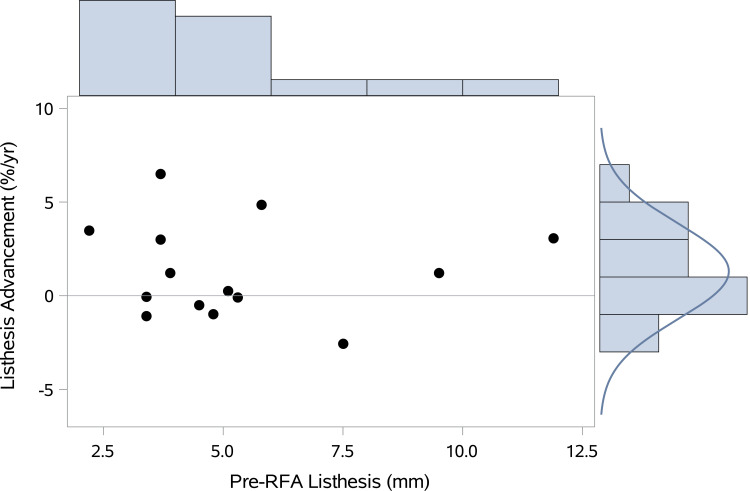
Results: The primary outcome was the percent advancement of spondylolisthesis per year measured on post-RFA lateral lumbar spine imaging compared with non-intervention inferred baseline advancement of 2% per very limited observational studies. Among the 15 participants enrolled, 14 completed the study (median age 66; 64.3% women; median BMI 33.5; mean follow-up time 23.9 months). The mean advancement of spondylolisthesis per year after RFA was 1.30% (95% CI -0.14 to 2.78%), with 9/14 below 1.25%.
Conclusion: Among patients with lumbar pain originating from facets in the setting of degenerative spondylolisthesis who underwent lumbar RFA, the observed advancement of spondylolisthesis is clinically similar to the estimated maximum baseline of 2% per year change. The study findings did not find a destabilizing effect of lumbar RFA in advancing spondylolisthesis in this patient population.
Keywords: RFA; degenerative spondylolisthesis; denervation; facet; listhesis; paraspinal muscle; radiofrequency ablation; rhizotomy; spinal instability.
© 2021 Patel et al.
Conflict of interest statement
The authors declare that they have no competing interests.
Figures
References
-
- Vogt MT, Rubin DA, Valentin RS, et al. Lumbar olisthesis and lower back symptoms in elderly white women. The Study of Osteoporotic Fractures. Spine. 1998;23(23):2640–2647. - PubMed
LinkOut - more resources
Full Text Sources
Other Literature Sources
