Effects of different resistance training frequencies on body composition and muscular performance adaptations in men
- PMID: 33976952
- PMCID: PMC8067909
- DOI: 10.7717/peerj.10537
Effects of different resistance training frequencies on body composition and muscular performance adaptations in men
Abstract
Background: The aim of this study was to compare the effects of 8 weeks resistance training (RT) with two sessions versus four sessions per week under volume load-equated conditions on body composition, maximal strength, and explosive actions performance in recreationally trained men.
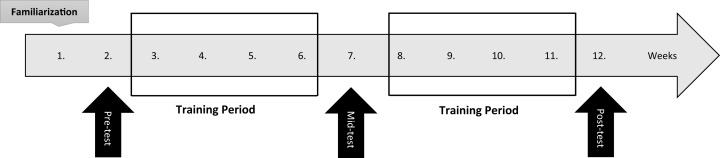
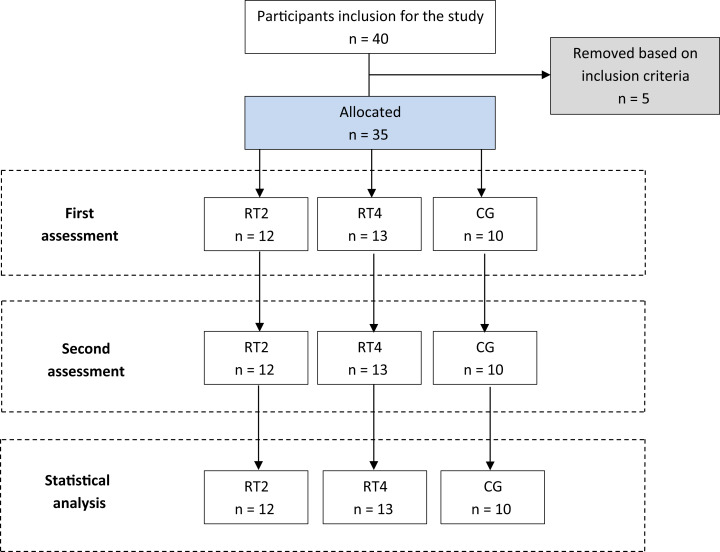
Methods: Thirty-five healthy young men participated in the study and were randomly divided into a two sessions per-week RT (RT2, n = 12), four sessions per-week RT (RT4, n = 13) or a control group (CG, n = 10). All subjects were evaluated for thigh, chest and arm circumference, countermovement jump (CMJ), medicine ball throw (MBT), 1-repetition maximum (1RM) leg press, bench press, arm curl, muscular endurance (i.e., 60% of 1RM to failure) for leg press, and bench press at pre, mid (week 4) and post an 8-week training intervention.
Results: A two-way analysis of variance with repeated measures (3 [group] × 3 [time]) revealed that both training groups increased chest and thigh circumferences, strength and explosive actions performance tests in comparison to CG following 8 weeks of training (p = 0.01 to 0.04). Group × time interactions were also noted in 1RM bench press (effects size [ES] = 1.07 vs. 0.89) and arm curl (ES = 1.15 vs. 0.89), with greater gains for RT4 than RT2 (p = 0.03).
Conclusion: RT improved muscle strength, explosive actions performance and markers of muscle size in recreationally trained men; however, four sessions of resistance training per week produced greater gains in muscular strength for the upper body measures (i.e., 1RM bench press and arm curl) when compared to two sessions per week under volume-equated conditions.
Keywords: Athletic performance; Body composition; Human physical conditioning; Recovery; Strength training.
© 2021 Arazi et al.
Conflict of interest statement
Rodrigo Ramirez Campillo is an Academic Editor for PeerJ.
Figures
References
-
- ACSM American College of Sports Medicine position stand. Progression models in resistance training for healthy adults. Medicine and Science in Sports and Exercise. 2009;41:687–708. - PubMed
-
- Arazi H, Asadi A. Effects of 8 weeks equal-volume resistance training with different workout frequency on maximal strength, endurance and body composition. International Journal of Sports Science and Engineering. 2011;5:112–118.
-
- Arazi H, Asadi A, Roohi S. Enhancing muscular performance in women: compound versus complex, traditional resistance and plyometric training alone. Journal of Musculoskeletal Research. 2014;17(2):1450007. doi: 10.1142/S0218957714500079. - DOI
LinkOut - more resources
Full Text Sources
Other Literature Sources