Review
. 2021 Mar 3;8(9):2004313.
doi: 10.1002/advs.202004313. eCollection 2021 May.

Kesterite Solar Cells: Insights into Current Strategies and Challenges

Affiliations
Review

Kesterite Solar Cells: Insights into Current Strategies and Challenges

Mingrui He et al. Adv Sci (Weinh). .

Abstract

Earth-abundant and environmentally benign kesterite Cu2ZnSn(S,Se)4 (CZTSSe) is a promising alternative to its cousin chalcopyrite Cu(In,Ga)(S,Se)2 (CIGS) for photovoltaic applications. However, the power conversion efficiency of CZTSSe solar cells has been stagnant at 12.6% for years, still far lower than that of CIGS (23.35%). In this report, insights into the latest cutting-edge strategies for further advance in the performance of kesterite solar cells is provided, particularly focusing on the postdeposition thermal treatment (for bare absorber, heterojunction, and completed device), alkali doping, and bandgap grading by engineering graded cation and/or anion alloying. These strategies, which have led to the step-change improvements in the power conversion efficiency of the counterpart CIGS solar cells, are also the most promising ones to achieve further efficiency breakthroughs for kesterite solar cells. Herein, the recent advances in kesterite solar cells along these pathways are reviewed, and more importantly, a comprehensive understanding of the underlying mechanisms is provided, and promising directions for the ongoing development of kesterite solar cells are proposed.

Keywords: alkali doping; bandgap engineering; kesterite; thermal treatment; thin film solar cell.


Conflict of interest statement

The authors declare no conflict of interest.

Figures

Figure 1
Figure 1
a) CZTSe bandgap versus the annealing temperature during the annealing/quenching condition. Inset: Tauc's plots for direct bandgap for lowering temperature. Reproduced with permission.[ 73 ] Copyright 2014, AIP Publishing LLC. b) Schema of defect and defect cluster states for the absorber annealed above critical temperature, with fast cooling, and with slow cooling rate, respectively. The defect formation energy selected from ref. [ 29 ]. c) CZTSSe bandgap shifts induced by slow and rapid cooling rate. Reproduced with permission.[ 69 ] Copyright 2014, AIP Publishing LLC. d) Diagram of E g–PL versus bandgap estimated from EQE, showing degree of band tail as function of ordering–disordering. The data are selected from refs. [ 41 , 68 , 166 , 167 ].
Figure 2
Figure 2
Elemental mapping for CZTSSe thin film after annealing in the air, SnOx can be found within grain boundaries. Reproduced with permission.[ 50 ] Copyright 2015, Wiley‐VCH.
Figure 3
Figure 3
a) Elemental depth profiles of heterojunction with and without the HT process detected by XPS. b,c) Schema of conduction and valence band according to XPS measurements with and without the HT process. d) XPS valence band characteristics for CdS and CZTS thin film with and without HT. The solid lines show the linear extrapolation lines for XPS data close to the valence band maximum. Reproduced with permission.[ 37 ] Copyright 2018, Springer Nature.
Figure 4
Figure 4
Schematics of alkali treatment for a) alloying Li and b) doping Na and c) K or Rb or Cs into CZTSSe and CIGS, respectively. The major benefit of Li is partial replacement of Cu to form Li alloyed CZTSSe. On the contrast, either alloying or doping Li in CIGS is detrimental to efficiency. The Na doping demonstrates positive impact both on CIGS and CZTSSe. Heavy alkali metals (K, Rb, and Cs) enable beyond 20% efficiency of CIGS solar cells. The studies of heavy alkali doping in CZTSSe show neglectable improvement.
Figure 5
Figure 5
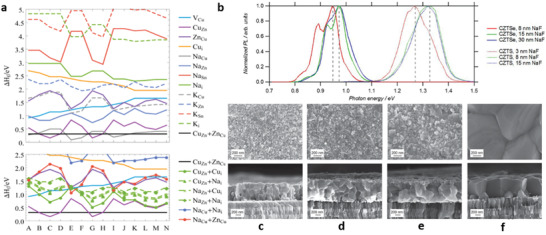
a) Calculated formation energy of (top) sodium and potassium associated point defects, and defect complexes (bottom) plotted at every extremum in the phase diagram, including related intrinsic defects for comparison. Reproduced with permission.[ 109 ] Copyright 2018, AIP Publishing LLC. b) Normalized ambient temperature PL spectra of CZTSe and CZTS thin films with different initial Na contents. Reproduced with permission.[ 117 ] Copyright 2015, AIP Publishing LLC. Top‐down (top) and cross‐sectional (bottom) SEM images of the sulfide CZTS thin films with different initial sodium floride contents: c) no NaF, d) 1 nm NaF, e) 4.5 nm NaF, and f) 23 nm NaF. Reproduced with permission.[ 45 ] Copyright 2015, Wiley‐VCH.
Figure 6
Figure 6
Thin film atomic force microscopy (AFM) topography images and SKPM potential maps. a) AFM topography, b) SKPM potential map, and c) plots of the topography and potential line scans of CZTSSe films without Li‐doping. d) AFM topography, e) potential map, and f) plots of the topography and potential line scans of CZTSSe films after Li‐doping. Reproduced with permission.[ 45 ] Copyright 2015, The Royal Society of Chemistry. g) Apparent carrier concentration derived from room‐temperature C–V measurements for (LixCu1− x)2ZnSn(S,Se)4 thin film solar cells. Reproduced with permission.[ 48 ] Copyright 2018, Wiley‐VCH.
Figure 7
Figure 7
a) The [S]/([S] + [Se]) depth profile percentages of CZTSSe cells derived from the depth‐resolved Raman spectroscopy data. b) The band structure depth profile for 12.3% front grading CZTSSe solar cell. Reproduced with permission.[ 151 ] Copyright 2016, The Royal Society of Chemistry. c) Cathodoluminescence (CL) peak position and bandgap value calculated from the Ge/Ge+Sn composition as a function of the distance from the back contact. Reproduced with permission.[ 159 ] Copyright 2017, American Chemical Society.
Figure 8
Figure 8
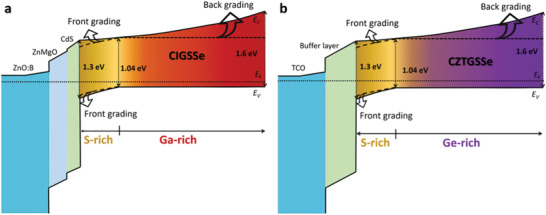
The double‐graded bandgap schematics of a) the state‐of‐the‐art CIGS thin film solar cell and of b) the proposed CZTGSSe thin film solar cells.

References

    1. Liu F., Zeng Q., Li J., Hao X., Ho‐Baillie A., Tang J., Green M. A., Mater. Today 2020, 41, 120.
    1. Lee T. D., Ebong A. U., Renewable Sustainable Energy Rev. 2017, 70, 1286.
    1. Green M. A., J. Mater. Sci.: Mater. Electron. 2007, 18, 15.
    1. Green M. A., Ho‐Baillie A., Snaith H. J., Nat. Photonics 2014, 8, 506.
    1. Pagliaro M., Ciriminna R., Palmisano G., ChemSusChem 2008, 1, 880. - PubMed

LinkOut - more resources