Review
. 2021 Mar 30:10:33.
doi: 10.12703/r/10-33. eCollection 2021.

Recent advances in dead cell clearance during acute lung injury and repair

Affiliations
Review

Recent advances in dead cell clearance during acute lung injury and repair

Patrick M Noone et al. Fac Rev. .

Abstract

Acute lung injury (ALI) and acute respiratory distress syndrome (ARDS) are clinical syndromes that cause significant mortality in clinical settings and morbidity among survivors accompanied by huge healthcare costs. Lung-resident cell dysfunction/death and neutrophil alveolitis accompanied by proteinous edema are the main pathological features of ALI/ARDS. While understanding of the mechanisms underlying ALI/ARDS pathogenesis is progressing and potential treatments such as statin therapy, nutritional strategies, and mesenchymal cell therapy are emerging, poor clinical outcomes in ALI/ARDS patients persist. Thus, a better understanding of lung-resident cell death and neutrophil alveolitis and their mitigation and clearance mechanisms may provide new therapeutic strategies to accelerate lung repair and improve outcomes in critically ill patients. Macrophages are required for normal tissue development and homeostasis as well as regulating tissue injury and repair through modulation of inflammation and other cellular processes. While macrophages mediate various functions, here we review recent dead cell clearance (efferocytosis) mechanisms mediated by these immune cells for maintaining tissue homeostasis after infectious and non-infectious lung injury.

Keywords: Acute lung injury; Alveoli; Efferocytosis; Lung repair; Macrophages.


Conflict of interest statement

The authors declare that they have no competing interests.Competing interests: No competing interests were disclosed.Competing interests: No competing interests were disclosed.

Figures
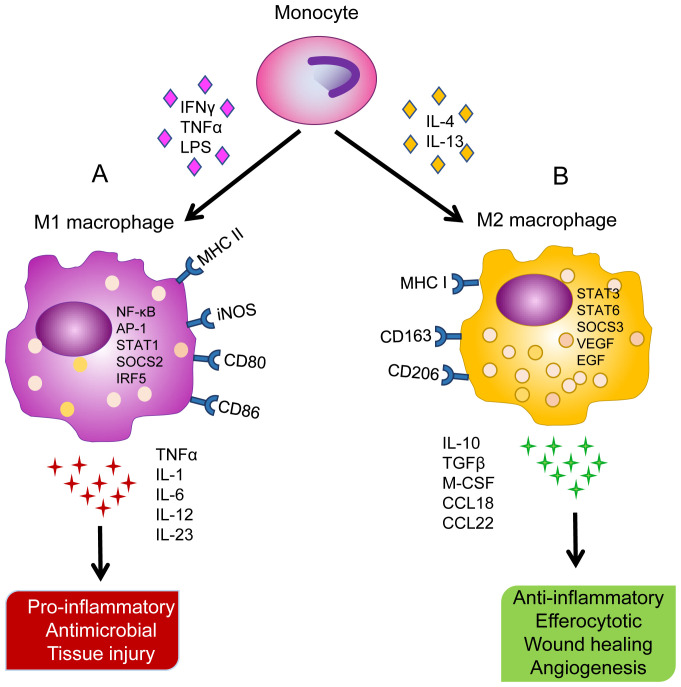
Figure 1.
Figure 1.. Different stimuli contributing to macrophage polarization along with differential surface markers, gene regulation, cytokine release, and physiological functions.
A) Monocyte differentiation into classically activated alveolar macrophages (AMФM1) upon stimulation with interferon gamma (IFNγ), tumor necrosis factor (TNF)-α, and lipopolysaccharide (LPS). High expression of major histocompatibility complex (MHC) II, inducible nitric oxide synthase (iNOS), CD80, and CD86 surface markers. Upregulation of nuclear factor (NF)-κB, activator protein 1 (AP-1), signal transducer and activator of transcription 1 (STAT1), suppressors of cytokine signaling 2 (SOCS2), and interferon regulatory factor 5 (IRF5). Release of TNF-α, interleukin (IL)-1, IL-6, IL-12, and IL-23 cytokines leading to pro-inflammatory response, antimicrobial activity, and collateral tissue injury. B) Monocyte differentiation into alternatively activated alveolar macrophages (AMФM2) upon stimulation with IL-4 and IL-13. High expression of MHC I, CD163, and CD206 surface markers. Upregulation of STAT3, STAT6, SOCS3, vascular endothelial growth factor (VEGF) and epithelial growth factor (EGF). Release of IL-10, transforming growth factor (TGF)-β, macrophage colony-stimulating factor (M-CSF), CCL18, and CCL22 leading to anti-inflammatory response, efferocytosis, wound healing, and angiogenesis.
Figure 2.
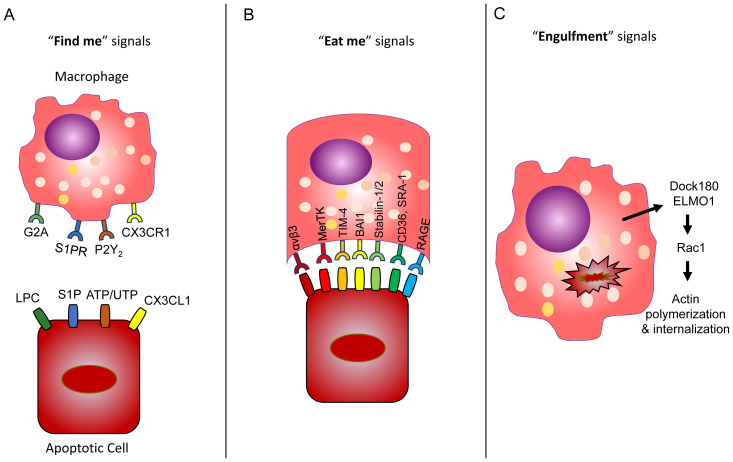
Figure 2.. Efferocytosis broken down into “find me”, “eat me”, and engulfment signals.
A) Apoptotic cells express “eat me” signals including lysophosphatidylcholine (LPC), sphingosine-1-phosphate (S1P), nucleotides ATP/UTP, and CX3CL1. These signals are recognized by G2A, S1PR, P2Y2, and CX3C motif chemokine receptor 1 (CX3CR1) receptors, respectively, by proximal macrophages. B) Recognized cells use Ptd-Ser receptors as an “eat me” signal to initiate engulfment, which can include αvβ3 integrins, MerTK, TIM-4, BAI1, stabilin-1/2, CD36, SRA-1, and receptor for advanced glycation end products (RAGE). C) Following engulfment, dedicator of cytokinesis protein 1 (Dock180) and engulfment and cell motility protein 1 (ELMO1) act together as a guanine nucleotide exchange factor (GEF) to induce Rac1 GTPase, leading to cytoskeletal changes via actin polymerization followed by apoptotic cell internalization and phagolysosomal degradation.

References

    1. Rubenfeld GD, Caldwell E, Peabody E, et al. : Incidence and outcomes of acute lung injury. N Engl J Med. 2005; 353(16): 1685–93. 10.1056/NEJMoa050333 - DOI - PubMed
    2. Faculty Opinions Recommendation

    1. Young M, DiSilvio B, Rao S, et al. : Mechanical Ventilation in ARDS. Crit Care Nurs Q. 2019; 42(4): 392–9. 10.1097/CNQ.0000000000000279 - DOI - PubMed
    2. Faculty Opinions Recommendation

    1. Hunter JD: Ventilator associated pneumonia. BMJ. 2012; 344: e3325. 10.1136/bmj.e3325 - DOI - PubMed
    1. Dietrich ES, Demmler M, Schulgen G, et al. : Nosocomial pneumonia: A cost-of-illness analysis. Infection. 2002; 30(2): 61–7. 10.1007/s15010-002-1083-8 - DOI - PubMed
    1. Huppert LA, Matthay MA, Ware LB: Pathogenesis of Acute Respiratory Distress Syndrome. Semin Respir Crit Care Med. 2019; 40(1): 31–9. 10.1055/s-0039-1683996 - DOI - PMC - PubMed
    2. Faculty Opinions Recommendation

LinkOut - more resources