


Detection of synovial sepsis in horses using enzymes as biomarkers
- PMID: 33977535
- PMCID: PMC9290786
- DOI: 10.1111/evj.13459
Detection of synovial sepsis in horses using enzymes as biomarkers
Abstract
Background: Synovial sepsis is a commonly occurring, potentially career-ending or even life-threatening orthopaedic emergency. Diagnosis of synovial sepsis is currently primarily based on synovial fluid analysis, which often leaves diagnostic ambiguity due to overlap of clinicopathological parameters between septic and aseptic inflammatory synovitis.
Objectives: To evaluate the reliability of lysozyme (LYS), myeloperoxidase (MPO) and elastase (ELT) as biomarkers for synovial sepsis in horses using a photometric assay to measure increased enzyme activity.
Study design: Prospective, single-blinded, analytical, clinical study.
Methods: Equine synovial samples were assigned to one of three groups: (1) healthy controls (n = 10), (2) aseptic (n = 27) and (3) septic synovitis (n = 30). The enzyme activity assays (LYS, MPO and ELT) were compared with standard synovial fluid parameters and broad-range bacterial 16S rDNA PCR.
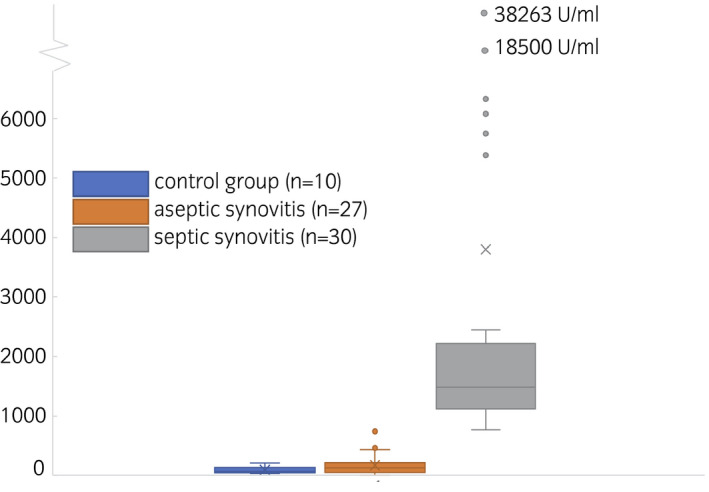
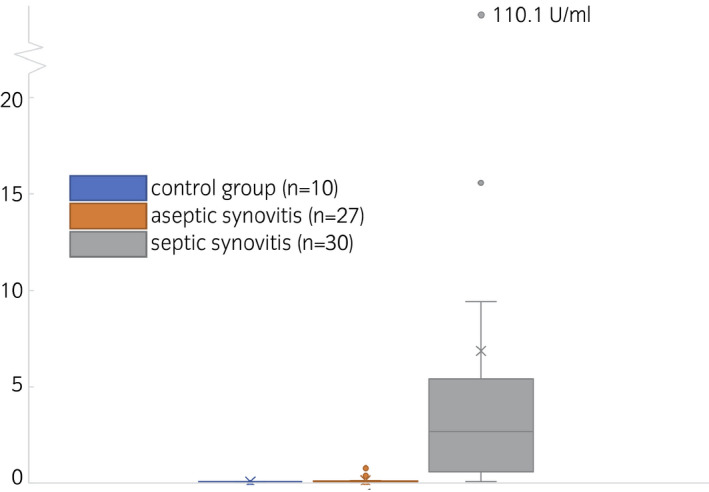
Results: LYS and MPO activities were significantly different between septic synovial samples, and both aseptic and control samples (P < .001, LYS: confidence interval [CI]: 2.25-3.41, resp., 2.21-3.8, MPO: CI 0.752-1.6, resp., 0.639-1.81). LYS achieved a 100% sensitivity and 100% specificity in differentiating between septic and aseptic (cut-off value 751.4) or control (cut-off: 484.6) samples (P < .001). MPO reached 93.33% sensitivity, 100% specificity for distinguishing septic from control (cut-off value: 0.1254) synovial samples and 93.33% sensitivity, 81.48% specificity for discriminating between septic and aseptic (cut-off value: 0.1305) synovial samples (P < .001). ELT activity could not be measured in any synovial sample. Both the LYS and the MPO measurements showed a highly significant correlation with PCR (LYS r = .79, MPO r = .69), synovial leukocyte count (LYS r = .752, MPO r = .571), % neutrophils (LYS r = .751, MPO r = 0.663) and each other (r = .744, all P < .001).
Main limitations: Variation in horses' signalment, affected synovial structures and synovial fluid freezing times may have affected the discriminative power of this study.
Conclusions: Increased MPO and LYS activities allow reliable, rapid diagnosis of synovial sepsis with high sensitivity and specificity.
Keywords: elastase; enzyme activity; horse; lysozyme; myeloperoxidase; septic arthritis; synovial infection.
© 2021 The Authors. Equine Veterinary Journal published by John Wiley & Sons Ltd on behalf of EVJ Ltd.
Conflict of interest statement
E. Sigl is a co‐founder of Qualizyme Diagnostics GmbH & Co KG. C. Gamerith is an employee of this company, which applied for a patent for the biomarker assays.
Figures
References
-
- Tulamo R, Bramlage LR, Gabel AA. Sequential clinical and synovial fluid changes associated with acute infectious arthritis in the horse. Equine Vet J. 1989;21:325–31. - PubMed
-
- Schneider RK, Bramlage LR, Moore RM, Mecklenburg LM, Kohn CW, Gabel AA. A retrospective study of 192 horses affected with septic arthritis/tenosynovitis. Equine Vet J. 1992;24:436–42. - PubMed
-
- Spiers S, May SA, Harrison LJ, Bennett D, Edwards GB. Proteolytic enzymes in equine joints with infectious arthritis. Equine Vet J. 1994;26:48–50. - PubMed
-
- Wright I, Smith MRW, Humphrey DJ, Eaton‐Evans T, Hillyer MH. Endoscopic surgery in the treatment of contaminated and infected synovial cavities. Equine Vet J. 2003;35:613–9. - PubMed
-
- Morton AJ. Diagnosis and treatment of septic arthritis. Vet Clin North Am: Equine Pract. 2005;21:627–49. - PubMed
MeSH terms
Substances
Grants and funding
LinkOut - more resources
Full Text Sources
Other Literature Sources
Medical
Research Materials
Miscellaneous
