Understanding the Meaning of Recovery to Patients Undergoing Abdominal Surgery
- PMID: 33978692
- PMCID: PMC8117063
- DOI: 10.1001/jamasurg.2021.1557
Understanding the Meaning of Recovery to Patients Undergoing Abdominal Surgery
Abstract
Importance: Postoperative recovery is difficult to define or measure. Research addressing interventions aimed to improve recovery after abdominal surgery often focuses on measures such as duration of hospital stay and complication rates. Although these clinical parameters are relevant, understanding patients' perspectives regarding postoperative recovery is fundamental to guiding patient-centered care.
Objective: To elucidate the meaning of recovery from the perspective of patients undergoing abdominal surgery.
Design, setting, and participants: This international qualitative study involved semistructured interviews with patients recovering from abdominal surgery from October 2016 to November 2018 in tertiary hospitals in 4 countries (Canada, Italy, Brazil, and Japan). A purposive maximal variation sampling method was used to ensure the recruitment of patients with varying demographic, clinical, and surgical characteristics. Data on race were not collected. Each interview lasted between 1 and 2 hours. Interviews were recorded and then transcribed verbatim. Transcripts were then analyzed using an inductive thematic analysis approach. Data analysis was conducted from July 2019 to September 2019.
Main outcomes and measures: The qualitative analysis revealed themes reflecting the meaning of recovery from the perspective of patients undergoing abdominal surgery.
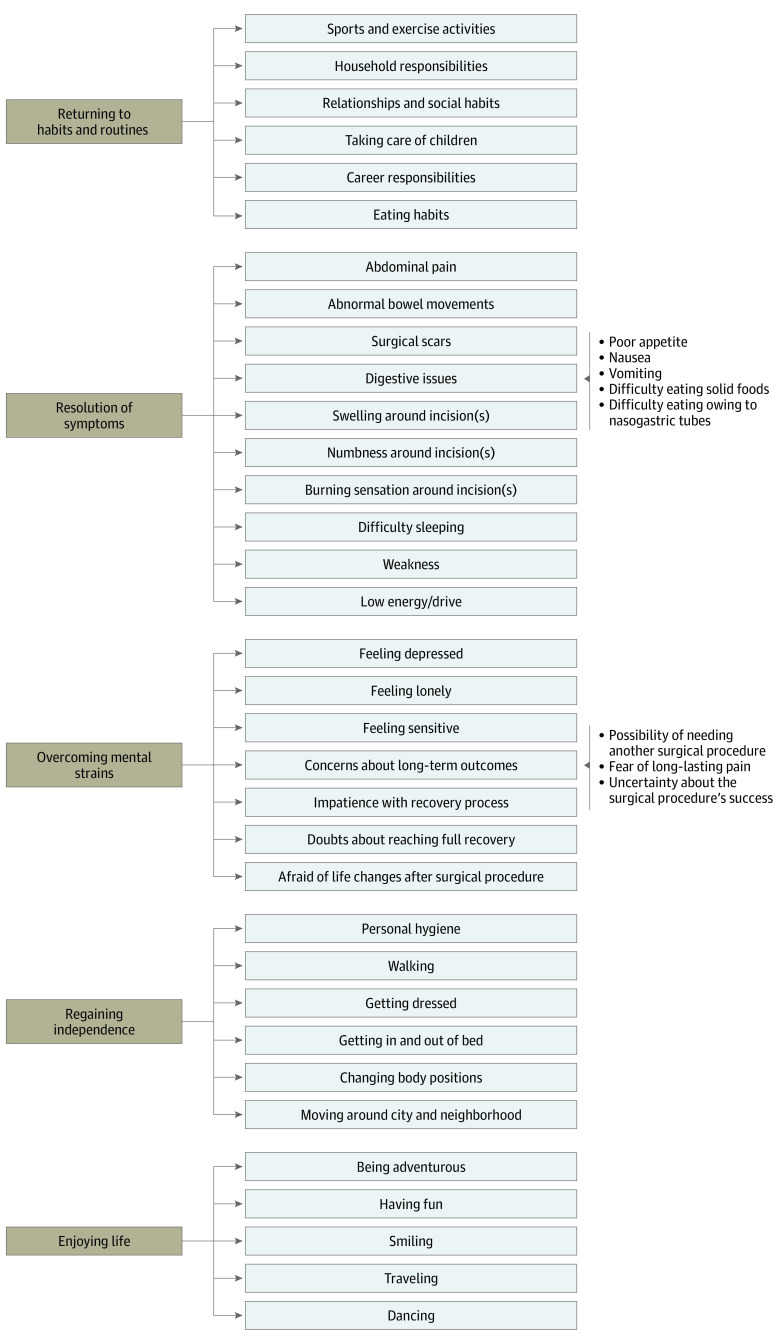
Results: Thirty patients recovering from abdominal surgery were interviewed (15 [50%] female; mean [SD] age, 57 [18] years; 10 [33%] underwent major surgery; 16 [53%] underwent laparoscopic surgery). The interviews revealed that for patients undergoing abdominal surgery, the meaning of recovery embodied 5 overarching themes: (1) returning to habits and routines, (2) resolution of symptoms, (3) overcoming mental strains, (4) regaining independence, and (5) enjoying life. Themes associating the meaning of recovery to traditional parameters, such as earlier hospital discharge or absence of complications, were not identified in the interviews.
Conclusions and relevance: This qualitative study suggests that the meaning of recovery from the perspective of patients undergoing abdominal surgery goes beyond traditional clinical parameters. The elements of recovery identified in this study should be taken into account in patient-surgeon discussions about recovery and when developing patient-centered strategies to improve postoperative outcomes.
Conflict of interest statement
Figures
Comment in
-
Traditional Measures of Surgical Outcomes Only Tell a Portion of the Patient Story-Who Measures Success?JAMA Surg. 2021 Aug 1;156(8):765-766. doi: 10.1001/jamasurg.2021.1558. JAMA Surg. 2021. PMID: 33978696 No abstract available.
References
-
- Institute of Medicine (US) Committee on Quality of Health Care in America . Crossing the Quality Chasm: A New Health System for the 21st Century. National Academies Press; 2001. - PubMed
-
- Hatchimonji JS, Sisti DA, Martin ND. Surgical futility and patient-centered care: the effects of human nature in decision making. Bulletin of the American College of Surgeons. Published November 1, 2016. Accessed January 29, 2021. https://bulletin.facs.org/2016/11/surgical-futility-and-patient-centered... - PubMed
-
- Steiner CA, Karaca Z, Moore BJ, Imshaug MC, Pickens G. Surgeries in hospital-based ambulatory surgery and hospital inpatient settings, 2014. Revised July 2020. Accessed April 6, 2021. - PubMed
Publication types
MeSH terms
LinkOut - more resources
Full Text Sources
Other Literature Sources
Medical