. 2021 Jul 2;49(W1):W29-W35.
doi: 10.1093/nar/gkab335.

antiSMASH 6.0: improving cluster detection and comparison capabilities

Affiliations

antiSMASH 6.0: improving cluster detection and comparison capabilities

Kai Blin et al. Nucleic Acids Res. .

Abstract

Many microorganisms produce natural products that form the basis of antimicrobials, antivirals, and other drugs. Genome mining is routinely used to complement screening-based workflows to discover novel natural products. Since 2011, the "antibiotics and secondary metabolite analysis shell-antiSMASH" (https://antismash.secondarymetabolites.org/) has supported researchers in their microbial genome mining tasks, both as a free-to-use web server and as a standalone tool under an OSI-approved open-source license. It is currently the most widely used tool for detecting and characterising biosynthetic gene clusters (BGCs) in bacteria and fungi. Here, we present the updated version 6 of antiSMASH. antiSMASH 6 increases the number of supported cluster types from 58 to 71, displays the modular structure of multi-modular BGCs, adds a new BGC comparison algorithm, allows for the integration of results from other prediction tools, and more effectively detects tailoring enzymes in RiPP clusters.


Figures

Graphical Abstract
Graphical Abstract
Here, we present version 6 of the secondary/specialized metabolite genome mining platform antiSMASH with improved detection capabilities, a new cluster compare feature and many further improvements.
Figure 1.
Figure 1.
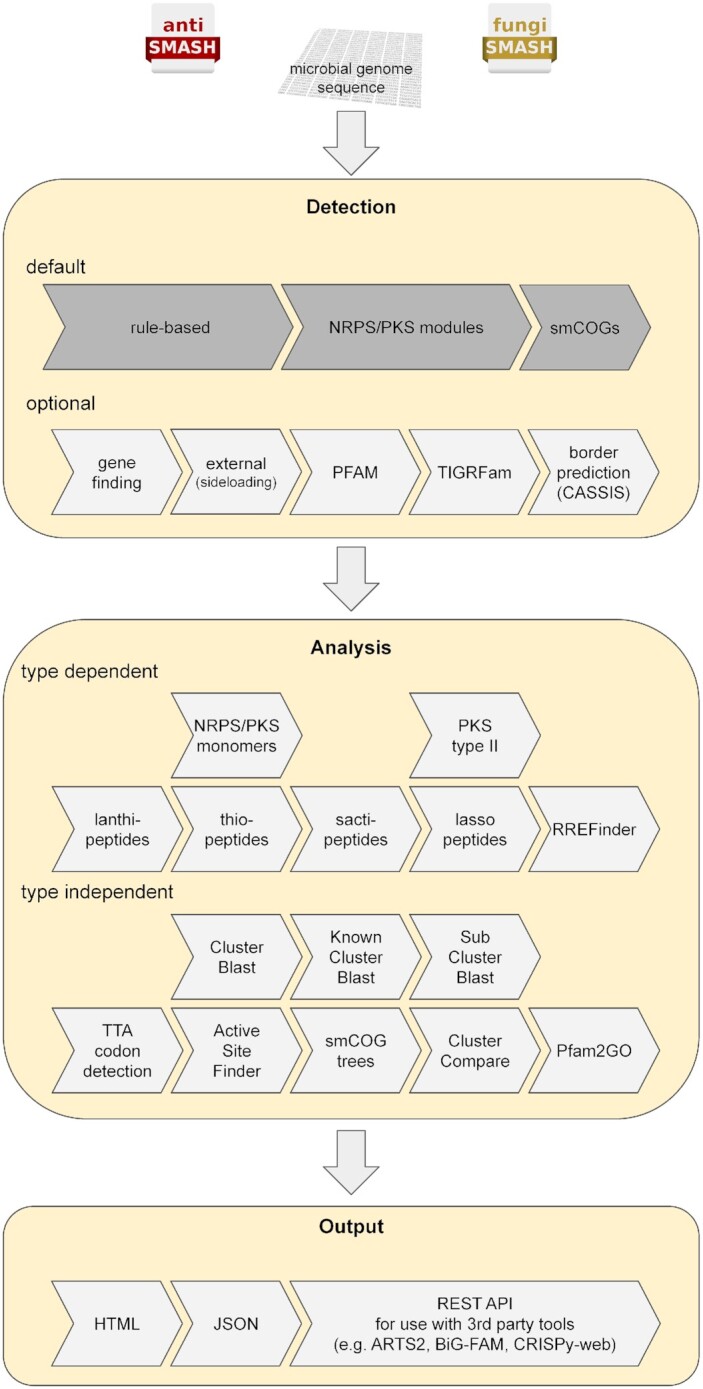
Schematic workflow of the antiSMASH secondary/specialized metabolite genome mining platform.
Figure 2.
Figure 2.
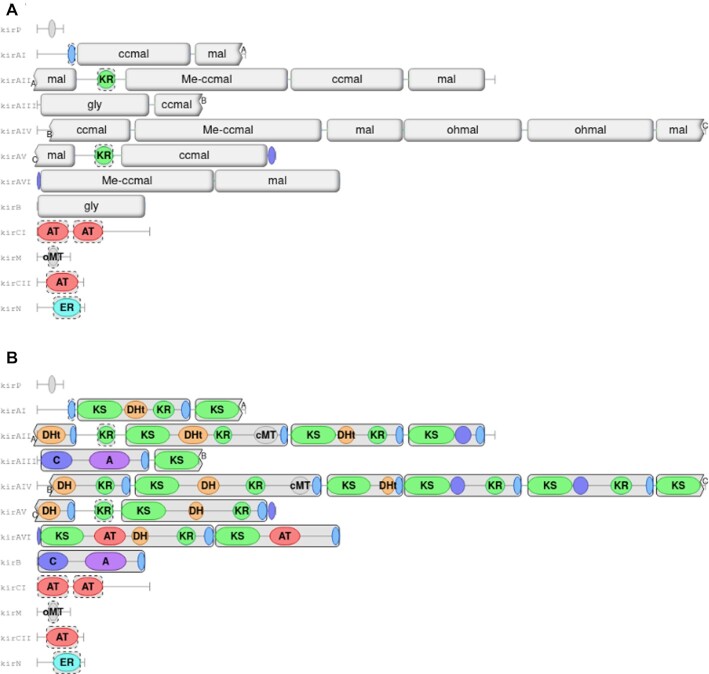
The NRPS/PKS domain view of the kirromycin biosynthetic gene cluster (NCBI ID: AM746336.1), consisting of trans-AT PKS, modular type I PKS and NRPS modules. A View with module lids, displaying the monomer predicted to be integrated into the final product. The jagged module edges on KirAI/AII/AIII/AIV show modules that are split across different protein-coding sequences, with the small lettering next to the edges indicating how the modules link up. B View with the module lids hidden, revealing the underlying protein domains.
Figure 3.
Figure 3.
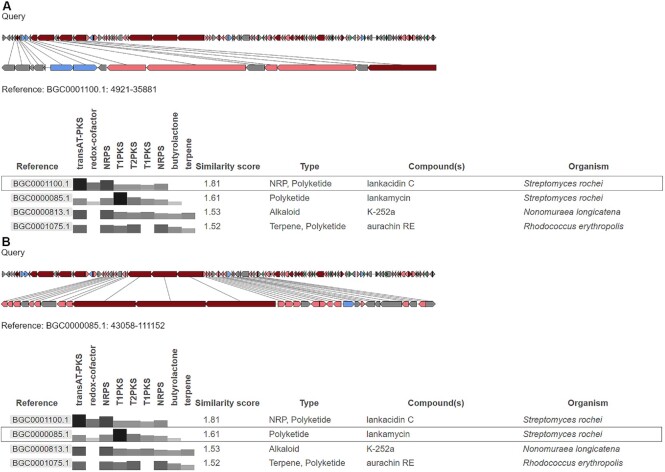
ClusterCompare output for the Streptomyces rochei large linear plasmid pSLA2-L (NCBI ID: NC_004808.2), which is densely packed with secondary metabolite biosynthetic genes (see (39)) with the MIBiG dataset in protocluster-to-region mode. Lines connect pairs of protein-coding genes with the highest similarity to make conserved functions more visible even at different scaling of query and reference. The comparisons show the similarity of (A) the left part of the region to the trans-AT PKS, NRPS hybrid cluster responsible for lankacidin C production (MIBiG ID: BGC0001100.1), as well as (B) the middle part of the region to the modular PKS type I cluster responsible for lankamycin biosynthesis (MIBiG ID: BGC0000085.1). The example illustrates how ClusterCompare can be used to distinguish between hybrid gene clusters and adjacent gene clusters that are part of the same region, based on comparison with individual reference BGCs.

References

    1. Newman D.J., Cragg G.M.. Natural products as sources of new drugs over the nearly four decades from 01/1981 to 09/2019. J. Nat. Prod. 2020; 83:770–803. - PubMed
    1. Ziemert N., Alanjary M., Weber T.. The evolution of genome mining in microbes - a review. Nat. Prod. Rep. 2016; 33:988–1005. - PubMed
    1. van Heel A.J., de Jong A., Song C., Viel J.H., Kok J., Kuipers O.P.. BAGEL4: a user-friendly web server to thoroughly mine RiPPs and bacteriocins. Nucleic Acids Res. 2018; 46:W278–W281. - PMC - PubMed
    1. Skinnider M.A., Johnston C.W., Gunabalasingam M., Merwin N.J., Kieliszek A.M., MacLellan R.J., Li H., Ranieri M.R.M., Webster A.L.H., Cao M.P.T.et al. .. Comprehensive prediction of secondary metabolite structure and biological activity from microbial genome sequences. Nat. Commun. 2020; 11:6058. - PMC - PubMed

    1. Santos-Aberturas J., Chandra G., Frattaruolo L., Lacret R., Pham T.H., Vior N.M., Eyles T.H., Truman A.W.. Uncovering the unexplored diversity of thioamidated ribosomal peptides in Actinobacteria using the RiPPER genome mining tool. Nucleic Acids Res. 2019; 47:4624–4637. - PMC - PubMed

Publication types

Substances