


Decreasing trends in thyroid cancer incidence in South Korea: What happened in South Korea?
- PMID: 33979040
- PMCID: PMC8209587
- DOI: 10.1002/cam4.3926
Decreasing trends in thyroid cancer incidence in South Korea: What happened in South Korea?
Abstract
Background: South Korea has the highest incidence of thyroid cancer in the world. Our study examined the trends in thyroid cancer incidence by the histologic type, cancer stage, and age group and explored possible factors that affected thyroid cancer trends.
Methods: We conducted a descriptive epidemiological study using the national cancer registry data and cause of death data from 1999 to 2016 in South Korea. Age-standardized rates were calculated using Segi's world standard population. Joinpoint regression analysis was applied to determine the changing point of thyroid cancer trends according to histologic type; Surveillance, Epidemiology, and End Results (SEER) summary stage; and age groups by sex.
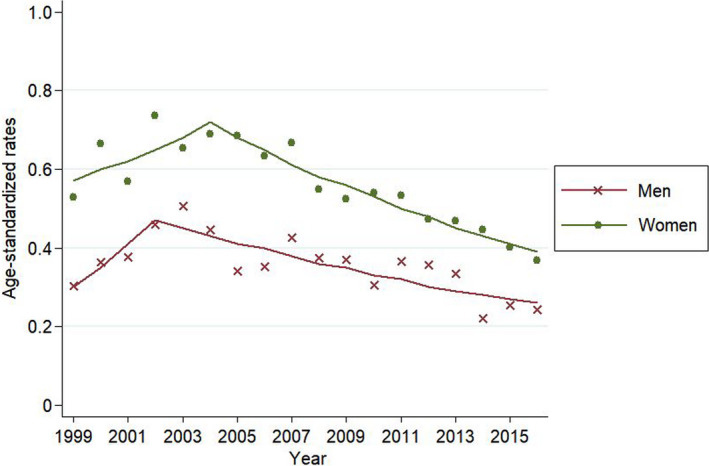
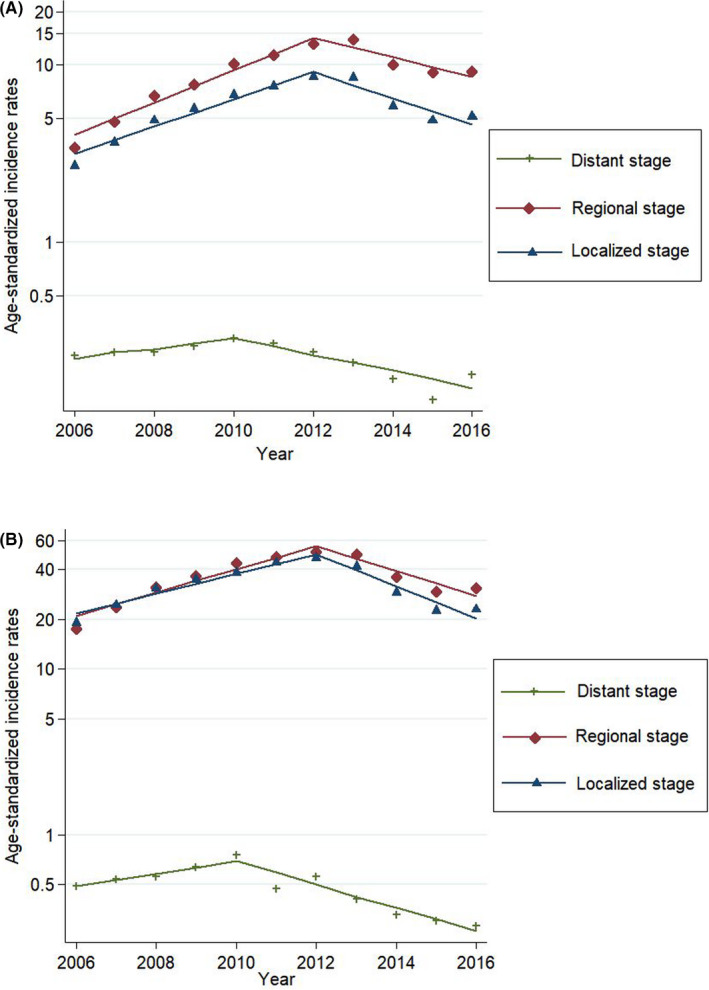
Results: The age-standardized incidence of thyroid cancer in both men and women increased from 6.3 per 100,000 people in 1999 to 63.4 per 100,000 in 2012 but declined from 2012 to 2016, before the debates for over diagnosis of thyroid cancer began in 2014. The age-standardized mortality rate of thyroid cancer, incidence of distant thyroid cancer, and incidence of regional and localized thyroid cancer started to decline since early 2000, 2010, and 2012, respectively. In addition, thyroid cancer prevalence in thyroid nodules showed decreasing trends from 1999-2000 to 2013-2014.
Conclusions: The incidence of thyroid cancer began declining from 2012, before the debates for over diagnosis of thyroid cancer began in 2014. Changes in guidelines for thyroid nodule examinations may have affected this inflection point. Moreover, the debates for over diagnosis of thyroid cancer may have accelerated the decline in thyroid cancer.
Keywords: South Korea; incidence; mortality; reservoir; thyroid neoplasm.
© 2021 The Authors. Cancer Medicine published by John Wiley & Sons Ltd.
Conflict of interest statement
The authors have no conflicts of interest.
Figures
References
-
- La Vecchia C, Malvezzi M, Bosetti C, et al. Thyroid cancer mortality and incidence: a global overview. Int J Cancer. 2015;136:2187‐2195. - PubMed
-
- Haymart MR, Davies L. South Korean thyroid cancer trends: good news and bad. Thyroid. 2018;28:1081‐1082. - PubMed
-
- Ahn HS, Welch HG. South Korea's thyroid‐cancer "epidemic"–turning the Tide. N Engl J Med. 2015;373:2389‐2390. - PubMed
Publication types
MeSH terms
LinkOut - more resources
Full Text Sources
Other Literature Sources
Medical
