


Nanomaterial-based delivery vehicles for therapeutic cancer vaccine development
- PMID: 33979069
- PMCID: PMC8185868
- DOI: 10.20892/j.issn.2095-3941.2021.0004
Nanomaterial-based delivery vehicles for therapeutic cancer vaccine development
Abstract
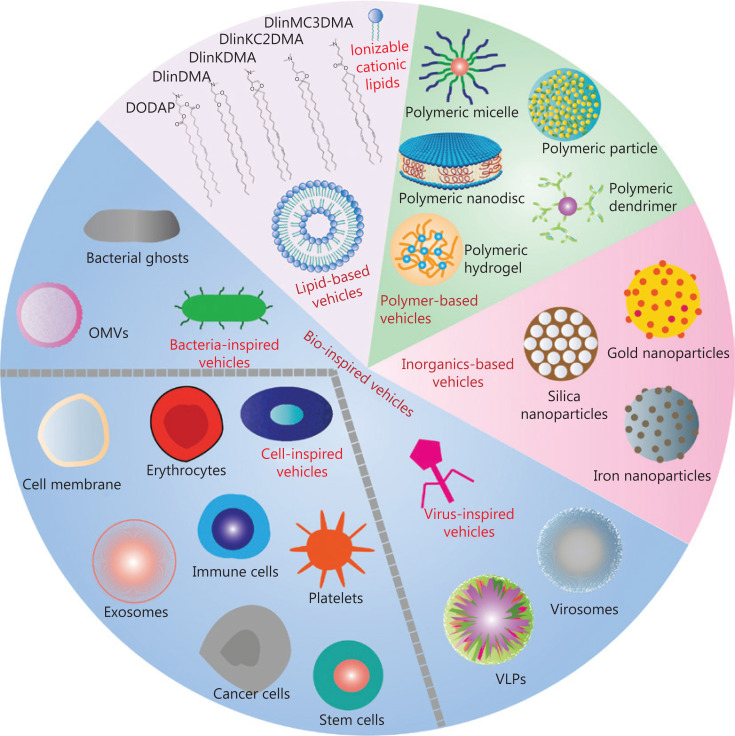
Nanomaterial-based delivery vehicles such as lipid-based, polymer-based, inorganics-based, and bio-inspired vehicles often carry distinct and attractive advantages in the development of therapeutic cancer vaccines. Based on various delivery vehicles, specifically designed nanomaterials-based vaccines are highly advantageous in boosting therapeutic and prophylactic antitumor immunities. Specifically, therapeutic vaccines featuring unique properties have made major contributions to the enhancement of antigen immunogenicity, encapsulation efficiency, biocompatibility, and stability, as well as promoting antigen cross-presentation and specific CD8+ T cell responses. However, for clinical applications, tumor-associated antigen-derived vaccines could be an obstacle, involving immune tolerance and deficiency of tumor specificities, in achieving maximum therapeutic indices. However, when using bioinformatics predictions with emerging innovations of in silico tools, neoantigen-based therapeutic vaccines might become potent personalized vaccines for tumor treatments. In this review, we summarize the development of preclinical therapeutic cancer vaccines and the advancements of nanomaterial-based delivery vehicles for cancer immunotherapies, which provide the basis for a personalized vaccine delivery platform. Moreover, we review the existing challenges and future perspectives of nanomaterial-based personalized vaccines for novel tumor immunotherapies.
Keywords: Nanomaterial-based delivery vehicles; bioinformatic prediction; neoantigen; personalized vaccines; tumor immunotherapy.
Copyright © 2021 Cancer Biology & Medicine.
Conflict of interest statement
No potential conflicts of interest are disclosed.
Figures
References
-
- Starnes CO. Coley’s toxins in perspective. Nature. 1992;357:11–2. - PubMed
-
- Morales A, Eidinger D, Bruce AW. Intracavitary Bacillus Calmette-Guerin in the treatment of superficial bladder tumors. J Urol. 1976;116:180–3. - PubMed
-
- Van der Bruggen P, Traversari C, Chomez P, Lurquin C, De Plaen E, Van den Eynde B, et al. A gene encoding an antigen recognized by cytolytic T lymphocytes on a human melanoma. Science. 1991;254:1643–7. - PubMed
Publication types
Grants and funding
- 2018YFA0208900/National Key R&D Program of China
- 2018YFE0205300/National Key R&D Program of China
- Z200020/Beijing Natural Science Foundation of China
- Z201100006820031/Beijing Nova Program
- ts20190987/Taishan Scholars Program of Shandong Province
- 31800838/National Natural Science Foundation of China
- 31820103004/National Natural Science Foundation of China
- 31730032/National Natural Science Foundation of China
- 31800799/National Natural Science Foundation of China
- QYZDJ-SSW-SLH022/Key Research Project of Frontier Science of the Chinese Academy of Sciences
- 11621505/Innovation Research Group of National Natural Science Foundation
LinkOut - more resources
Full Text Sources
Research Materials