Review
. 2021 May 11;16(5):1093-1103.
doi: 10.1016/j.stemcr.2021.03.021.

Non-human primates as a model for human development

Affiliations
Review

Non-human primates as a model for human development

Tomonori Nakamura et al. Stem Cell Reports. .

Abstract

Human development has been studied for over a century, but the molecular mechanisms underlying human embryogenesis remain largely unknown due to technical difficulties and ethical issues. Accordingly, mice have been used as a model for mammalian development and studied extensively to infer human biology based on the conservation of fundamental processes between the two species. As research has progressed, however, species-specific differences in characteristics between rodents and primates have become apparent. Non-human primates (NHPs) have also been used for biomedical research, and are now attracting attention as a model for human development. Here, we summarize primate species from the evolutionary and genomic points of view. Then we review the current issues and progress in gene modification technology for NHPs. Finally, we discuss recent studies on the early embryogenesis of primates and future perspectives.

Keywords: development; embryogenesis; gene modification with NHPs; non-human primates; peri-implantation.


Figures

Figure 1
Figure 1
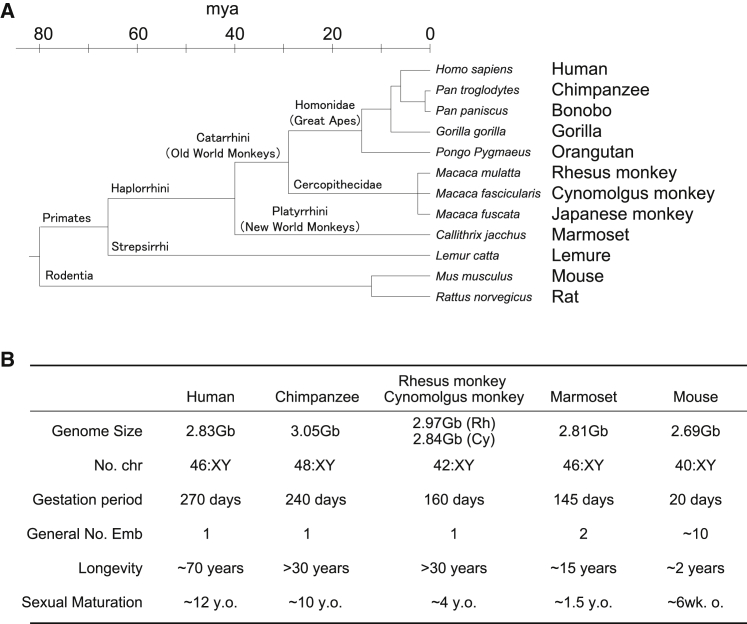
General description of primates (A) Simplified phylogenetic tree of primates including rodents. Primates are separated roughly into three groups: New World monkeys, Old World monkeys, and Great apes. Of these, chimpanzees, rhesus and cynomolgus monkeys, and marmosets have been used for biomedical research, while the Great apes are no longer permissible in invasive experiments. mya, million years ago. (B) Summary table of general information. Generally, primates have evolved to increase their body size and life span, and reduce their litter numbers. However, marmosets and most New World monkeys have small body size and relatively short generation periods. Marmosets also have an interesting feature: the generally produce dizygotic twins sharing a single placental system. y.o., years old; wk.o., weeks old.
Figure 2
Figure 2
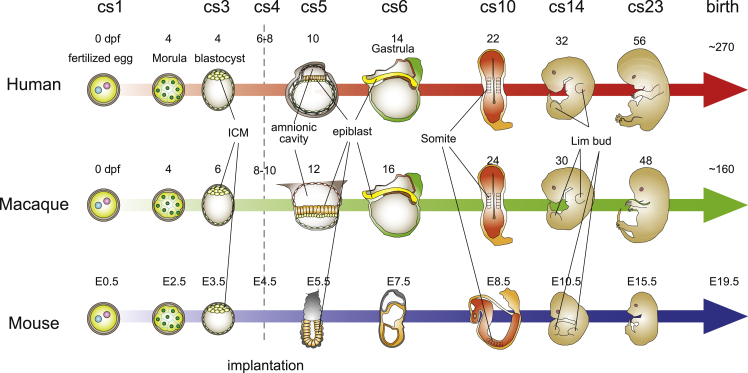
Development of humans, macaques, and mice during the embryonic period The key developmental processes are fundamentally conserved among humans, monkeys, but mice, and the timing when these events occur is divergent. cs, Carnegie stage; dpf, days post-fertilization; E, embryonic days; ICM, inner cell mass.
Figure 3
Figure 3
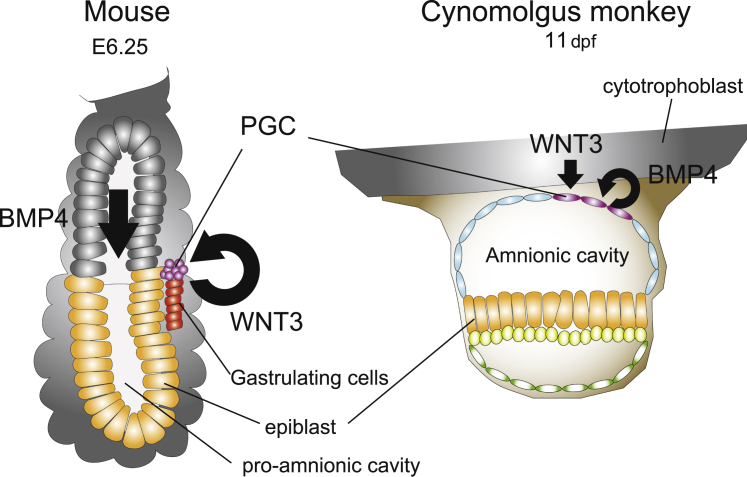
Similarity and difference of germ cell specification between mice and cynomolgus monkeys In mice, PGCs are known to be specified at the most proximal-posterior end of the epiblast by stimulations with Wnt3 and Bmp4, after onset of gastrulation. On the other hand, in cynomolgus monkeys, and perhaps in humans, the WNT and BMP pathways play critical roles in inducing the germ cell fate as in mice, but primate PGCs appear at the top of the amnion prior to gastrulation.

References

    1. Bedzhov I., Zernicka-Goetz M. Self-organizing properties of mouse pluripotent cells initiate morphogenesis upon implantation. Cell. 2014;156:1032–1044. - PMC - PubMed
    1. Blakeley P., Fogarty N.M., del Valle I., Wamaitha S.E., Hu T.X., Elder K., Snell P., Christie L., Robson P., Niakan K.K. Defining the three cell lineages of the human blastocyst by single-cell RNA-seq. Development. 2015;142:3151–3165. - PMC - PubMed
    1. Boroviak T., Loos R., Lombard P., Okahara J., Behr R., Sasaki E., Nichols J., Smith A., Bertone P. Lineage-specific profiling delineates the emergence and progression of naive pluripotency in mammalian embryogenesis. Dev. Cell. 2015;35:366–382. - PMC - PubMed
    1. Chan A.W., Chong K.Y., Martinovich C., Simerly C., Schatten G. Transgenic monkeys produced by retroviral gene transfer into mature oocytes. Science. 2001;291:309–312. - PubMed
    1. Chu C., Yang Z., Yang J., Yan L., Si C., Kang Y., Chen Z., Chen Y., Ji W., Niu Y. Homologous recombination-mediated targeted integration in monkey embryos using TALE nucleases. BMC Biotechnol. 2019;19:7. - PMC - PubMed

Publication types