Birthweight, Childhood Body Mass Index, Height and Growth, and Risk of Polycystic Ovary Syndrome
- PMID: 33979806
- PMCID: PMC8255636
- DOI: 10.1159/000515294
Birthweight, Childhood Body Mass Index, Height and Growth, and Risk of Polycystic Ovary Syndrome
Abstract
Introduction: Adult obesity is linked with polycystic ovary syndrome (PCOS), but the importance of body size at ages before PCOS is diagnosed is unknown.
Objective: To investigate associations between a woman's own birthweight, childhood body mass index (BMI), height and growth patterns in relation to her risk of PCOS.
Methods: We included 65,665 girls from the Copenhagen School Health Records Register, born in the period 1960-1996, with information on birthweight and measured weight and height at the ages of 7-13 years. Overweight was defined using International Obesity Task Force (IOTF) criteria. From the Danish National Patient Register, 606 women aged 15-50 years were identified. Hazard ratios (HRs) and 95% confidence intervals (CIs) were estimated by Cox regression analysis.
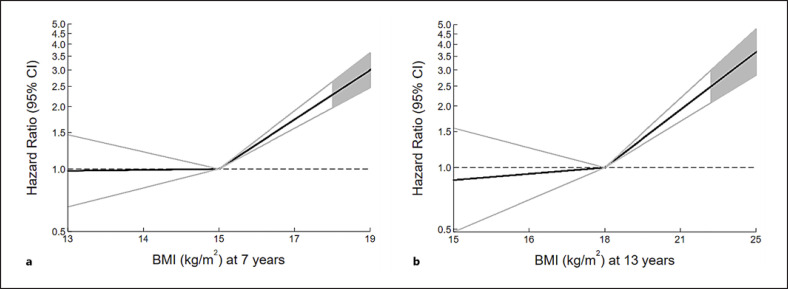
Results: Birthweight was not associated with PCOS. At the age of 7-13 years, girls with overweight had a higher risk of developing PCOS than girls without overweight; HR 2.83 (95% CI 2.34-3.42) at age 7 years and 2.99 (95% CI 2.38-3.76) at age 13 years. Furthermore, girls with overweight at both 7 and 13 years had a higher risk of developing PCOS than girls without overweight or overweight at only one age. Height was positively associated with PCOS risk at all ages. Girls who were persistently tall or changed from tall to average height had a higher risk of developing PCOS than girls with average height growth.
Conclusion: Overweight and tall stature in childhood are positively associated with PCOS risk, but birthweight is not.
Keywords: Birthweight; Body height; Body weights and measures; Child; Polycystic ovary syndrome.
© 2021 The Author(s) Published by S. Karger AG, Basel.
Conflict of interest statement
Dr. Jens-Christian Holm reports obesity related services to patients and health care professionals. All other authors have no declarations.
Figures
References
-
- Azziz R, Carmina E, Chen Z, Dunaif A, Laven JS, Legro RS, et al. Polycystic ovary syndrome. Nat Rev Dis Primers. 2016 Aug;2((1)):16057. - PubMed
-
- Bozdag G, Mumusoglu S, Zengin D, Karabulut E, Yildiz BO. The prevalence and phenotypic features of polycystic ovary syndrome: a systematic review and meta-analysis. Hum Reprod. 2016 Dec;31((12)):2841–55. - PubMed
-
- Gottschau M, Kjaer SK, Jensen A, Munk C, Mellemkjaer L. Risk of cancer among women with polycystic ovary syndrome: a Danish cohort study. Gynecol Oncol. 2015 Jan;136((1)):99–103. - PubMed
-
- Rubin KH, Glintborg D, Nybo M, Abrahamsen B, Andersen M. Development and Risk Factors of Type 2 Diabetes in a Nationwide Population of Women With Polycystic Ovary Syndrome. J Clin Endocrinol Metab. 2017 Oct;102((10)):3848–57. - PubMed
Publication types
MeSH terms
LinkOut - more resources
Full Text Sources
Other Literature Sources
Medical