Editorial
doi: 10.3324/haematol.2021.278643.
Band 3, an essential red blood cell hub of activity
Affiliations
- PMID: 33979993
- PMCID: PMC8561271
- DOI: 10.3324/haematol.2021.278643
Item in Clipboard
Editorial
Band 3, an essential red blood cell hub of activity
Haematologica.
.
No abstract available
Figures
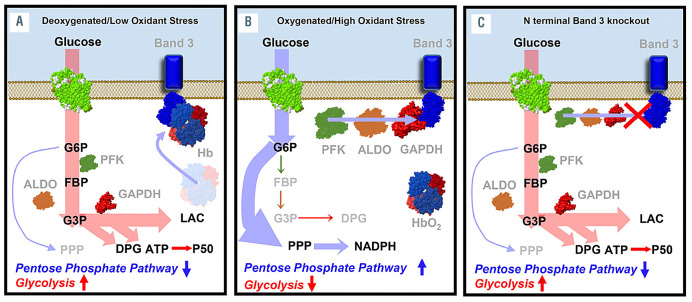
The influence of band 3 on red blood cell metabolism in different conditions. The schematic, adapted from Issaian et al.5 shows different conditions and the influence of band 3 on red blood cell metabolism in three different scenarios. (A) In deoxygenation/low oxidant stress conditions, deoxyhemoglobin can bind to the N-terminus of band 3, while glycolytic enzymes become displaced from the same region and are then activated, resulting in increased fluxes through glycolysis and decreased fluxes through the pentose phosphate pathway. (B) In oxygenated or high oxidative stress conditions, glycolytic enzymes can bind to the N-terminus of band 3, resulting in their partial inhibition, decreasing the metabolic flux through glycolysis and increasing flux through the pentose phosphate pathway to generate the reducing equivalent NADPH necessary to counteract oxidant stress. (C) In the absence of the extreme N-terminus of band 3 during storage, under high oxidative stress conditions, glycolytic enzymes cannot bind band 3 N-termini, so glyceraldehyde 3-phosphate dehydrogenase flux continues, and the pentose phosphate pathway is suppressed, leading to enhanced oxidative stress. G6P: glucose-6-phosphate; PFK: phospho-fructokinase; FBP: fructose 1,6, biphosphatase; ALDO: aldolase; G3P: glucose-3-phosphate; GAPDH: glyceraldehyde 3-phosphate dehydrogenase; DPG: diphosphoglycerate; ATP: adenosine triphosphate; LAC: lactate; Hb: hemoglobin; PPP: pentose phosphate pathway: NADPH: nicotinamide adenine dinucleotide phosphate. Image adapted from Issaian et al.5
Comment on
-
The interactome of the N-terminus of band 3 regulates red blood cell metabolism and storage quality.Haematologica. 2021 Nov 1;106(11):2971-2985. doi: 10.3324/haematol.2020.278252. Haematologica. 2021. PMID: 33979990 Free PMC article.
References
-
- Fairbanks G, Steck TL, Wallach DF. Electrophoretic analysis of the major polypeptides of the human erythrocyte membrane. Biochemistry. 1971;10(13):2606-2617. - PubMed
Publication types
MeSH terms
Substances
LinkOut - more resources
Full Text Sources
Other Literature Sources