Case Reports
. 2021 May 12;21(1):145.
doi: 10.1186/s12871-021-01365-y.

A case report of individualized ventilation in a COVID-19 patient - new possibilities and caveats to consider with flow-controlled ventilation

Affiliations
Case Reports

A case report of individualized ventilation in a COVID-19 patient - new possibilities and caveats to consider with flow-controlled ventilation

Patrick Spraider et al. BMC Anesthesiol. .

Abstract

Background: Flow-controlled ventilation (FCV) is a novel ventilation method increasingly being used clinically, particularly during the current COVID-19 pandemic. However, the continuous flow pattern in FCV during inspiration and expiration has a significant impact on respiratory parameters and ventilatory settings compared to conventional ventilation modes. In addition, the constant flow combined with direct intratracheal pressure measurement allows determination of dynamic compliance and ventilation settings can be adjusted accordingly, reflecting a personalized ventilation approach.

Case presentation: A 50-year old women with confirmed SARS-CoV-2 infection suffering from acute respiratory distress syndrome (ARDS) was admitted to a tertiary medical center. Initial ventilation occurred with best standard of care pressure-controlled ventilation (PCV) and was then switched to FCV, by adopting PCV ventilator settings. This led to an increase in oxygenation by 30 %. Subsequently, to reduce invasiveness of mechanical ventilation, FCV was individualized by dynamic compliance guided adjustment of both, positive end-expiratory pressure and peak pressure; this intervention reduced driving pressure from 18 to 12 cm H2O. However, after several hours, compliance further deteriorated which resulted in a tidal volume of only 4.7 ml/kg.

Conclusions: An individualized FCV approach increased oxygenation parameters in a patient suffering from severe COVID-19 related ARDS. Direct intratracheal pressure measurements allow for determination of dynamic compliance and thus optimization of ventilator settings, thereby reducing applied and dissipated energy. However, although desirable, this personalized ventilation strategy may reach its limits when lung function is so severely impaired that patient's oxygenation has to be ensured at the expense of lung protective ventilation concepts.

Keywords: COVID-19; Case Report; Lung Compliance; Respiratory Distress Syndrome, Adult; Stress Mechanical.


Conflict of interest statement

The authors declare that they have no competing interests.

Figures

Fig. 1
Fig. 1
Computed tomography four days prior to admission showing spacious areas of ground glass opacities including consolidation and air bronchogram (a, coronal plane; b, axial plane, with kind permission of the Department of Radiodiagnostics, Central Hospital Bolzano, Bozen/Bolzano, Italy)
Fig. 2
Fig. 2
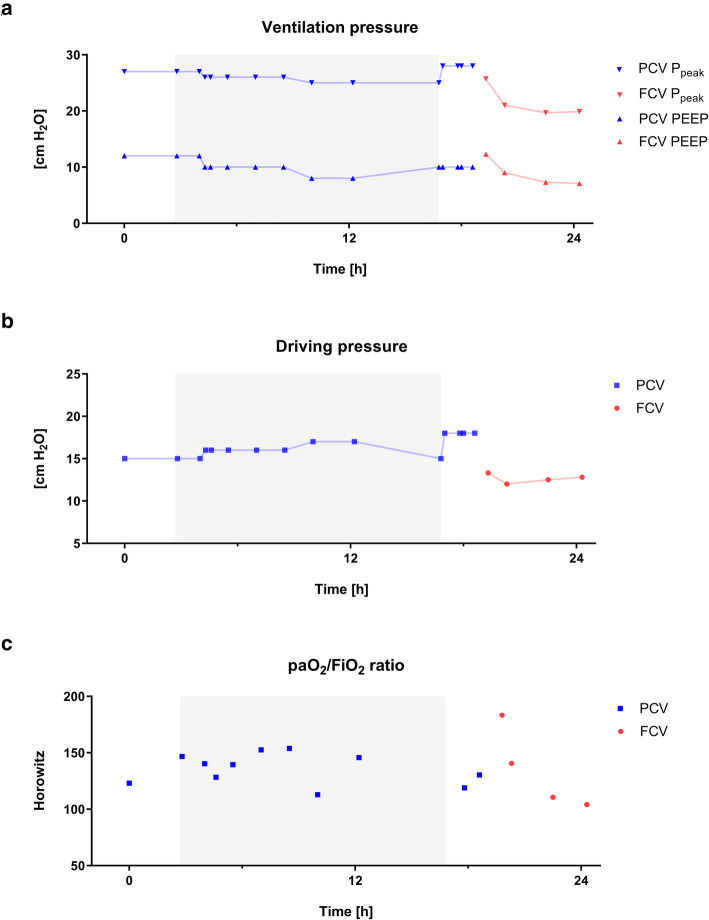
demonstrates the course of respiratory parameters during pressure-controlled ventilation (PCV; blue) and flow-controlled ventilation (FCV; red) since hospital admission. The grey area indicates prone position of the patient, the white area supine position. For FCV the (effective) alveolar pressures are calculated based on the measured resistance and the set flow according to Ohm’s law. a, peak inspiratory pressure (Ppeak) and positive end-expiratory pressure (PEEP). b, driving pressure. c, ratio of arterial partial pressure of oxygen (paO2) to fraction of inspired oxygen (FiO2)
Fig. 3
Fig. 3
Pressure-volume loops obtained from intratracheal pressure measurement. a, represents the pressure-volume loop at the beginning of FCV with a peak inspiratory pressure (Ppeak) set to 28 cm H2O and a positive end-expiratory pressure (PEEP) of 10 cm H20. Considering the measured resistance of 11.7 cm H2O/l/s and the set flow of 12 l/min and applying Ohm’s law, the alveolar Ppeak calculates to only 25.7 cm H2O and the alveolar PEEP to 12.3 cm H2O. b, after compliance-guided pressure settings Ppeak was reduced to 23 cm H2O (alveolar 21 cm H2O) and PEEP 7 cm H2O (alveolar 9 cm H2O) resulting in an almost linear relation of pressure and volume during in- and expiration. The steeper course of the PV loop in B compared to A indicates the increased compliance after individualized pressure settings. c, two hours after first compliance-guided pressure setting, re-evaluation showed a slight decline in lung mechanics. Therefore, Ppeak was adjusted to 22 cm H2O (alveolar 20 cm H2O) and PEEP to 5 cm H2O (alveolar 7 cm H2O). The initial kinking of the inspiratory pressure volume curve in C is an indicator for intratidal recruitment

References

    1. Gattinoni L, Chiumello D, Caironi P, et al. COVID-19 pneumonia: different respiratory treatments for different phenotypes? Intensive Care Med. 2020;46(6):1099–102. doi: 10.1007/s00134-020-06033-2. - DOI - PMC - PubMed
    1. Gattinoni L, Chiumello D, Rossi S. COVID-19 pneumonia: ARDS or not? Crit Care. 2020;24(1):154. doi: 10.1186/s13054-020-02880-z. - DOI - PMC - PubMed
    1. Marini JJ, Gattinoni L. Management of COVID-19 respiratory distress [published online ahead of print, 2020 Apr 24] JAMA. 2020 doi: 10.1001/jama.2020.6825. - DOI - PubMed
    1. ARDS Definition Task Force. Ranieri VM, Rubenfeld GD, et al. Acute respiratory distress syndrome: The berlin definition. JAMA. 2012;307(23):2526–33. - PubMed
    1. Bartlett RH, Ogino MT, Brodie D, et al. Initial ELSO guidance document: ECMO for COVID-19 patients with severe cardiopulmonary failure. ASAIO J. 2020;66(5):472–4. doi: 10.1097/MAT.0000000000001173. - DOI - PMC - PubMed

Publication types