


Socioeconomic and Geographic Disparities in Idiopathic Intracranial Hypertension
- PMID: 33980705
- PMCID: PMC8205454
- DOI: 10.1212/WNL.0000000000012037
Socioeconomic and Geographic Disparities in Idiopathic Intracranial Hypertension
Abstract
Objective: To identify relationships between idiopathic intracranial hypertension (IIH) and socioeconomic determinants of health, such as low-income status and proximity to healthy food.
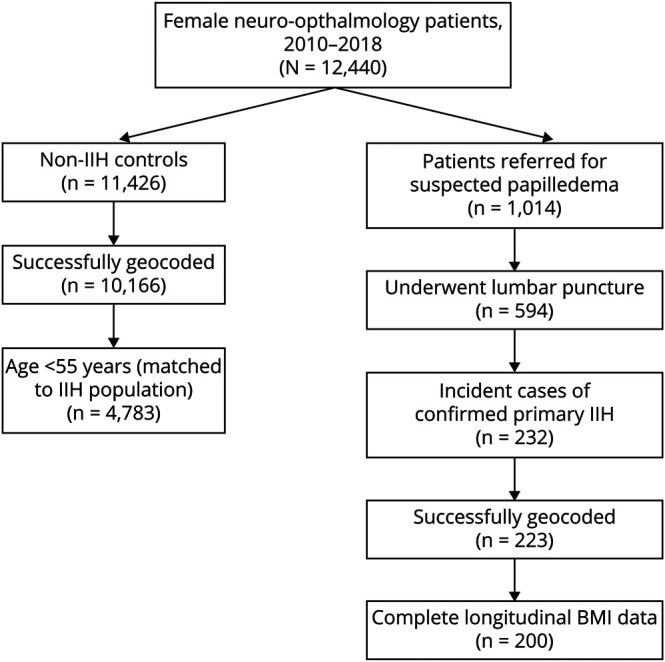
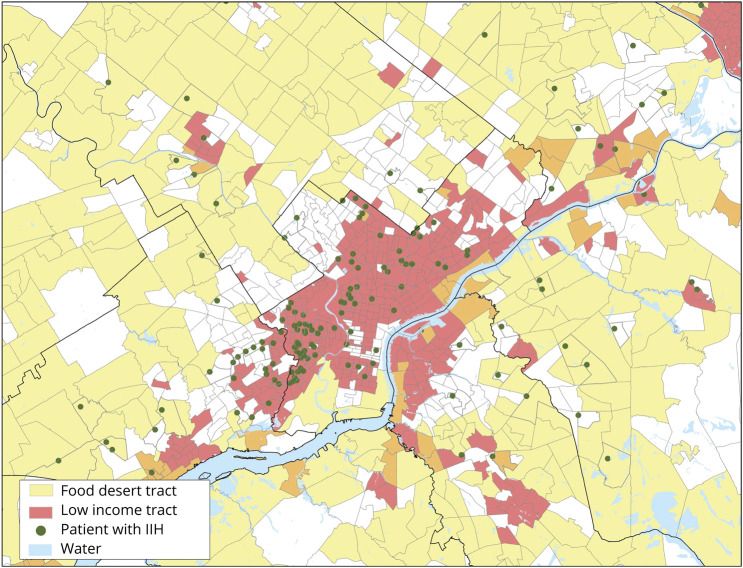
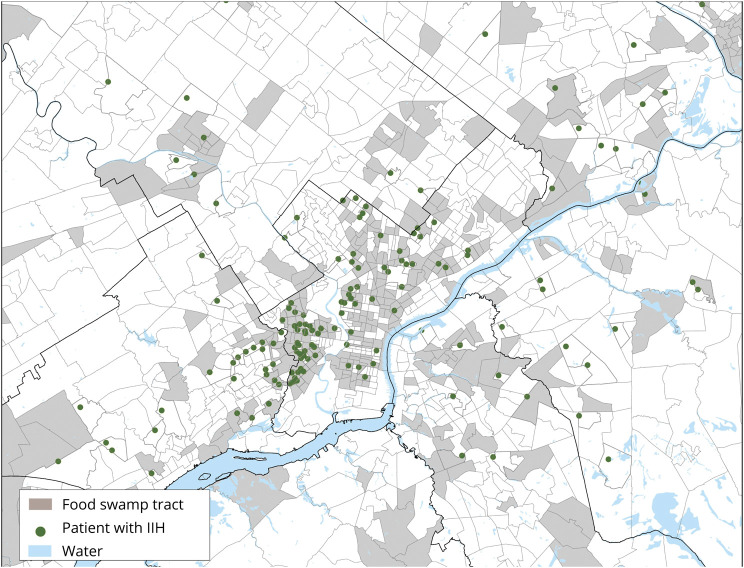
Methods: This retrospective case-control study of adult female neuro-ophthalmology patients from one institution identified 223 women with and 4,783 women without IIH. Street addresses were geocoded and merged with US census data to obtain census tract-level information on income and food access. Choropleth maps visualized IIH clusters within certain neighborhoods. Logistic regression compared the proportion of patients with IIH from racial and ethnic minority backgrounds, low-income census tracts, and food deserts and swamps to controls without IIH.
Results: In our cohort, when adjusted for age, women with IIH were more likely to be Black (odds ratio [OR] 3.96, 95% confidence interval [CI] 2.98-5.25), Hispanic (OR 2.23, 95% CI 1.14-4.36), and live in low-income tracts (OR 2.24, 95% CI 1.71-2.95) or food swamps (OR 1.54, 95% CI 1.15-2.07). Patients with IIH were less likely to live in food deserts than controls (OR 0.61, 95% CI 0.45-0.83). The association between Black race and IIH remained significant even after adjusting for other variables.
Conclusion: IIH is more common among Black and Hispanic women than expected even when accounting for the demographics of a metropolitan city. Some of this relationship is driven by the association of obesity and IIH incidence with low income and proximity to unhealthy foods.
© 2021 American Academy of Neurology.
Figures
References
-
- Friedman DI, Liu GT, Digre KB. Revised diagnostic criteria for the pseudotumor cerebri syndrome in adults and children. Neurology 2013;81(13):1159-1165. - PubMed
Publication types
MeSH terms
Grants and funding
LinkOut - more resources
Full Text Sources
Other Literature Sources
