


How machine learning is impacting research in atrial fibrillation: implications for risk prediction and future management
- PMID: 33982064
- PMCID: PMC8477792
- DOI: 10.1093/cvr/cvab169
How machine learning is impacting research in atrial fibrillation: implications for risk prediction and future management
Abstract
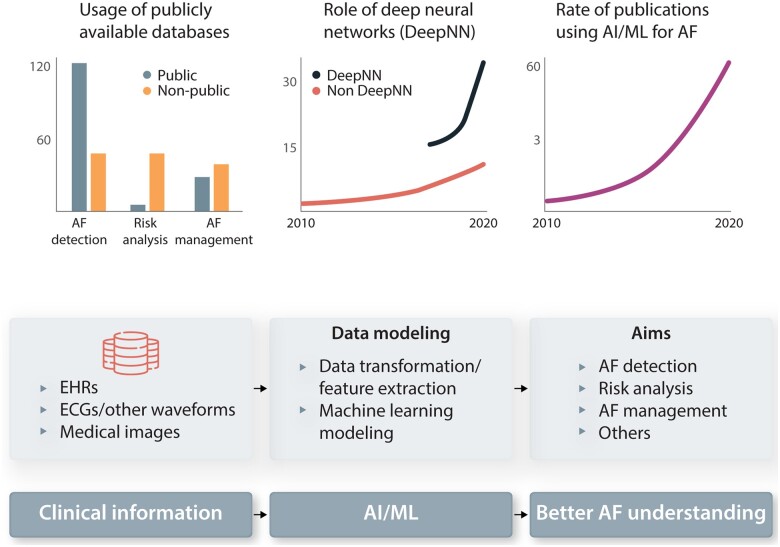
There has been an exponential growth of artificial intelligence (AI) and machine learning (ML) publications aimed at advancing our understanding of atrial fibrillation (AF), which has been mainly driven by the confluence of two factors: the advances in deep neural networks (DeepNNs) and the availability of large, open access databases. It is observed that most of the attention has centred on applying ML for dvsetecting AF, particularly using electrocardiograms (ECGs) as the main data modality. Nearly a third of them used DeepNNs to minimize or eliminate the need for transforming the ECGs to extract features prior to ML modelling; however, we did not observe a significant advantage in following this approach. We also found a fraction of studies using other data modalities, and others centred in aims, such as risk prediction, AF management, and others. From the clinical perspective, AI/ML can help expand the utility of AF detection and risk prediction, especially for patients with additional comorbidities. The use of AI/ML for detection and risk prediction into applications and smart mobile health (mHealth) technology would enable 'real time' dynamic assessments. AI/ML could also adapt to treatment changes over time, as well as incident risk factors. Incorporation of a dynamic AI/ML model into mHealth technology would facilitate 'real time' assessment of stroke risk, facilitating mitigation of modifiable risk factors (e.g. blood pressure control). Overall, this would lead to an improvement in clinical care for patients with AF.
Keywords: Artificial intelligence; Machine learning; Risk analysis; Wearables; Atrial fibrillation.
Published on behalf of the European Society of Cardiology. All rights reserved. © The Author(s) 2021. For permissions, please email: journals.permissions@oup.com.
Figures


References
-
- Lip GYH, Fauchier L, Freedman SB, Gelder IV, Natale A, Gianni C, Nattel S, Potpara T, Rienstra M, Tse H-F, Lane DA. Atrial fibrillation. Nat Rev Dis Primers 2016;2:16016. - PubMed
-
- Chebbout R, Heywood EG, Drake TM, Wild JRL, Lee J, Wilson M, Lee MJ. A systematic review of the incidence of and risk factors for postoperative atrial fibrillation following general surgery. Anaesthesia 2018;73:490–498. - PubMed
-
- Dwivedi YK, Hughes L, Ismagilova E, Aarts G, Coombs C, Crick T, Duan Y, Dwivedi R, Edwards J, Eirug A, Galanos V, Ilavarasan PV, Janssen M, Jones P, Kar AK, Kizgin H, Kronemann B, Lal B, Lucini B, Medaglia R, Le Meunier-FitzHugh K, Le Meunier-FitzHugh LC, Misra S, Mogaji E, Sharma SK, Singh JB, Raghavan V, Raman R, Rana NP, Samothrakis S, Spencer J, Tamilmani K, Tubadji A, Walton P, Williams MD. Artificial intelligence (AI): multidisciplinary perspectives on emerging challenges, opportunities, and agenda for research, practice and policy. Int J Inf Manage 2021; 57:101994.
-
- Russel S, Norvig P. Artificial Intelligence: A Modern Approach, 4th edn. Harlow, UK: Pearson Education Limited; 2020.
Publication types
MeSH terms
LinkOut - more resources
Full Text Sources
Other Literature Sources
Medical
