


Treatment and prognostic factors of pituicytoma: a single-center experience and comprehensive literature review
- PMID: 33982223
- PMCID: PMC8416853
- DOI: 10.1007/s11102-021-01152-5
Treatment and prognostic factors of pituicytoma: a single-center experience and comprehensive literature review
Abstract
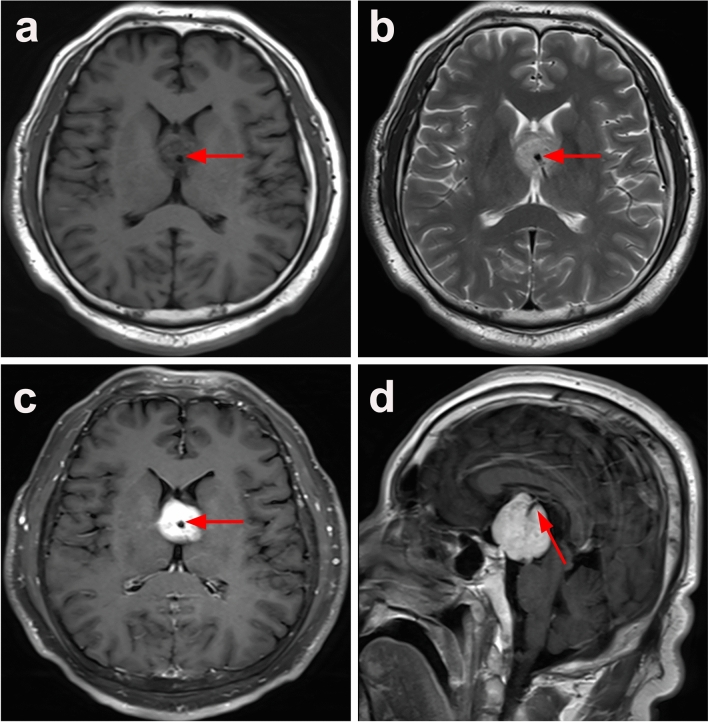
Purpose: Preoperative diagnosis of pituicytomas is difficult, and management and prognostic factors remain ambiguous. The purpose of this study was to elucidate the radiological characteristics of pituicytoma, to assess the risk factors affecting tumor progression, and to propose the optimal treatment regimen based on comprehensive analysis.
Methods: We reviewed the clinical data of 22 patients with pituicytoma confirmed pathologically in our institution. In addition, 93 cases of pituicytoma in the previous literature were recruited. The individual data of 115 patients were analyzed to evaluate the adverse factors affecting pituicytoma progression.
Results: In the combined cohort, 3 of 61 patients who underwent gross-total resection (GTR) developed recurrence (4.9%); of the 54 patients who received non-GTR, 19 progressed (35.2%). Univariate and multivariate Cox regression analysis verified male gender (HR 2.855, 95% CI 1.008-8.089; p = 0.048), TS (transsphenoidal surgery; HR 3.559, 95% CI 1.015-12.476; p = 0.047), and non-GTR (HR 4.388, 95%CI 1.240-15.521; p = 0.022) were independent unfavorable factors for pituicytoma progression. A multivariate logistic regression model verified that tumor diameter ≥ 1.85 cm (OR 4.859, 95% CI 1.335-17.691; p = 0.016) was independent adverse factors for GTR. Compared with TS, OT (open transcranial) is more likely to have postoperative complications (OR 3.185, 95% CI 1.020-9.944; p = 0.046), especially vision deterioration (OR 37.267, 95% CI 4.486-309.595; p = 0.001).
Conclusion: Based on our findings, GTR was advocated as an optimal treatment for pituicytomas. However, in order to avoid damage to important structures, partial resection is acceptable. After that, adjuvant radiotherapy is recommended for male patients with high Ki-67 index, and the remaining patients can be followed up closely. When the tumor recurs or progresses, it is recommended to re-operate and remove the lesion completely as far as possible. If GTR is still not possible, postoperative radiotherapy for the residual tumor is recommended.
Keywords: Diagnosis; Oncology; Pituicytoma; Radiotherapy; Total resection; Treatment strategy.
© 2021. The Author(s).
Conflict of interest statement
The authors have no personal, financial, or institutional interest in any of the drugs, materials, or devices described in this article.
Figures



References
Publication types
MeSH terms
Grants and funding
LinkOut - more resources
Full Text Sources
Other Literature Sources
Medical
