. 2021 May 13;17(5):e1009531.
doi: 10.1371/journal.pgen.1009531. eCollection 2021 May.

Glucocorticoid signaling in pancreatic islets modulates gene regulatory programs and genetic risk of type 2 diabetes

Affiliations

Glucocorticoid signaling in pancreatic islets modulates gene regulatory programs and genetic risk of type 2 diabetes

Anthony Aylward et al. PLoS Genet. .

Abstract

Glucocorticoids are key regulators of glucose homeostasis and pancreatic islet function, but the gene regulatory programs driving responses to glucocorticoid signaling in islets and the contribution of these programs to diabetes risk are unknown. In this study we used ATAC-seq and RNA-seq to map chromatin accessibility and gene expression from eleven primary human islet samples cultured in vitro with the glucocorticoid dexamethasone at multiple doses and durations. We identified thousands of accessible chromatin sites and genes with significant changes in activity in response to glucocorticoids. Chromatin sites up-regulated in glucocorticoid signaling were prominently enriched for glucocorticoid receptor binding sites and up-regulated genes were enriched for ion transport and lipid metabolism, whereas down-regulated chromatin sites and genes were enriched for inflammatory, stress response and proliferative processes. Genetic variants associated with glucose levels and T2D risk were enriched in glucocorticoid-responsive chromatin sites, including fine-mapped variants at 51 known signals. Among fine-mapped variants in glucocorticoid-responsive chromatin, a likely casual variant at the 2p21 locus had glucocorticoid-dependent allelic effects on beta cell enhancer activity and affected SIX2 and SIX3 expression. Our results provide a comprehensive map of islet regulatory programs in response to glucocorticoids through which we uncover a role for islet glucocorticoid signaling in mediating genetic risk of T2D.


Conflict of interest statement

I have read the journal’s policy and the authors of this manuscript have the following competing interests: KJG is a consultant for Genentech and holds stock in Vertex Pharmaceuticals

Figures
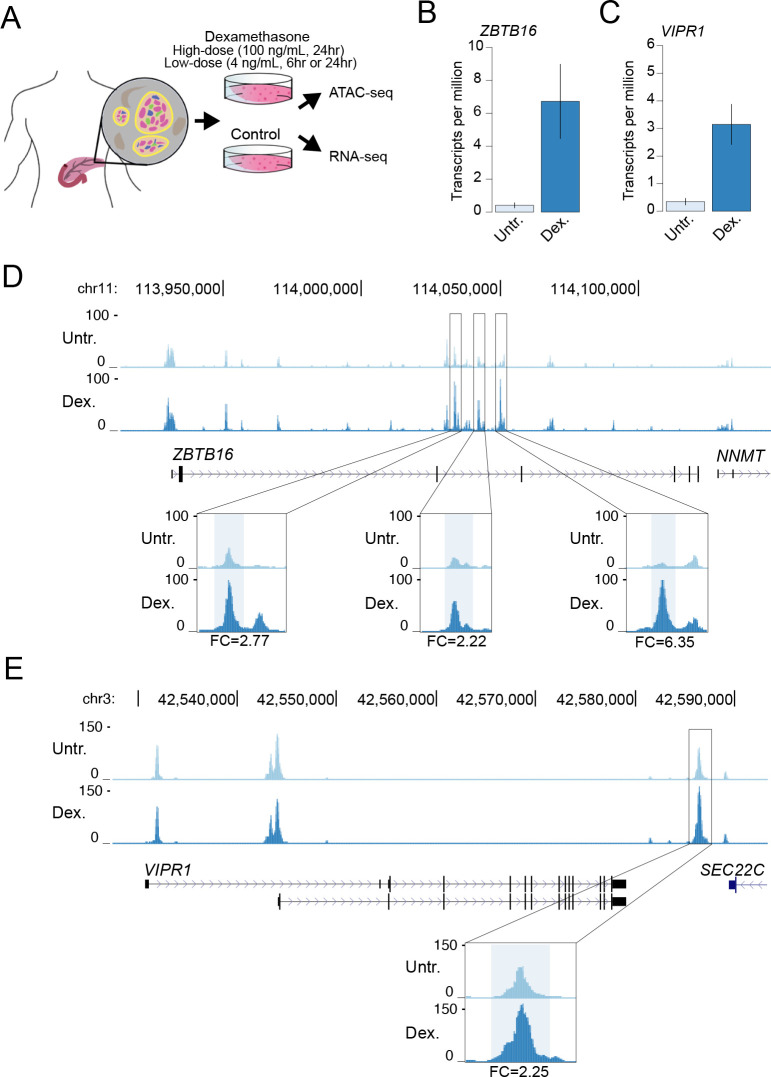
Fig 1
Fig 1. A map of gene regulation in pancreatic islets in response to glucocorticoid signaling.
(A) Overview of study design. Primary pancreatic islet samples were split and separately cultured in normal conditions and including the glucocorticoid dexamethasone at either a high-dose (100ng/mL for 24hr) or low-dose (4 ng/mL for 6hr or 24hr) treatment, and then profiled for gene expression and accessible chromatin using RNA-seq and ATAC-seq assays. Genes with known induction in glucocorticoid signaling (B) ZBTB16 and (C) VIPR1 had increased expression in glucocorticoid-treated islets compared to untreated islets. Values represent mean and standard error. (D) At the ZBTB16 locus several accessible chromatin sites intronic to ZBTB16 had increased accessibility in glucocorticoid treated (Dex.) compared to untreated (Untr.) islets. (E) At the VIPR1 locus an accessible chromatin site downstream of VIPR1 had increased accessibility in glucocorticoid treated (Dex.) compared to untreated (Untr.) islets. Values in D and E represent RPKM normalized ATAC-seq read counts. Fold-change (FC) in accessible chromatin signal in glucocorticoid treatment compared to untreated indicated at highlighted sites. All results shown are for the high-dose treatment.
Fig 2
Fig 2. Glucocorticoid signaling affects chromatin accessibility in pancreatic islets.
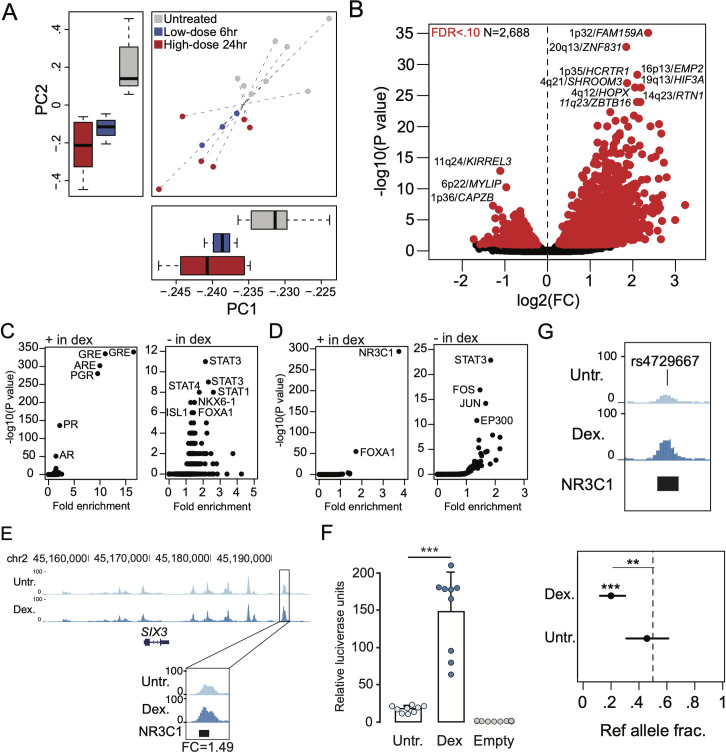
(A) Principal components plot showing ATAC-seq signal for high-dose (red) and low-dose (blue) glucocorticoid-treated islets and untreated (grey) islets from 9 total donors. Dashed lines connect assays from the same sample, and box plots on each axis represent the distribution of principal components of samples for each condition. (B) Volcano plot of sites with differential chromatin accessibility in glucocorticoid treated compared to untreated islets. Sites with significant differential activity (FDR < .10) are highlighted in red. The sites with the most significant changes are labelled with the locus and the nearest gene. (C) Transcription factor (TF) sequence motifs enriched in differential chromatin sites with increased activity (+ in dex) and decreased activity (- in dex) in glucocorticoid-treated islets. (D) Enrichment of ChIP-seq sites from ENCODE for 160 TFs in differential chromatin sites with increased activity (+ in dex) and decreased activity (- in dex) in glucocorticoid-treated islets. (E) A chromatin site at the SIX2/3 locus had increased activity in glucocorticoid-treated islets and overlapped a ChIP-seq site for the glucocorticoid receptor (GR/NR3C1) (top). Fold-change (FC) in accessible chromatin signal in glucocorticoid treatment compared to untreated indicated at the highlighted site for high-dose treatment. (F) The differential site at SIX2/3 had glucocorticoid-dependent effects on enhancer activity in gene reporter assays in MIN6 cells (bottom). Values represent mean and standard deviation. (G) Variant rs4729667 mapped in a chromatin site with increased activity in glucocorticoid-treated islets and had stronger allelic imbalance in chromatin accessibility in glucocorticoid-treated compared to untreated islets. Values represent ref allele fraction and 95% confidence intervals. For panels B, C and D the values shown are from results using high-dose treatment. **P < .01, ***P<1x10⁻⁴.
Fig 3
Fig 3. Glucocorticoid signaling affects gene expression levels in pancreatic islets.
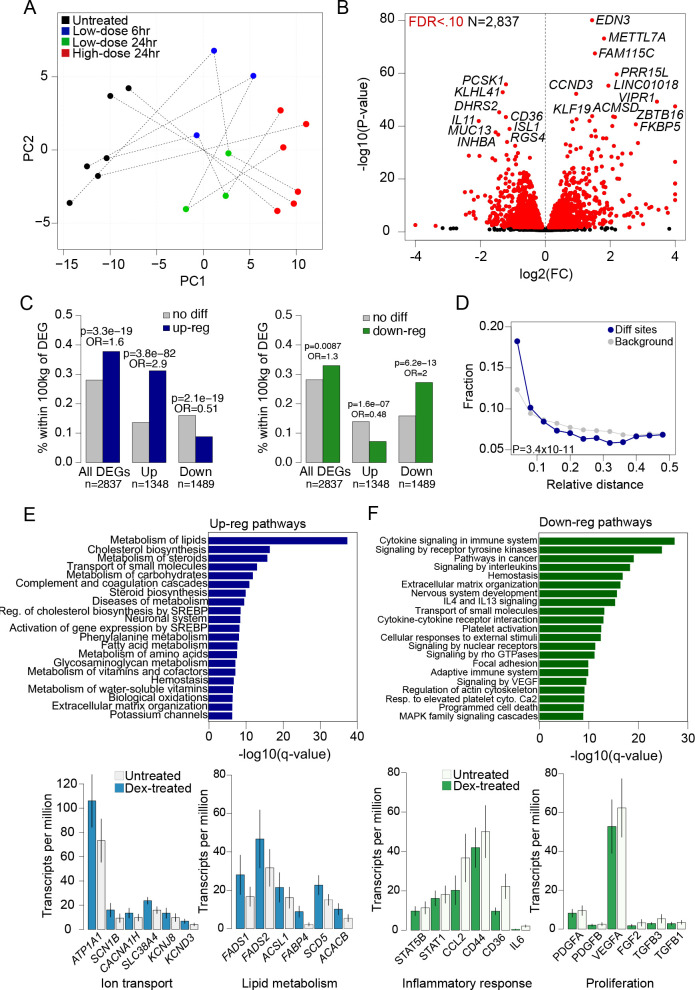
(A) Principal components plot of gene expression from high-dose (red) and low-dose (green 24hr, blue 6hr) glucocorticoid-treated and untreated (black) islets from a total of 6 samples. Dashed lines connect assays from the same sample. (B) Volcano plot showing genes with differential expression in glucocorticoid-treated islets compared to untreated islets. Genes with significantly differential expression (FDR < .10) are highlighted in red, and genes with pronounced changed in expression are listed. (C) Percentage of accessible chromatin sites with up-regulated activity (left) and down-regulated activity (right) in glucocorticoid-treated islets within 100kb of differentially expressed genes (DEGs) compared to chromatin sites without differential activity. (D) Relative distance metric (from bedtools reldist) between accessible chromatin sites with differential activity (dex) and genes with differential expression compared to all chromatin sites (background). (E) Biological pathway terms enriched among genes with up-regulated expression in glucocorticoid-treated islets (top), and the expression level of selected genes annotated with ion transport and lipid metabolism terms in glucocorticoid-treated and untreated islets (bottom). Values represent mean expression and standard error. (F) Biological pathway terms enriched among genes with up-regulated expression in glucocorticoid-treated islets (top), and the expression level of selected genes annotated with inflammatory response and proliferation pathway terms in glucocorticoid-treated and untreated islets (bottom). Values represent mean expression and standard error. For panels B, C, D and E the values shown are from results using high-dose treatment.
Fig 4
Fig 4. Type 2 diabetes and glucose associated variants affect glucocorticoid-responsive islet regulatory programs.
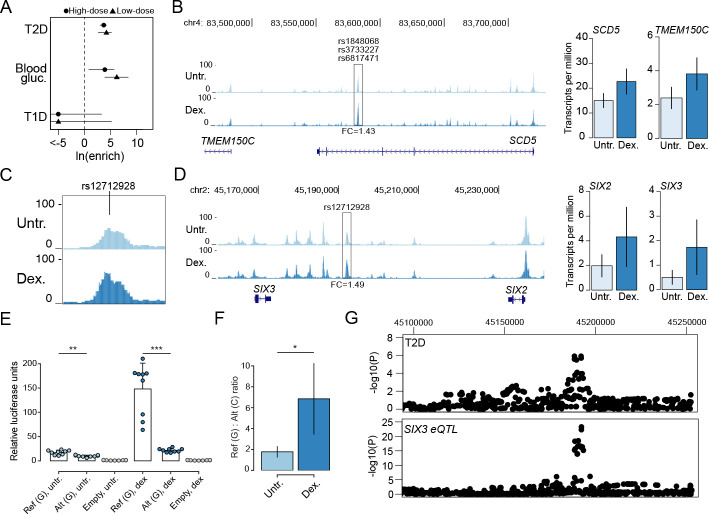
(A) Enrichment of variants associated with type 1 diabetes (T1D), type 2 diabetes (T2D) and blood sugar (glucose) levels for differential chromatin sites in high-dose and low-dose glucocorticoid-treated islets. Values represent log enrichment estimates and 95% confidence intervals. (B) Multiple fine-mapped T2D variants at the SCD5/TMEM150C locus mapped in a glucocorticoid-responsive islet accessible chromatin site. Both the SCD5 and TMEM150C genes had increased expression in glucocorticoid-treated islets. Genome browser tracks represent RPKM normalized ATAC-seq signal, and bar plots represent mean expression and standard error. (C, D) Variant rs12712928 with evidence for blood sugar and T2D association mapped in a glucocorticoid-responsive chromatin site at the SIX2/3 locus. Both the SIX2 and SIX3 genes had increased expression in glucocorticoid-treated islets. Genome browser tracks represent RPKM normalized ATAC-seq signal, and bar plots represent mean expression and standard error. (E) Variant rs12712928 had significant allelic effects on enhancer activity in gene reporter assays in MIN6 cells. Values represent mean and standard deviation. (F) The allelic effects of rs12712928 were more pronounced in glucocorticoid-treated relative to untreated islets. Values represent fold-change and 95% CI. (G) The T2D association signal at SIX2/3 was colocalized with an eQTL for SIX3 expression in islets. For panels B, C and D the values shown are from results using high-dose treatment. For panels B and D, the fold-change (FC) in accessible chromatin signal in glucocorticoid treatment compared to untreated is indicated at highlighted sites. ***P<1x10⁻⁴, **P<1x10⁻³, *P<1x10⁻².

References

    1. Becker DE. Basic and clinical pharmacology of glucocorticosteroids. Anesth Prog. 2013;60: 25–31; quiz 32. doi: 10.2344/0003-3006-60.1.25 - DOI - PMC - PubMed
    1. Coutinho AE, Chapman KE. The anti-inflammatory and immunosuppressive effects of glucocorticoids, recent developments and mechanistic insights. Mol Cell Endocrinol. 2011;335: 2–13. doi: 10.1016/j.mce.2010.04.005 - DOI - PMC - PubMed
    1. Patel R, Williams-Dautovich J, Cummins CL. Minireview: new molecular mediators of glucocorticoid receptor activity in metabolic tissues. Mol Endocrinol Baltim Md. 2014;28: 999–1011. doi: 10.1210/me.2014-1062 - DOI - PMC - PubMed
    1. Bauerle KT, Harris C. Glucocorticoids and Diabetes. Mo Med. 2016;113: 378–383. - PMC - PubMed
    1. Suh S, Park MK. Glucocorticoid-Induced Diabetes Mellitus: An Important but Overlooked Problem. Endocrinol Metab Seoul Korea. 2017;32: 180–189. doi: 10.3803/EnM.2017.32.2.180 - DOI - PMC - PubMed

Publication types