


Phenome-wide association of 1809 phenotypes and COVID-19 disease progression in the Veterans Health Administration Million Veteran Program
- PMID: 33984066
- PMCID: PMC8118298
- DOI: 10.1371/journal.pone.0251651
Phenome-wide association of 1809 phenotypes and COVID-19 disease progression in the Veterans Health Administration Million Veteran Program
Abstract
Background: The risk factors associated with the stages of Coronavirus Disease-2019 (COVID-19) disease progression are not well known. We aim to identify risk factors specific to each state of COVID-19 progression from SARS-CoV-2 infection through death.
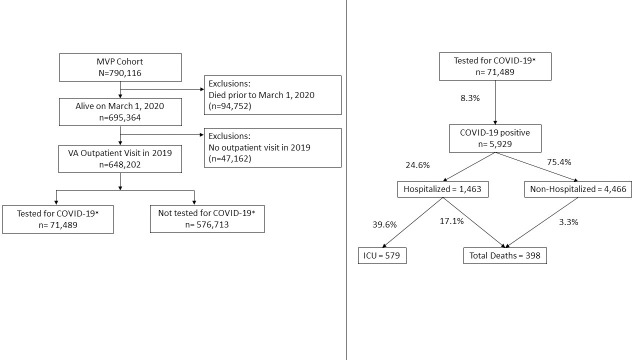
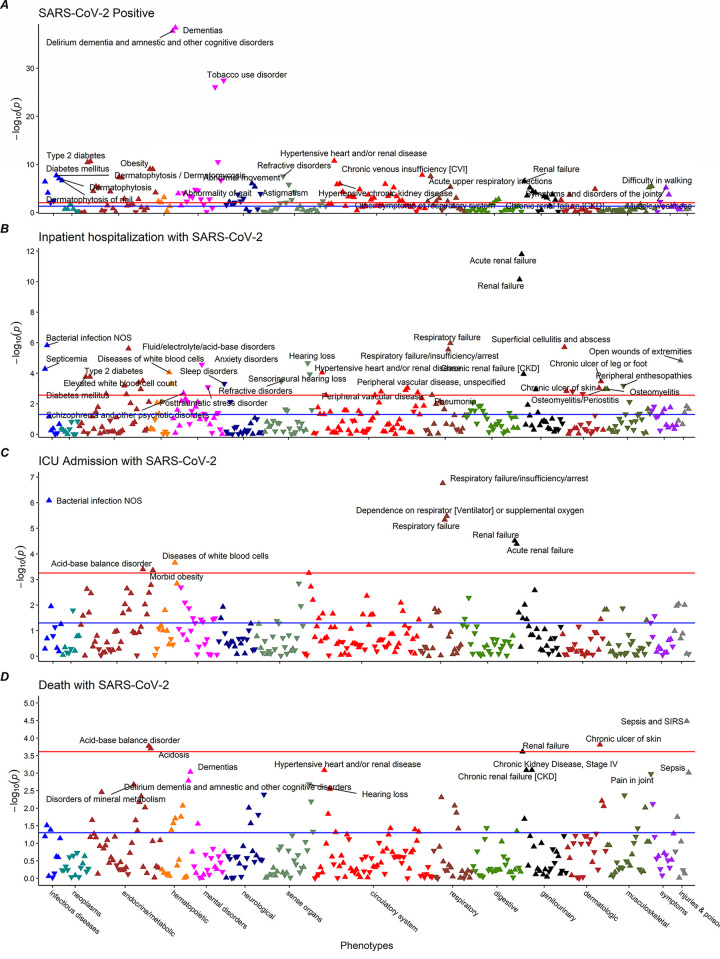
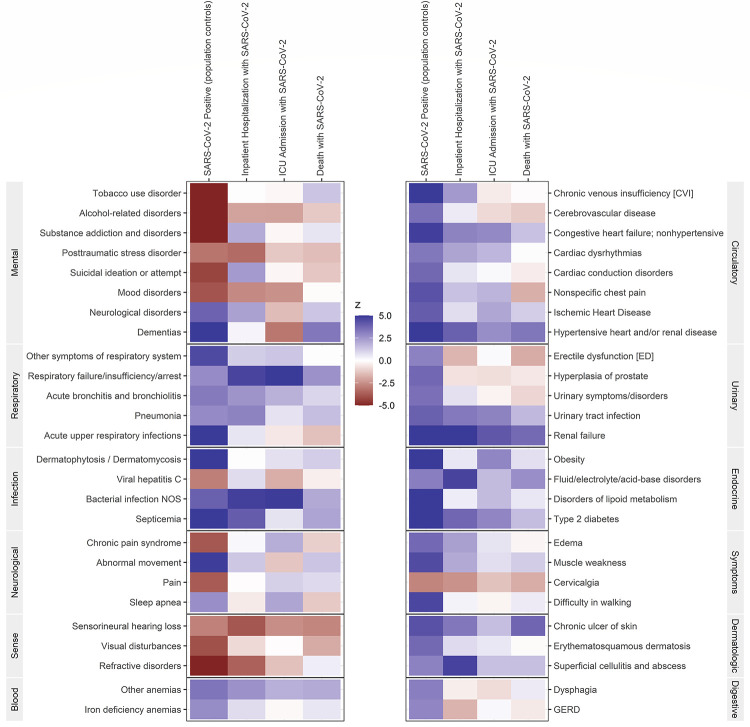
Methods and results: We included 648,202 participants from the Veteran Affairs Million Veteran Program (2011-). We identified characteristics and 1,809 ICD code-based phenotypes from the electronic health record. We used logistic regression to examine the association of age, sex, body mass index (BMI), race, and prevalent phenotypes to the stages of COVID-19 disease progression: infection, hospitalization, intensive care unit (ICU) admission, and 30-day mortality (separate models for each). Models were adjusted for age, sex, race, ethnicity, number of visit months and ICD codes, state infection rate and controlled for multiple testing using false discovery rate (≤0.1). As of August 10, 2020, 5,929 individuals were SARS-CoV-2 positive and among those, 1,463 (25%) were hospitalized, 579 (10%) were in ICU, and 398 (7%) died. We observed a lower risk in women vs. men for ICU and mortality (Odds Ratio (95% CI): 0.48 (0.30-0.76) and 0.59 (0.31-1.15), respectively) and a higher risk in Black vs. Other race patients for hospitalization and ICU (OR (95%CI): 1.53 (1.32-1.77) and 1.63 (1.32-2.02), respectively). We observed an increased risk of all COVID-19 disease states with older age and BMI ≥35 vs. 20-24 kg/m2. Renal failure, respiratory failure, morbid obesity, acid-base balance disorder, white blood cell diseases, hydronephrosis and bacterial infections were associated with an increased risk of ICU admissions; sepsis, chronic skin ulcers, acid-base balance disorder and acidosis were associated with mortality.
Conclusions: Older age, higher BMI, males and patients with a history of respiratory, kidney, bacterial or metabolic comorbidities experienced greater COVID-19 severity. Future studies to investigate the underlying mechanisms associated with these phenotype clusters and COVID-19 are warranted.
Conflict of interest statement
The authors have declared that no competing interests exist.
Figures
References
-
- Johns Hopkins University. COVID-19 United States cases by county. 2020 [cited 14 Jul 2020]. Available: https://coronavirus.jhu.edu/us-map.
-
- U.S. Department of Veterans Affairs [VA]. Novel Coronavirus Disease (COVID-19). In: United States Department of Veterans Affairs Public Health [Internet]. 2020 [cited 15 Jul 2020]. Available: https://www.publichealth.va.gov/n-coronavirus/.
-
- Thebault R, Tran A, Williams V. The coronavirus is infecting and killing black Americans at an alarmingly high rate. Washington Post. 7 April 2020.
Publication types
MeSH terms
LinkOut - more resources
Full Text Sources
Other Literature Sources
Medical
Research Materials
Miscellaneous
