


An investment case for the prevention and management of rheumatic heart disease in the African Union 2021-30: a modelling study
- PMID: 33984296
- PMCID: PMC9087136
- DOI: 10.1016/S2214-109X(21)00199-6
An investment case for the prevention and management of rheumatic heart disease in the African Union 2021-30: a modelling study
Abstract
Background: Despite declines in deaths from rheumatic heart disease (RHD) in Africa over the past 30 years, it remains a major cause of cardiovascular morbidity and mortality on the continent. We present an investment case for interventions to prevent and manage RHD in the African Union (AU).
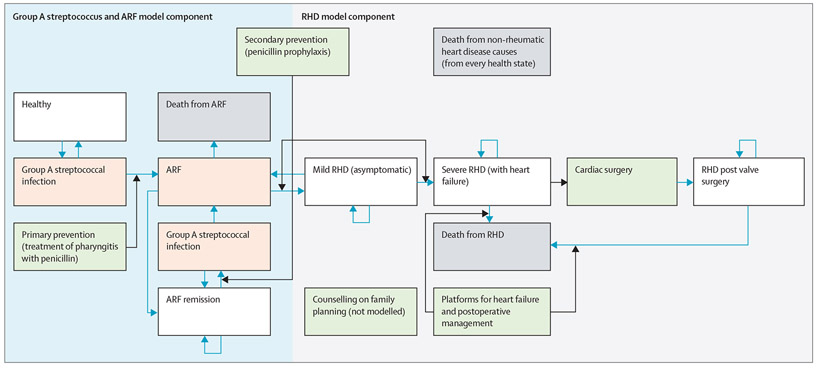
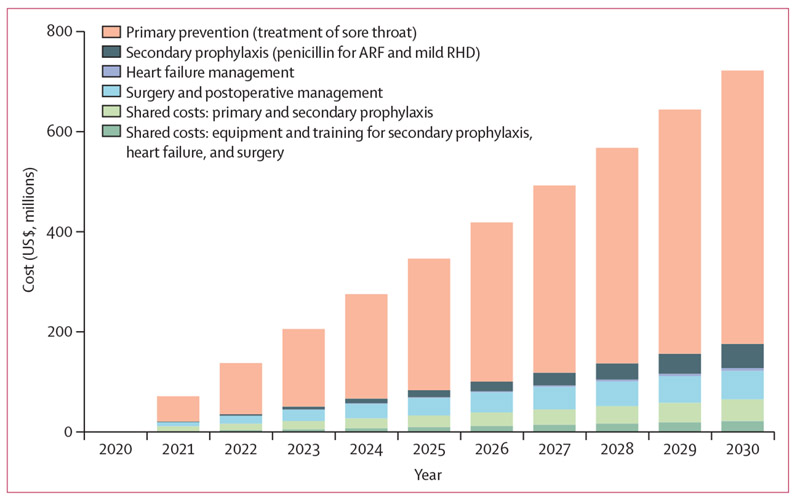
Methods: We created a cohort state-transition model to estimate key outcomes in the disease process, including cases of pharyngitis from group A streptococcus, episodes of acute rheumatic fever (ARF), cases of RHD, heart failure, and deaths. With this model, we estimated the impact of scaling up interventions using estimates of effect sizes from published studies. We estimated the cost to scale up coverage of interventions and summarised the benefits by monetising health gains estimated in the model using a full income approach. Costs and benefits were compared using the benefit-cost ratio and the net benefits with discounted costs and benefits.
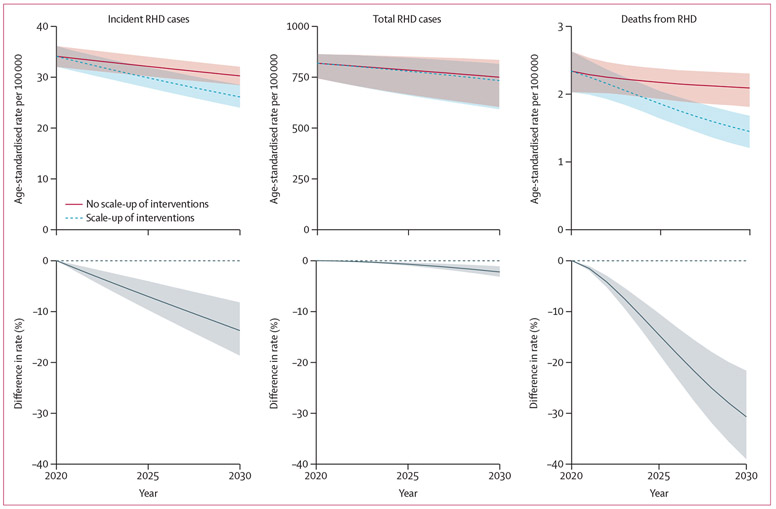
Findings: Operationally achievable levels of scale-up of interventions along the disease spectrum, including primary prevention, secondary prevention, platforms for management of heart failure, and heart valve surgery could avert 74 000 (UI 50 000-104 000) deaths from RHD and ARF from 2021 to 2030 in the AU, reaching a 30·7% (21·6-39·0) reduction in the age-standardised death rate from RHD in 2030, compared with no increase in coverage of interventions. The estimated benefit-cost ratio for plausible scale-up of secondary prevention and secondary and tertiary care interventions was 4·7 (2·9-6·3) with a net benefit of $2·8 billion (1·6-3·9; 2019 US$) through 2030. The estimated benefit-cost ratio for primary prevention scale-up was low to 2030 (0·2, <0·1-0·4), increasing with delayed benefits accrued to 2090. The benefit-cost dynamics of primary prevention were sensitive to the costs of different delivery approaches, uncertain epidemiological parameters regarding group A streptococcal pharyngitis and ARF, assumptions about long-term demographic and economic trends, and discounting.
Interpretation: Increased coverage of interventions to control and manage RHD could accelerate progress towards eradication in AU member states. Gaps in local epidemiological data and particular components of the disease process create uncertainty around the level of benefits. In the short term, costs of secondary prevention and secondary and tertiary care for RHD are lower than for primary prevention, and benefits accrue earlier.
Funding: World Heart Federation, Leona M and Harry B Helmsley Charitable Trust, and American Heart Association.
Copyright © 2021 The Author(s). Published by Elsevier Ltd. This is an Open Access article under the CC BY-NC-ND 4.0 license. Published by Elsevier Ltd.. All rights reserved.
Conflict of interest statement
Declaration of interests DAW reports grants from the American Heart Association during the time of the study. GFK reports grants from the National Heart, Lung, and Blood Institute during the time of the study.
Figures
Comment in
-
Targeted investment needed to end rheumatic heart disease in Africa.Lancet Glob Health. 2021 Jul;9(7):e887-e888. doi: 10.1016/S2214-109X(21)00215-1. Epub 2021 May 10. Lancet Glob Health. 2021. PMID: 33984297 No abstract available.
References
-
- Watkins DA, Johnson CO, Colquhoun SM, et al. Global, regional, and national burden of rheumatic heart disease, 1990–2015. N Engl J Med 2017; 377: 713–22. - PubMed
-
- Karthikeyan G, Guilherme L. Acute rheumatic fever. Lancet 2018; 392: 161–74. - PubMed
-
- Steer AC, Carapetis JR, Nolan TM, Shann F. Systematic review of rheumatic heart disease prevalence in children in developing countries: the role of environmental factors. J Paediatr Child Health 2002; 38: 229–34. - PubMed
Publication types
MeSH terms
Grants and funding
LinkOut - more resources
Full Text Sources
Other Literature Sources
Miscellaneous
