


Time course of outcome in poor grade subarachnoid hemorrhage patients: a longitudinal retrospective study
- PMID: 33985460
- PMCID: PMC8117582
- DOI: 10.1186/s12883-021-02229-1
Time course of outcome in poor grade subarachnoid hemorrhage patients: a longitudinal retrospective study
Abstract
Background: Neurological outcome and mortality of patients suffering from poor grade subarachnoid hemorrhage (SAH) may have changed over time. Several factors, including patients' characteristics, the presence of hydrocephalus and intraparenchymal hematoma, might also contribute to this effect. The aim of this study was to assess the temporal changes in mortality and neurologic outcome in SAH patients and identify their predictors.
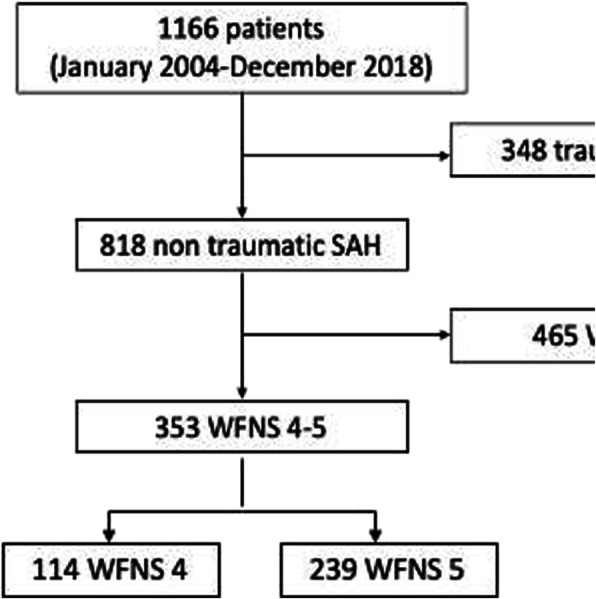
Methods: We performed a single center retrospective cohort study from 2004 to 2018. All non-traumatic SAH patients with poor grade on admission (WFNS score of 4 or 5) who remained at least 24 h in the hospital were included. Time course was analyzed into four groups according to the years of admission (2004-2007; 2008-2011; 2012-2015 and 2016-2018).
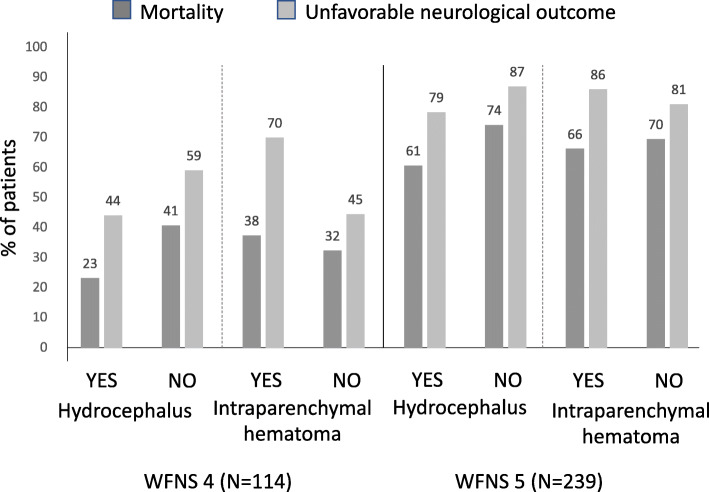
Results: A total of 353 patients were included in this study: 202 patients died (57 %) and 260 (74 %) had unfavorable neurological outcome (UO) at 3 months. Mortality tended to decrease in in 2008-2011 and 2016-2018 periods (HR 0.55 [0.34-0.89] and HR 0.33 [0.20-0.53], respectively, when compared to 2004-2007). The proportion of patients with UO remained high and did not vary significantly over time. Patients with WFNS 5 had higher mortality (68 % vs. 34 %, p = 0.001) and more frequent UO (83 % vs. 54 %, p = 0.001) than those with WFNS 4. In the multivariable analysis, WFNS 5 was independently associated with mortality (HR 2.12 [1.43-3.14]) and UO (OR 3.23 [1.67-6.25]). The presence of hydrocephalus was associated with a lower risk of mortality (HR 0.60 [0.43-0.84]).
Conclusions: Both hospital mortality and UO remained high in poor grade SAH patients. Patients with WFNS 5 on admission had worse prognosis than others; this should be taken into consideration for future clinical studies.
Keywords: Hydrocephalus; Intracranial hemorrhage; Mortality; Neurological outcome; Subarachnoid hemorrhage.
Conflict of interest statement
The authors declare that they have no competing interests.
Figures

References
-
- Connolly ES, Jr, Rabinstein AA, Carhuapoma JR, Derdeyn CP, Dion J, Higashida RT, et al. Guidelines for the management of aneurysmal subarachnoid hemorrhage: a guideline for healthcare professionals from the American Heart Association/american Stroke Association. Stroke. 2012;43 6:1711–37. doi: 10.1161/STR.0b013e3182587839. - DOI - PubMed
MeSH terms
LinkOut - more resources
Full Text Sources
Other Literature Sources
