


Obesity and occupation in Thailand: using a Bayesian hierarchical model to obtain prevalence estimates from the National Health Examination Survey
- PMID: 33985465
- PMCID: PMC8117309
- DOI: 10.1186/s12889-021-10944-0
Obesity and occupation in Thailand: using a Bayesian hierarchical model to obtain prevalence estimates from the National Health Examination Survey
Abstract
Background: Like many developing countries, Thailand has experienced a rapid rise in obesity, accompanied by a rapid change in occupational structure. It is plausible that these two trends are related, with movement into sedentary occupations leading to increases in obesity. National health examination survey data contains information on obesity and socioeconomic conditions that can help untangle the relationship, but analysis is challenging because of small sample sizes.
Methods: This paper explores the relationship between occupation and obesity using data on 10,127 respondents aged 20-59 from the 2009 National Health Examination Survey. Obesity is measured using waist circumference. Modelling is carried out using an approach known as Multiple Regression with Post-Stratification (MRP). We use Bayesian hierarchical models to construct prevalence estimates disaggregated by age, sex, education, urban-rural residence, region, and occupation, and use census population weights to aggregate up. The Bayesian hierarchical model is designed to protect against overfitting and false discovery, which is particularly important in an exploratory study such as this one.
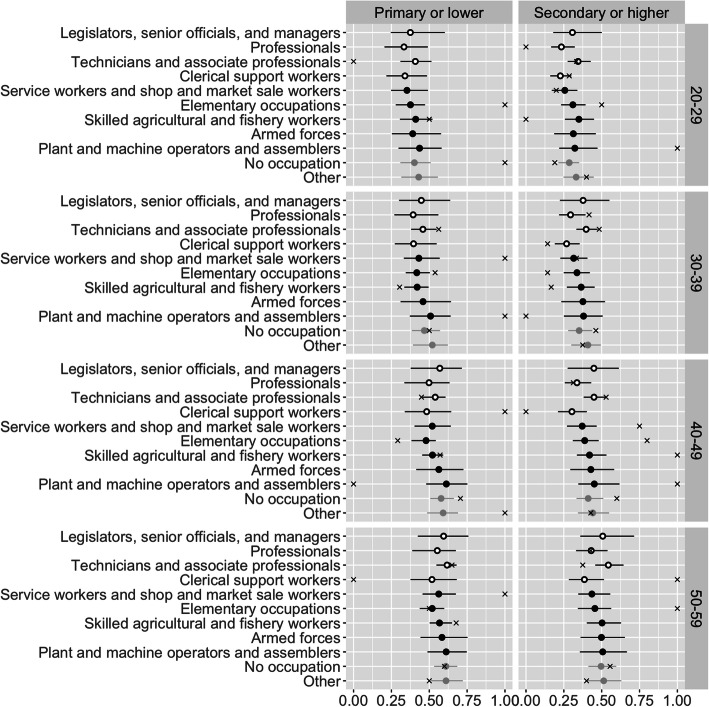
Results: There is no clear relationship between the overall sedentary nature of occupations and obesity. Instead, obesity appears to vary occupation by occupation. For instance, women in professional occupations, and men who are agricultural or fishery workers, have relatively low rates of obesity.
Conclusion: Bayesian hierarchical models plus post-stratification offers new possibilities for using surveys to learn about complex health issues.
Keywords: Bayesian hierarchical model; Obesity; Occupation; Small area estimation; Thailand.
Conflict of interest statement
The authors declare that they have no competing interests.
Figures


References
-
- National Statistical Office . Working trend of Thai labour. 2017.
-
- Howitt C, Brage S, Hambleton IR, Westgate K, Samuels TA, Rose AMC, et al. A cross-sectional study of physical activity and sedentary behaviours in a Caribbean population: combining objective and questionnaire data to guide future interventions. BMC Public Health. 2016;16:1036. doi: 10.1186/s12889-016-3689-2. - DOI - PMC - PubMed
-
- Cameron AJ, Welborn TA, Zimmet PZ, Dunstan DW, Owen N, Salmon J, et al. Overweight and obesity in Australia: the 1999–2000 Australian diabetes, obesity and lifestyle study (Ausdiab) MJA. 2003;178:427–432. - PubMed
MeSH terms
LinkOut - more resources
Full Text Sources
Other Literature Sources
Medical
