


Spatial structure in migration routes maintained despite regional convergence among eastern populations of Swainson's Thrushes
- PMID: 33985582
- PMCID: PMC8117314
- DOI: 10.1186/s40462-021-00263-9
Spatial structure in migration routes maintained despite regional convergence among eastern populations of Swainson's Thrushes
Abstract
Background: Migratory connectivity links the different populations across the full cycle and across the species range and may lead to differences in survival among populations. Studies on spatial and temporal migratory connectivity along migration routes are rare, especially for small migratory animals.
Methods: We used an automated radio-telemetry array to assess migratory connectivity en route and between early and later stages of the fall migration of the eastern populations of Swainson's Thrush, and to assess the variation of migration pace between consecutive detection from the different receiving stations along the migratory journey. We tracked 241 individuals from across eastern Canada to determine if populations were mixing around the Gulf of Mexico. We also tested the influence of tagging longitude, latitude and age on migration pace.
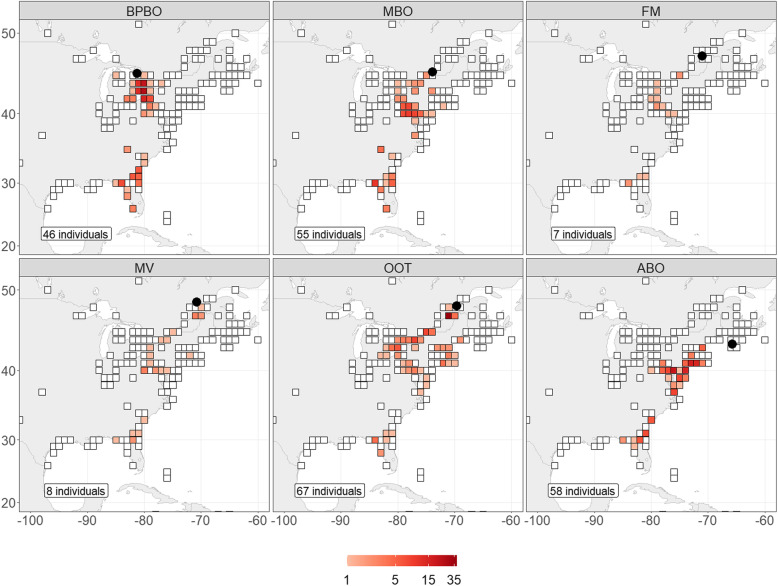
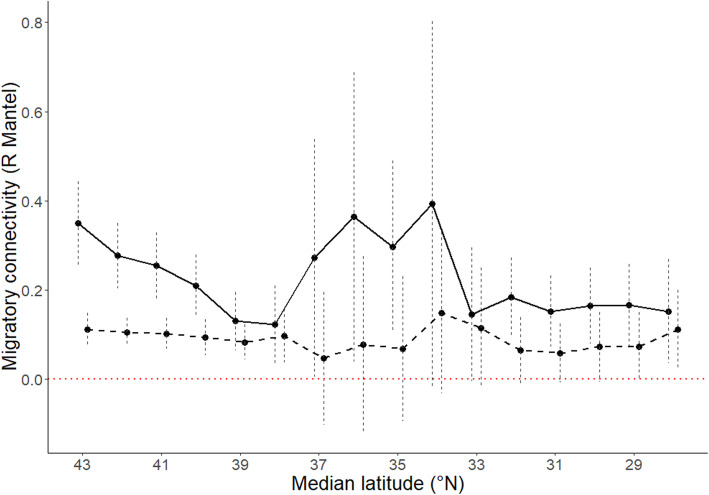
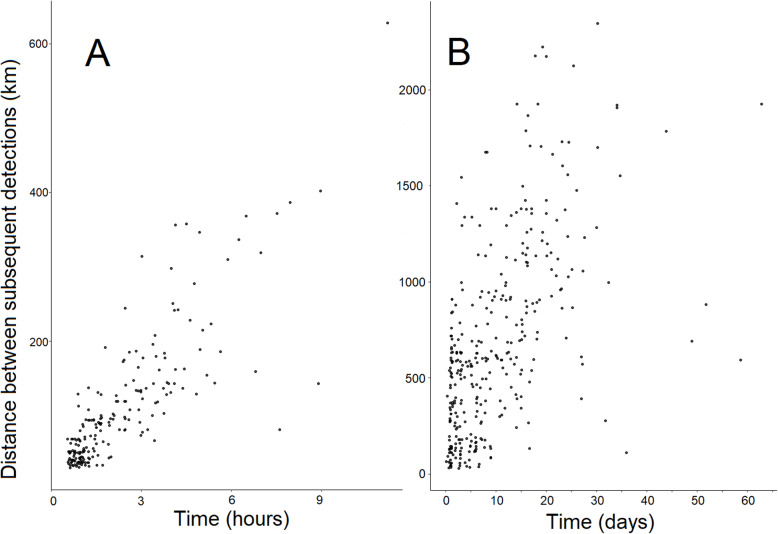
Results: Migration routes varied and converged towards the northeast coast of the Gulf of Mexico, but in this region, populations maintained finer-scale spatial structure. Migration pace increased as birds progressed south, independent of age and tagging site.
Conclusions: We showed that for songbirds, migratory connectivity can be maintained at fine spatial scales despite the regional convergence of populations, highlighting the importance of detailed spatial tracking for identification of population specific migration routes. Overall, our study provides a portrait of migratory movements of eastern Swainson's Thrush and a framework for understanding spatial structure in migration routes for other species.
Keywords: Migration pace; Migratory connectivity; Motus; Neotropical migrants; Radio-telemetry.
Conflict of interest statement
The authors declare that they have no competing interests.
Figures

References
-
- Anderson DR, Link WA, Johnson DH, Kenneth P. Suggestions for presenting the results of data analyses. J Wildl Manag. 2001;65(3):373–378. doi: 10.2307/3803088. - DOI
-
- Baldwin JW, Leap K, Finn JT, Smetzer JR. Bayesian state-space models reveal unobserved off-shore nocturnal migration from Motus data. Ecol Model. 2018;386:38–46. doi: 10.1016/j.ecolmodel.2018.08.006. - DOI
-
- Bayly NJ, Rosenberg KV, Easton WE, Gómez C, Carlisle J, Ewert DN, Drake A, Goodrich L. Major stopover regions and migratory bottlenecks for Nearctic-Neotropical landbirds within the Neotropics: a review. Bird Conserv Int. 2018;28(1):1–26. doi: 10.1017/S0959270917000296. - DOI
-
- Bégin-Marchand C, Desrochers A, Tremblay JA, Côté P. Comparing fall migration of three Catharus species using a radio-telemetry network (in press). Anim Migr. 2020;7(1):1–8. 10.1515/ami-2020-0001.
LinkOut - more resources
Full Text Sources
Other Literature Sources
Research Materials
