Randomized Controlled Trial
. 2021 May 13;9(1):107.
doi: 10.1186/s40168-021-01060-7.

Strain engraftment competition and functional augmentation in a multi-donor fecal microbiota transplantation trial for obesity

Affiliations
Randomized Controlled Trial

Strain engraftment competition and functional augmentation in a multi-donor fecal microbiota transplantation trial for obesity

Brooke C Wilson et al. Microbiome. .

Abstract

Background: Donor selection is an important factor influencing the engraftment and efficacy of fecal microbiota transplantation (FMT) for complex conditions associated with microbial dysbiosis. However, the degree, variation, and stability of strain engraftment have not yet been assessed in the context of multiple donors.

Methods: We conducted a double-blinded randomized control trial of FMT in 87 adolescents with obesity. Participants were randomized to receive multi-donor FMT (capsules containing the fecal microbiota of four sex-matched lean donors) or placebo (saline capsules). Following a bowel cleanse, participants ingested a total of 28 capsules over two consecutive days. Capsules from individual donors and participant stool samples collected at baseline, 6, 12, and 26 weeks post-treatment were analyzed by shotgun metagenomic sequencing allowing us to track bacterial strain engraftment and its functional implications on recipients' gut microbiomes.

Results: Multi-donor FMT sustainably altered the structure and the function of the gut microbiome. In what was effectively a microbiome competition experiment, we discovered that two donor microbiomes (one female, one male) dominated strain engraftment and were characterized by high microbial diversity and a high Prevotella to Bacteroides (P/B) ratio. Engrafted strains led to enterotype-level shifts in community composition and provided genes that altered the metabolic potential of the community. Despite our attempts to standardize FMT dose and origin, FMT recipients varied widely in their engraftment of donor strains.

Conclusion: Our study provides evidence for the existence of FMT super-donors whose microbiomes are highly effective at engrafting in the recipient gut. Dominant engrafting male and female donor microbiomes harbored diverse microbial species and genes and were characterized by a high P/B ratio. Yet, the high variability of strain engraftment among FMT recipients suggests the host environment also plays a critical role in mediating FMT receptivity.

Trial registration: The Gut Bugs trial was registered with the Australian New Zealand Clinical Trials Registry ( ACTRN12615001351505 ).

Trial protocol: The trial protocol is available at https://bmjopen.bmj.com/content/9/4/e026174 . Video Abstract.


Conflict of interest statement

The authors declare that they have no competing interests.

Figures
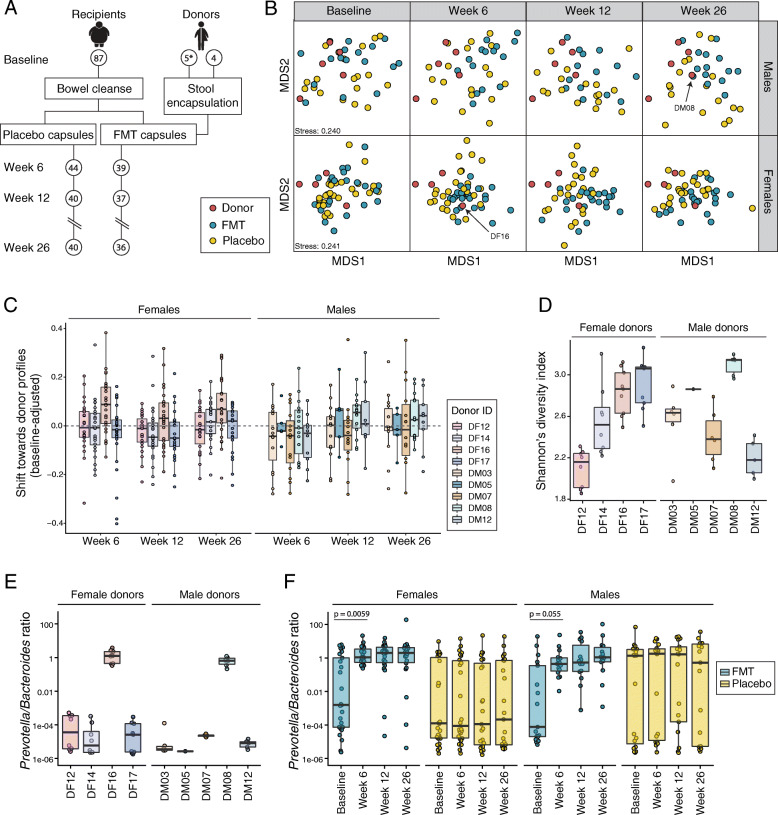
Fig. 1
Fig. 1
FMT led to prominent shifts in the gut microbiome composition towards particular donors. a Design of the Gut Bugs trial. Circles represent stool sample collection time points with corresponding participant numbers indicated. *One male donor was replaced during the trial; hence, 5 male donors were recruited. b Multidimensional scaling plots based on species-level Bray-Curtis dissimilarities, subset by sex and surveyed time point. Multiple samples from each donor, corresponding to each donation batch, were averaged to generate a composite donor profile. c Shifts in similarity of FMT recipients’ fecal metagenome to each contributing donor after adjusting for baseline similarity. d Alpha diversity of the gut microbiome of donors as measured by Shannon’s diversity index. Multiple points correspond to separate donations. e, f Prevotella/Bacteroides ratio of the gut microbiome of donors (e) and FMT and placebo recipients (f). Differences from baseline to week 6 were measured by Wilcoxon signed-rank test
Fig. 2
Fig. 2
Bacterial species of the gut microbiome whose relative abundance was altered post-FMT. Species are grouped according to whether they were enriched (top panel) or reduced (bottom panel) post-FMT and are listed in order of statistical significance from week 6 onwards (linear model, FDR adjusted q < 0.1). Relative abundances were log10-transformed with a small pseudo-count (1E-06) added to account for zero abundance values. A relative abundance < 0.0001% signifies that the species did not pass the minimum threshold abundance level for quantification. Each cell represents the mean transformed relative abundance for a specific species according to the grouping variable; “All” combines male and female averages, while “Females” and “Males” allow species abundances to be subset by sex and contributing donors. Placebo recipient profiles are not displayed, as no bacterial species in their gut microbiome were significantly altered throughout the course of the study.
Fig. 3
Fig. 3
Strain profiling reveals a variety of competition dynamics for conspecific microbial strains. a Phylogenetic tree of different Bacteroides faecis strains, one of the species enriched post-FMT. Bacteroides faecis strains were present in 138 fecal metagenomes as determined by SNP haplotyping. Scale bar signifies difference in sequence similarity between SNP haplotypes. b Distribution of median normalized DNA distances for conspecific strain pairs. Recipient strains (pre-FMT, post-FMT, and placebo) were compared against donor strains from the corresponding treatment batch. Because we had multiple stool samples for each donor, we also compared intra-donor strains (plotted in red). This allowed us to set a universal strain threshold of 0.2 median normalized DNA distance for calling identical strains, as indicated by the vertical dashed line. c Proportions of strains identified as being either unique to recipient (matching recipient’s baseline strain) or unique to donors (matching any of the contributing donor strains). Strains that were newly detected, or that did not match the recipient’s baseline strain or any contributing donor strains were designated as “Novel”. d Proportion of longitudinal strain profiling scenarios by treatment group. Differences between FMT and placebo proportions for each scenario were tested by proportion test with significance denoted by *p < 0.05, ***p < 0.0005, n.s. not significant
Fig. 4
Fig. 4
Inter-individual variability in donor strain engraftment. a Proportion of donor-engrafted strains in recipients at each post-treatment timepoint. Data points represent recipient fecal metagenome samples. b Engraftment efficiency of donors represents the proportion of strains within the donor’s fecal metagenome that engrafted among FMT recipients, detected at week 6. c Donor-specific contributions to overall strain engraftment in FMT recipients
Fig. 5
Fig. 5
FMT-engrafting strains altered the metabolic capacity of the gut microbiome. a Bacterial metabolic pathways in the gut microbiome found to be differentially abundant between FMT and placebo recipients at week 6 (linear model, FDR adjusted q < 0.2). b Heatmap displaying UniRef90 gene families belonging to the nicotinamide adenine dinucleotide (NAD) biosynthesis from aspartate pathway that were gained (red cells) by female FMT recipients at week 6 (i.e., were not present at baseline). Placebo recipient data were included to differentiate between environmental gain (gene families likely acquired from common species within the environment) and FMT-specific gain (gene families likely acquired from a donor-engrafting species)

References

    1. Jayasinghe TN, Chiavaroli V, Holland DJ, Cutfield WS, O’Sullivan JM. The new era of treatment for obesity and metabolic disorders: evidence and expectations for gut microbiome transplantation. Front Cell Infect Microbiol. 2016;6:15. doi: 10.3389/fcimb.2016.00015. - DOI - PMC - PubMed
    1. Ridaura VK, Faith JJ, Rey FE, Cheng J, Duncan AE, Kau AL, Griffin NW, Lombard V, Henrissat B, Bain JR, Muehlbauer MJ, Ilkayeva O, Semenkovich CF, Funai K, Hayashi DK, Lyle BJ, Martini MC, Ursell LK, Clemente JC, van Treuren W, Walters WA, Knight R, Newgard CB, Heath AC, Gordon JI. Gut microbiota from twins discordant for obesity modulate metabolism in mice. Science. 2013;341(6150):1241214. doi: 10.1126/science.1241214. - DOI - PMC - PubMed
    1. Liou AP, Paziuk M, Luevano J-M, Machineni S, Turnbaugh PJ, Kaplan LM. Conserved shifts in the gut microbiota due to gastric bypass reduce host weight and adiposity. Sci Transl Med. 2013;5(178):178ra41. doi: 10.1126/scitranslmed.3005687. - DOI - PMC - PubMed
    1. Turnbaugh PJ, Ley RE, Mahowald MA, Magrini V, Mardis ER, Gordon JI. An obesity-associated gut microbiome with increased capacity for energy harvest. Nature. 2006;444(7122):1027–1131. doi: 10.1038/nature05414. - DOI - PubMed
    1. Yu EW, Gao L, Stastka P, Cheney MC, Mahabamunuge J, Torres Soto M, et al. Fecal microbiota transplantation for the improvement of metabolism in obesity: the FMT-TRIM double-blind placebo-controlled pilot trial. PLOS Med. 2020;17(3):e1003051. doi: 10.1371/journal.pmed.1003051. - DOI - PMC - PubMed

Publication types

LinkOut - more resources
