


Long-term exposure to ambient fine particulate matter originating from traffic and residential wood combustion and the prevalence of depression
- PMID: 33985992
- PMCID: PMC8515112
- DOI: 10.1136/jech-2021-216772
Long-term exposure to ambient fine particulate matter originating from traffic and residential wood combustion and the prevalence of depression
Abstract
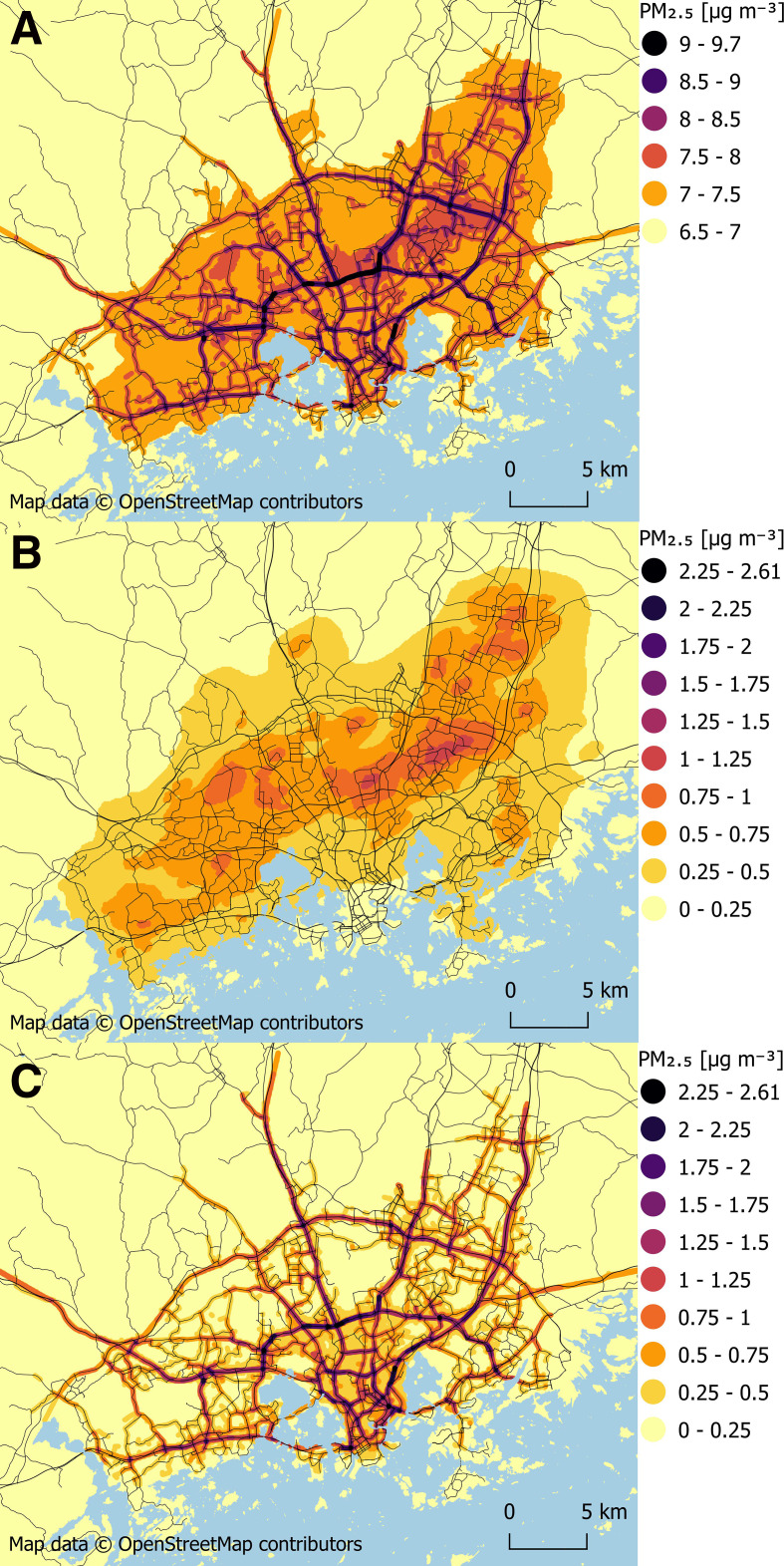
Introduction: Air pollution has been suggested to be associated with depression. However, current evidence is conflicting, and no study has considered different sources of ambient particulate matter with an aerodynamic diameter below 2.5 µm (PM2.5). We evaluated the associations of long-term exposure to PM2.5 from road traffic and residential wood combustion with the prevalence of depression in the Helsinki region, Finland.
Methods: We conducted a cross-sectional analysis based on the Helsinki Capital Region Environmental Health Survey 2015-2016 (N=5895). Modelled long-term outdoor concentrations of PM2.5 were evaluated using high-resolution emission and dispersion modelling on an urban scale and linked to the home addresses of study participants. The outcome was self-reported doctor-diagnosed or treated depression. We applied logistic regression and calculated the OR for 1 μg/m3 increase in PM2.5, with 95% CI. Models were adjusted for potential confounders, including traffic noise and urban green space.
Results: Of the participants, 377 reported to have been diagnosed or treated for depression by a doctor. Long-term exposure to PM2.5 from road traffic (OR=1.23, 95% CI 0.86 to 1.73; n=5895) or residential wood combustion (OR=0.78, 95% CI 0.43 to 1.41; n=5895) was not associated with the prevalence of depression. The estimates for PM2.5 from road traffic were elevated, but statistically non-significant, for non-smokers (OR=1.38, 95% CI 0.94 to 2.01; n=4716).
Conclusions: We found no convincing evidence of an effect of long-term exposure to PM2.5 from road traffic or residential wood combustion on depression.
Keywords: air pollution; depression; environmental health; traffic.
© Author(s) (or their employer(s)) 2021. Re-use permitted under CC BY-NC. No commercial re-use. See rights and permissions. Published by BMJ.
Conflict of interest statement
Competing interests: None declared.
Figures
References
-
- Fekadu N, Shibeshi W, Engidawork E. Major depressive disorder: pathophysiology and clinical management. J Depress Anxiety 2017;06:255–61. 10.4172/2167-1044.1000255 - DOI
Publication types
MeSH terms
Substances
LinkOut - more resources
Full Text Sources
Other Literature Sources
Medical
