


Risk factors for severity of COVID-19: a rapid review to inform vaccine prioritisation in Canada
- PMID: 33986052
- PMCID: PMC8126435
- DOI: 10.1136/bmjopen-2020-044684
Risk factors for severity of COVID-19: a rapid review to inform vaccine prioritisation in Canada
Abstract
Objectives: Rapid review to determine the magnitude of association between potential risk factors and severity of COVID-19, to inform vaccine prioritisation in Canada.
Setting: Ovid MEDLINE(R) ALL, Epistemonikos COVID-19 in L·OVE Platform, McMaster COVID-19 Evidence Alerts and websites were searched to 15 June 2020. Eligible studies were conducted in high-income countries and used multivariate analyses.
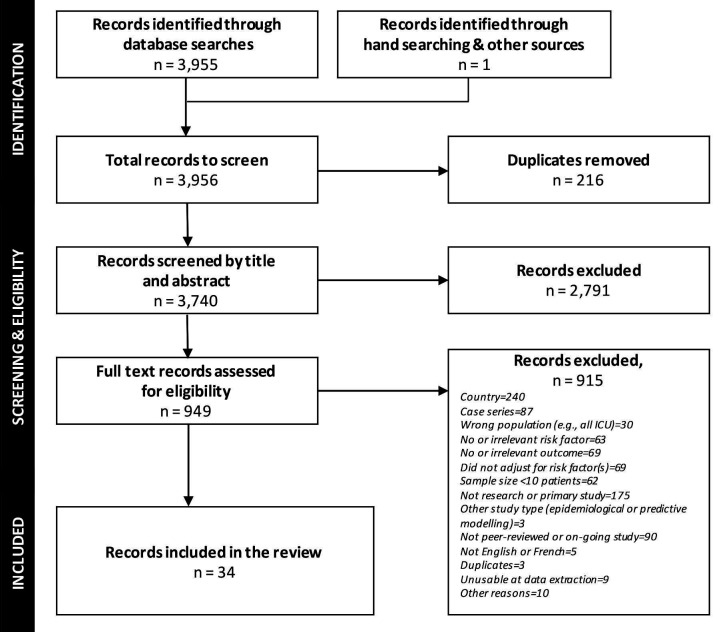
Participants: After piloting, screening, data extraction and quality appraisal were performed by a single experienced reviewer. Of 3740 unique records identified, 34 were included that reported on median 596 (range 44-418 794) participants, aged 42-84 years. 19/34 (56%) were good quality.
Outcomes: Hospitalisation, intensive care unit admission, length of stay in hospital or intensive care unit, mechanical ventilation, severe disease, mortality.
Results: Authors synthesised findings narratively and appraised the certainty of the evidence for each risk factor-outcome association. There was low or moderate certainty evidence for a large (≥2-fold) magnitude of association between hospitalisation in people with COVID-19, and: obesity class III, heart failure, diabetes, chronic kidney disease, dementia, age >45 years, male gender, black race/ethnicity (vs non-Hispanic white), homelessness and low income. Age >60 and >70 years may be associated with large increases in mechanical ventilation and severe disease, respectively. For mortality, a large magnitude of association may exist with liver disease, Bangladeshi ethnicity (vs British white), age >45 years, age >80 years (vs 65-69 years) and male gender among 20-64 years (but not older). Associations with hospitalisation and mortality may be very large (≥5-fold) for those aged ≥60 years.
Conclusions: Increasing age (especially >60 years) may be the most important risk factor for severe outcomes. High-quality primary research accounting for multiple confounders is needed to better understand the magnitude of associations for severity of COVID-19 with several other factors.
Prospero registration number: CRD42020198001.
Keywords: COVID-19; epidemiology; intensive & critical care; public health.
© Author(s) (or their employer(s)) 2021. Re-use permitted under CC BY-NC. No commercial re-use. See rights and permissions. Published by BMJ.
Conflict of interest statement
Competing interests: All authors have completed the ICMJE uniform disclosure form at www.icmje.org/coi_disclosure.pdf and declare: grants from the National Advisory Committee for Immunisation during the conduct of the study; no other relationships or activities that could appear to have influenced the submitted work. LH is supported by a Canada Research Chair in Knowledge Synthesis and Translation.
Figures
References
-
- World Health Organization . Naming the coronavirus disease (COVID-19) and the virus that causes it, 2020. Available: https://www.who.int/emergencies/diseases/novel-coronavirus-2019/technica... [Accessed 31 Jul 2020].
-
- World Health Organization . Coronavirus disease 2019 (COVID-19): situation report - 51. Geneva, Switzerland: World Health Organization, 2020. https://www.who.int/docs/default-source/coronaviruse/situation-reports/2...
-
- World Health Organization . Coronavirus disease 2019 (COVID-19): weekly epidemiological update 17. Geneva, Switzerland: World Health Organization, 2020. https://www.who.int/publications/m/item/weekly-epidemiological-update-8-...
-
- Government of Canada . Coronavirus disease 2019 (COVID-19): epidemiology update. Ottawa, Canada: Government of Canada, 2020. https://health-infobase.canada.ca/src/data/covidLive/Epidemiological-sum...
Publication types
MeSH terms
Substances
LinkOut - more resources
Full Text Sources
Other Literature Sources
Medical
