


Salt tolerance of selected halophytes at the two initial growth stages for future management options
- PMID: 33986348
- PMCID: PMC8119488
- DOI: 10.1038/s41598-021-89462-3
Salt tolerance of selected halophytes at the two initial growth stages for future management options
Abstract
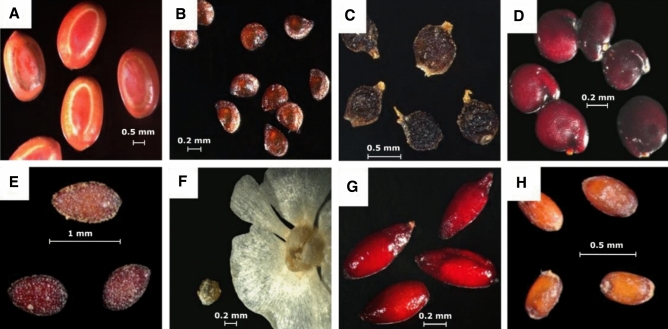
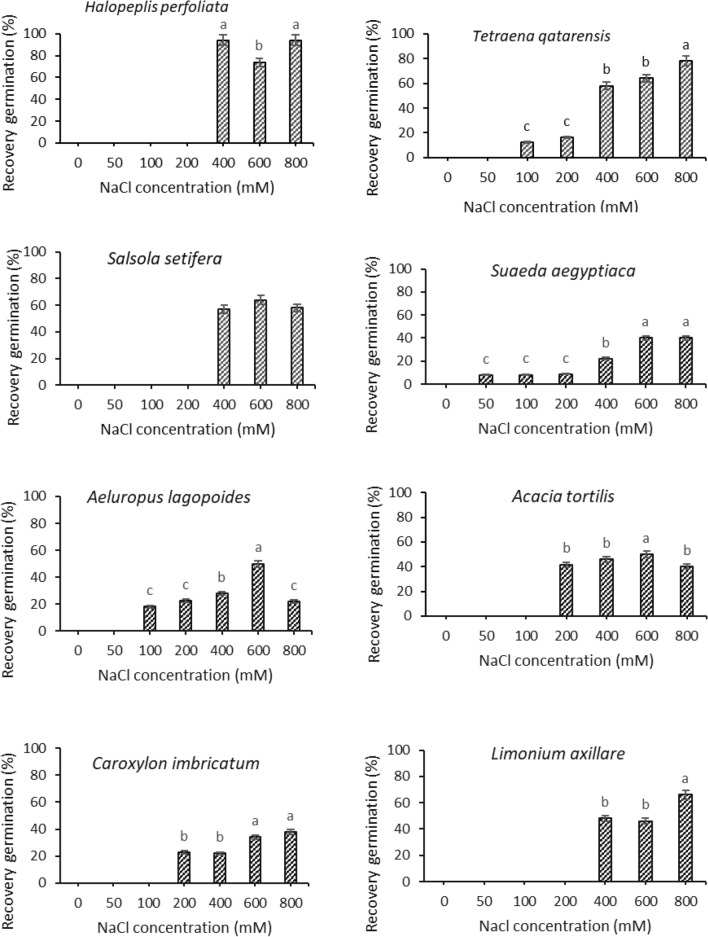
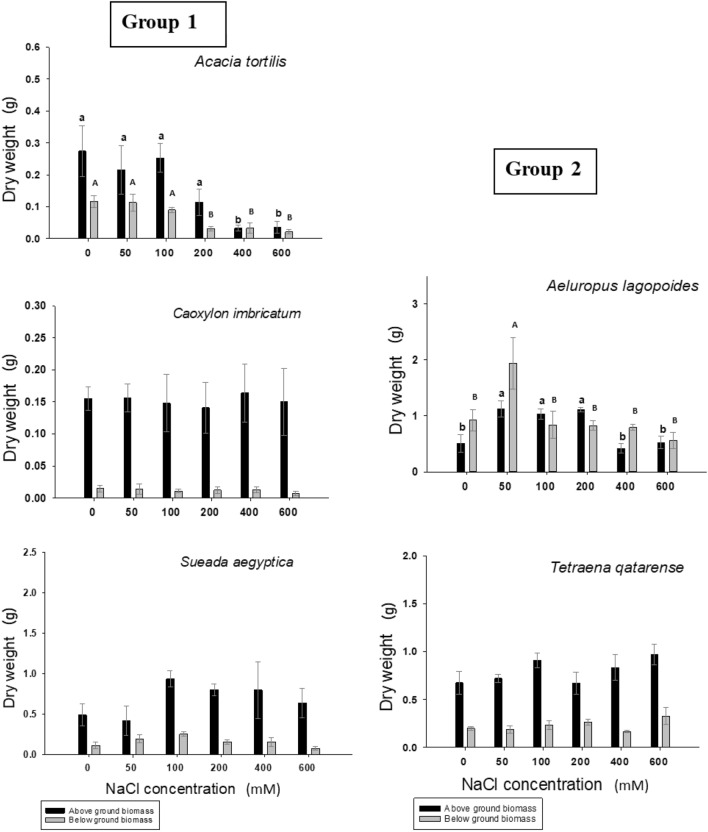
Scarcity of water and the small area of the agricultural land are considered as the crucial environmental issues challenged the Arabian Gulf countries. In this study, experiments were conducted to identify the salt tolerance during the germination and the seedling stages of some native halophytes in the State of Qatar. Seeds of eight native species (Salsola setifera, Halopeplis perfoliata, Caroxylon imbricatum, Suaeda aegyptiaca, Acacia tortilis, Limonium axillare, Tetraena qatarensis and Aeluropus lagopoides) were investigated. Except for Tetraena qatarensis, Acacia tortilis and Suaeda aegyptiaca, all achieved ≥ 30% of seed germination at a concentration of 200 mM NaCl. Around 30% of Salsola setifera seeds were able to germinate in a salt concentration of 400 mM. Germination recovery of seeds that have been treated with 800 mM NaCl for 3 weeks was the greatest for Halopeplis perfoliata (94%) and the lowest for Aeluropus lagopoides (22%). Five halophytes were investigated for seedling growth under saline irrigation ranged from 0 to 600 mM NaCl. No significant differences obtained in growth biomass of seedlings of each of Caroxylon imbricatum, Suaeda aegyptiaca and Tetraena qatarensis between saline and non-saline treatments.
Conflict of interest statement
The authors declare no competing interests.
Figures


References
-
- Flowers TJ, Hajibagheri MA, Clipson NJW. Halophytes. Q. Rev. Biol. 1986 doi: 10.1086/415032. - DOI
-
- Gallagher JL. Halophytic crops for cultivation at seawater salinity. Plant Soil. 1985;89:323–336. doi: 10.1007/BF02182251. - DOI
-
- Shaer EMH. Halophytes and salt-tolerant plants as potential forage for ruminants in the Near East region. Small Rumin. Res. 2010;91(1):3–12. doi: 10.1016/j.smallrumres.2010.01.010. - DOI
-
- Glenn EP, O’Leary JW. Productivity and irrigation requirements of halophytes grown with seawater in the Sonoran desert. J. Arid Environ. 1985;9:81–91. doi: 10.1016/S0140-1963(18)31273-4. - DOI
Publication types
LinkOut - more resources
Full Text Sources
Other Literature Sources
