. 2020 Jan;31(2):102-116.
doi: 10.1055/s-0039-1691501. Epub 2019 Nov 27.

Modifying Positional Selectivity in C-H Functionalization Reactions with Nitrogen-Centered Radicals: Generalizable Approaches to 1,6-Hydrogen-Atom Transfer Processes

Affiliations

Modifying Positional Selectivity in C-H Functionalization Reactions with Nitrogen-Centered Radicals: Generalizable Approaches to 1,6-Hydrogen-Atom Transfer Processes

Melanie A Short et al. Synlett. 2020 Jan.

Abstract

Nitrogen-centered radicals are powerful reaction intermediates owing in part to their ability to guide position-selective C(sp3)-H functionalization reactions. Typically, these reactive species dictate the site of functionalization by preferentially engaging in 1,5-hydrogen-atom transfer (1,5-HAT) processes. Broadly relevant approaches to alter the site-selectivity of HAT pathways would be valuable because they could be paired with a variety of tactics to install diverse functional groups. Yet, until recently, there have been no generalizable strategies to modify the position-selectivity observed in these HAT processes. This Synpacts article reviews transformations in which nitrogen-centered radicals preferentially react through 1,6-HAT pathways. Specific attention will be focused on strategies that employ alcohol- and amine-anchored sulfamate esters and sulfamides as templates to achieve otherwise rare γ-selective functionalization reactions.

Keywords: hydrogen-atom transfer; nitrogen-centered radicals; radicals; remote C–H functionalization; sulfamate ester; sulfamide.


Figures
Scheme 1
Scheme 1
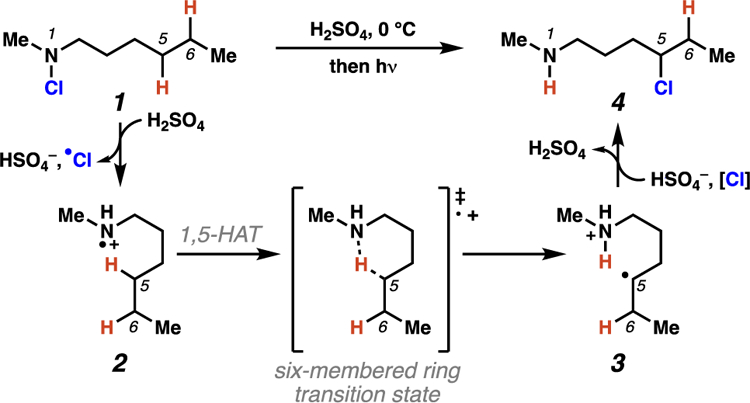
Traditionally, nitrogen-centered radicals react through kinetically favored 6-membered ring transition states resulting in 1,5-HAT processes.
Scheme 2
Scheme 2
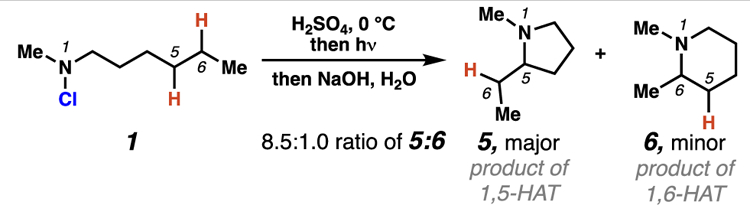
In 1960, E. J. Corey and Hertler determined that in some traditional HLF reactions, where position-selectivity arises predominantly from 1,5-HAT processes, minor products can form through 1,6-HAT processes.
Scheme 3
Scheme 3
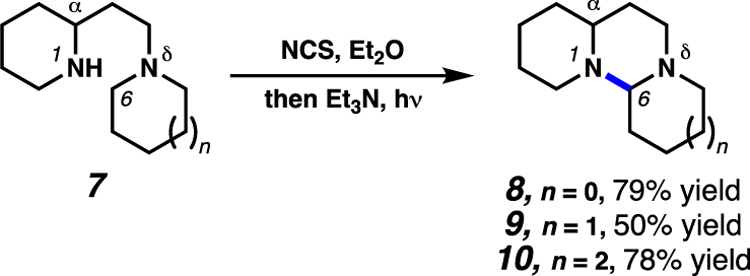
Ban and co-workers demonstrate that substrates lacking δ-C(sp3)–H bonds react through exclusive 1,6-HAT pathways.
Scheme 4
Scheme 4
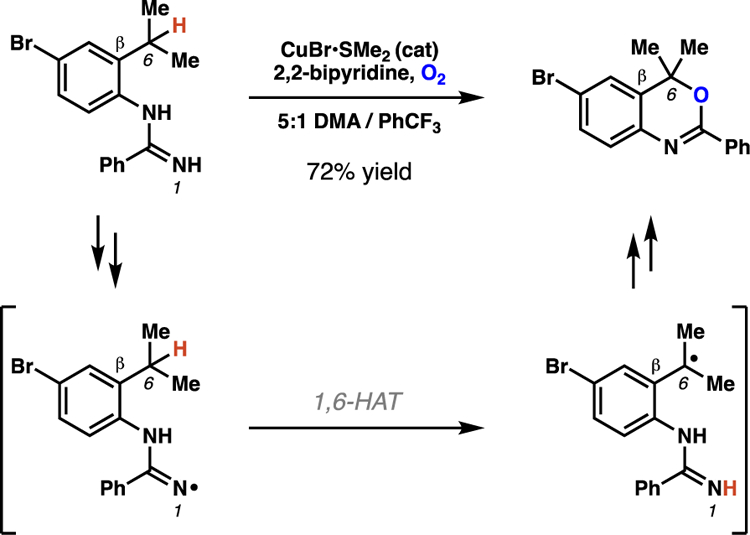
Chiba and co-workers describe amidinyl radicals reacting through 1,6-HAT pathways when no β-C(sp3)–H bonds are present for abstraction through 1,5-HAT processes.
Scheme 5
Scheme 5
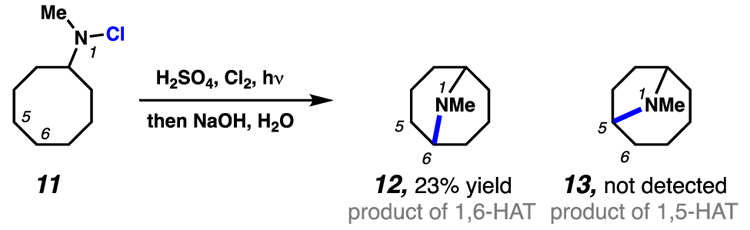
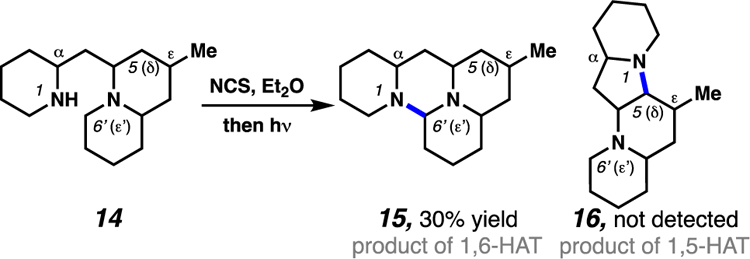
Wawzonek and Thelen demonstrate that 1,6-HAT pathways are operative when employing cycloalkylamine substrates where geometric constraints preclude 1,5-HAT processes.
Scheme 6
Scheme 6
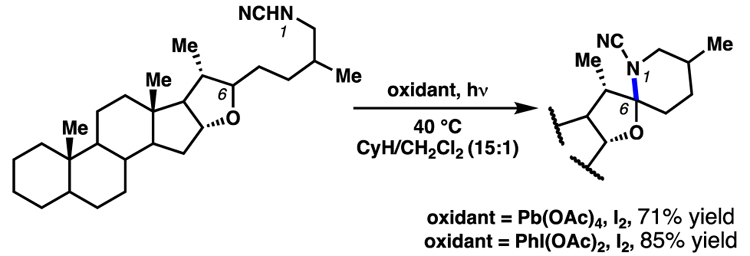
Heteroatoms can serve to weaken adjacent C(sp3)–H bonds as a strategy to enable exclusive 1,6-HAT reactivity.
Scheme 7
Scheme 7
Suárez and co-workers employ oxidants in the presence of iodine to generate nitrogen-centered radicals. These transformations rely on low C–H bond dissociation energies to achieve site-selective 1,6-HAT processes.
Scheme 8
Scheme 8
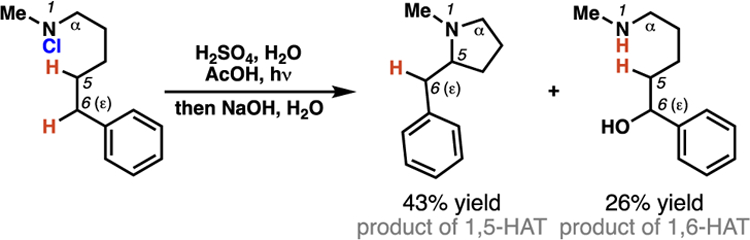
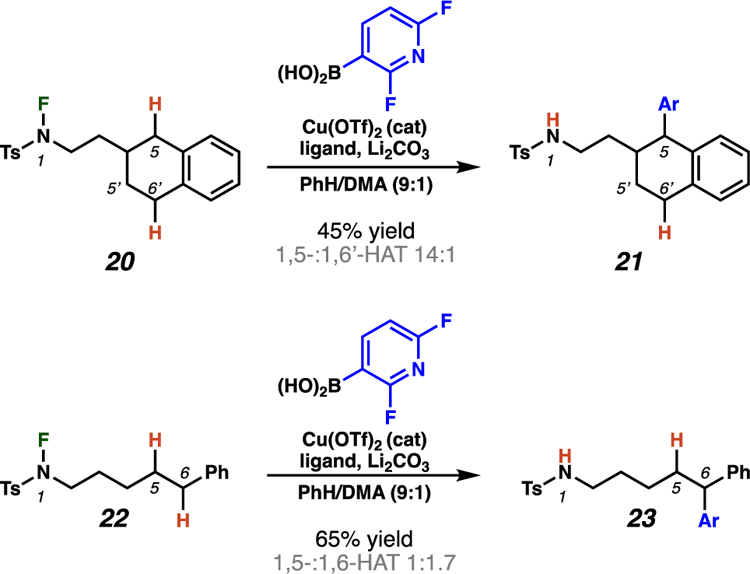
Neale et al. observed only a slight preference for 1,5-HAT pathways when weak, benzylic C–H bonds can be transformed through 1,6-HAT pathways.
Scheme 9
Scheme 9
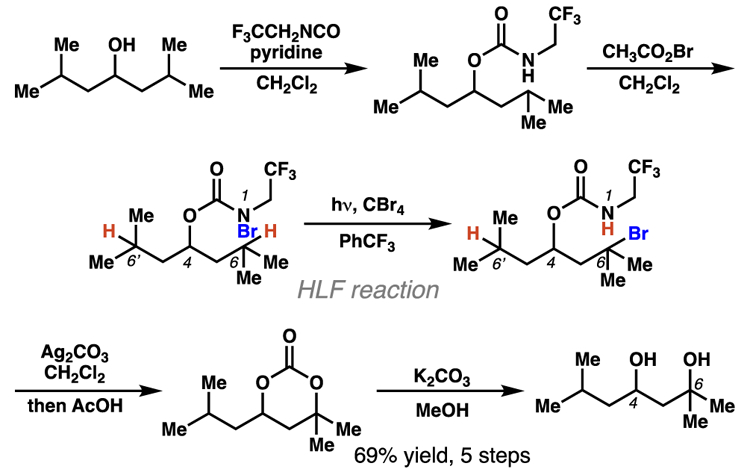
Baran and co-workers describe a multi-step sequence to prepare 1,3-diols. The key step relies on an HLF-type 1,6-HAT process to achieve the desired positional selectivity.
Scheme 10
Scheme 10
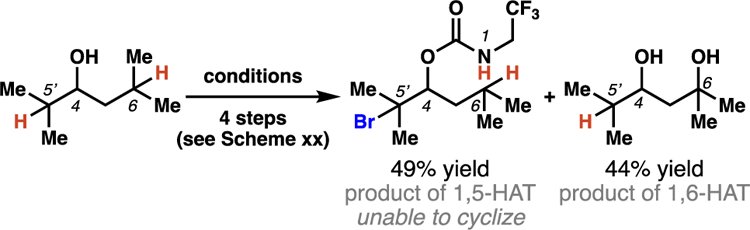
When Baran, et al. employ a substrate in which either 1,5- or 1,6-HAT processes can engage tertiary C–H bonds, both pathways proceed with nearly equivalent selectivity.
Scheme 11
Scheme 11
The system developed by Nagib and co-workers can preferentially engage 1,6-HAT pathways based on abstraction of weak, benzylic hydrogen atoms.
Scheme 12
Scheme 12
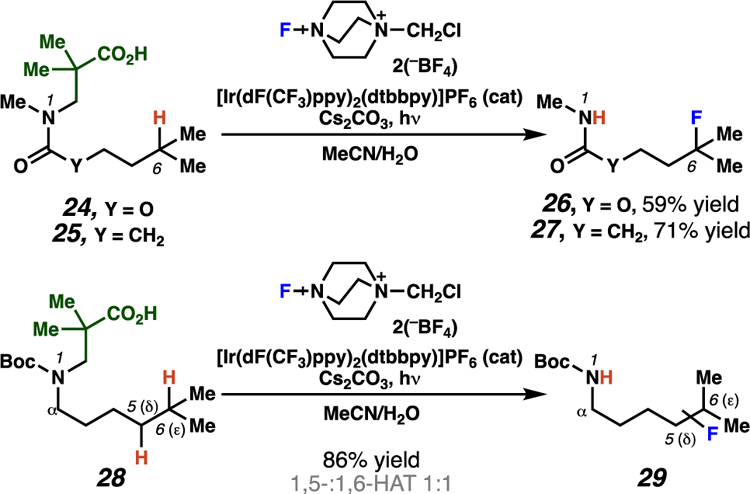
Leonori and co-workers provide examples of radical-mediated remote C–H fluorination reactions.
Scheme 13
Scheme 13
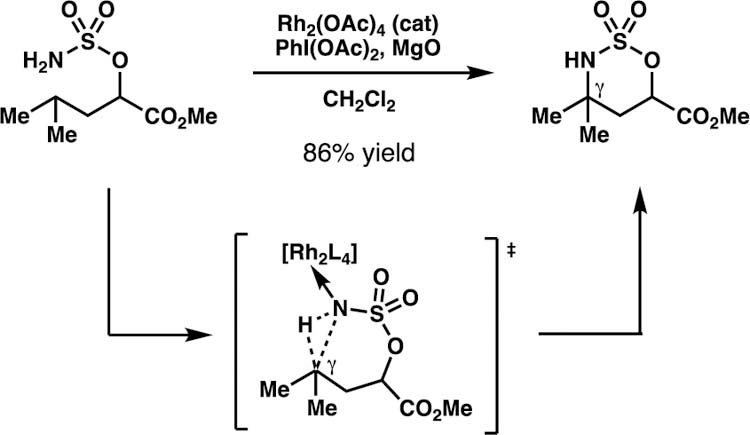
Rhodium-catalyzed intramolecular amination reactions inspired our idea that sulfamate esters might direct site-selective 1,6-HAT processes.
Scheme 14
Scheme 14
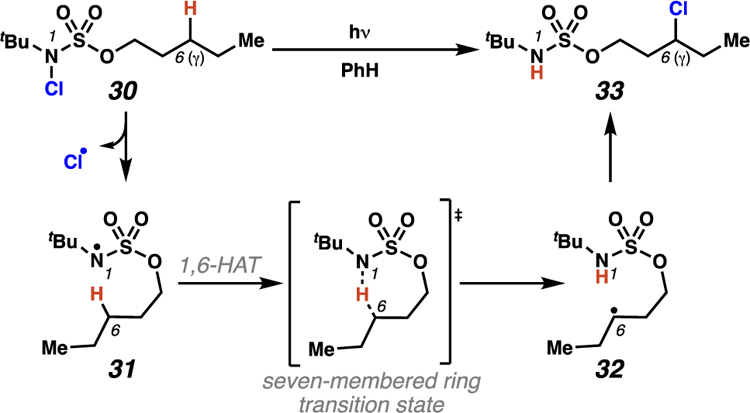
Sulfamate esters selectively engage in 1,6-HAT processes to chlorinate alkanes by a radical chain propagation mechanism.
Scheme 15
Scheme 15
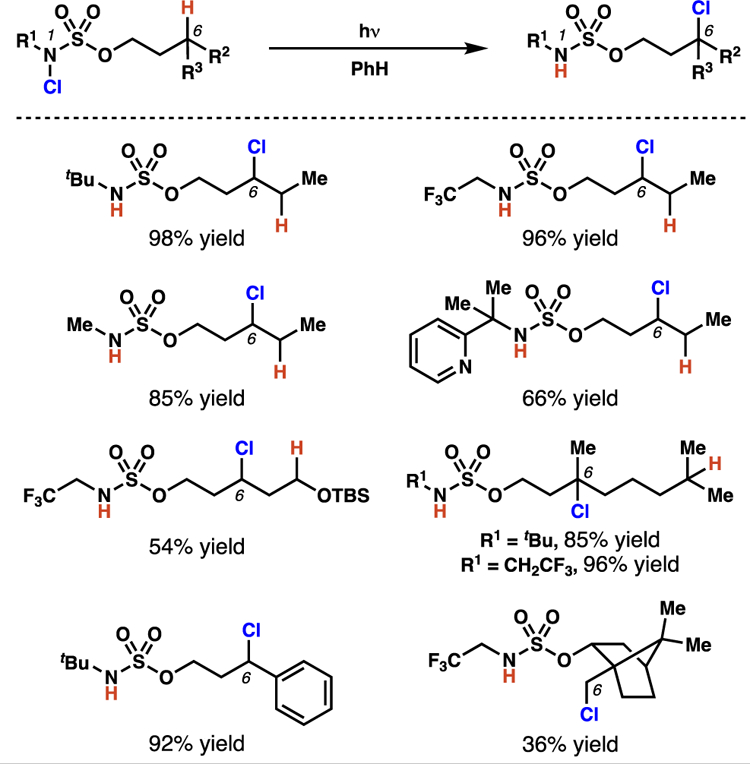
Sulfamate esters direct chlorine-transfer at primary, secondary, tertiary, and benzylic centers with site-selectivity that is complementary to that available based on innate selectivity.
Scheme 16
Scheme 16
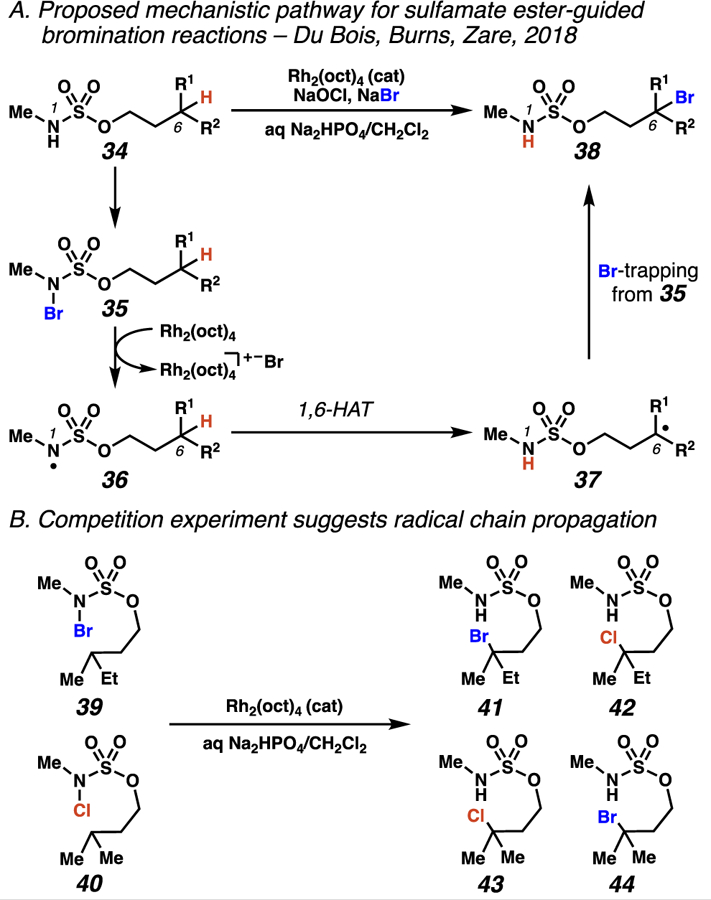
Du Bois, Burns, and Zare propose that sulfamate esters direct bromination based on a radical chain propagation mechanism (A), and use mass spectrometry and a crossover experiment (B) to support this claim.
Scheme 17
Scheme 17
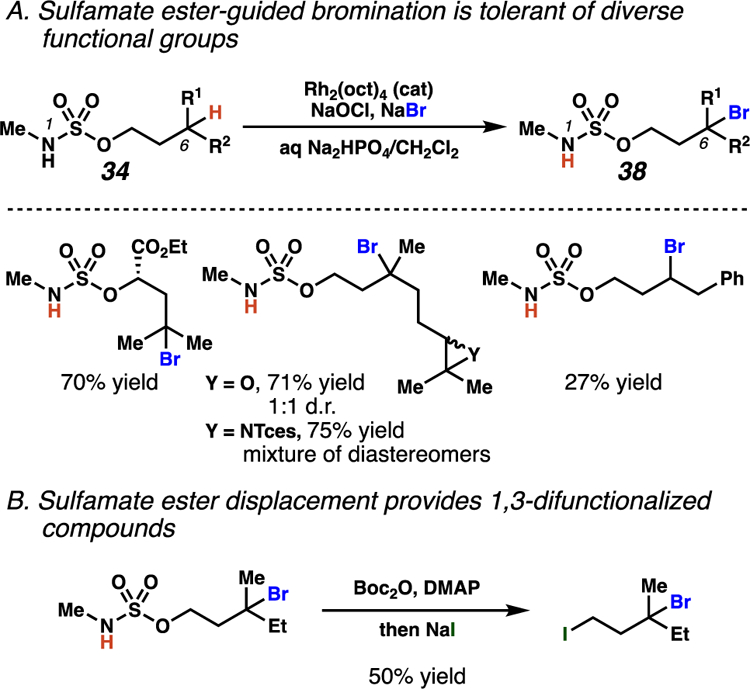
A. Sulfamate ester-directed, rhodium-mediated bromination is well-documented at tertiary centers and tolerates esters, epoxides, and aziridines. B. Subsequent sulfamate ester displacement furnishes 1,3-difunctionalized compounds.
Scheme 18
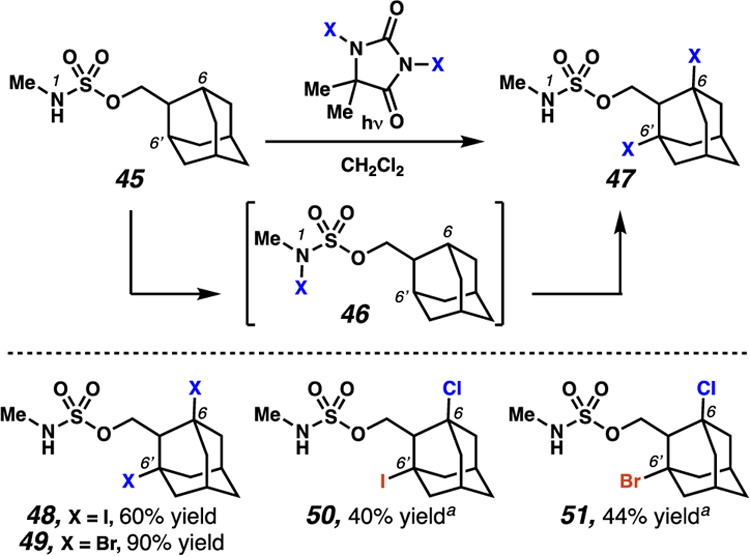
Scheme 18
Muñiz and co-workers confirm that sulfamate esters guide 1,6-HAT processes to achieve C–H halogenation, and invent protocol to dihalogenate alkanes. a Yields reported over 3 steps.
Scheme 19
Scheme 19
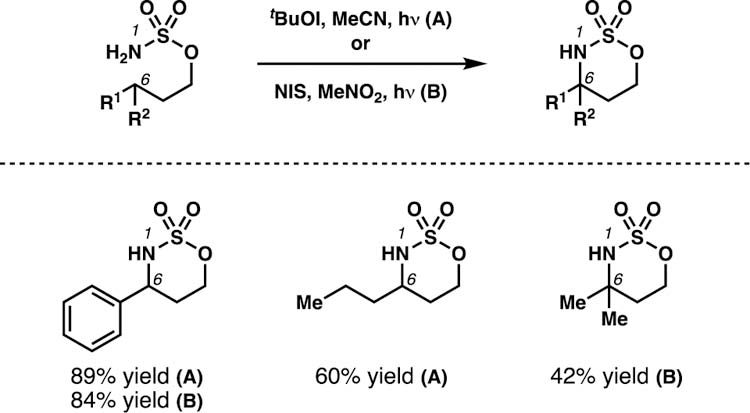
As an alternative to metal-mediated amination technologies, Minakata et al. have disclosed a protocol for sulfamate ester-guided amination promoted by electrophilic iodine oxidants.
Scheme 20
Scheme 20
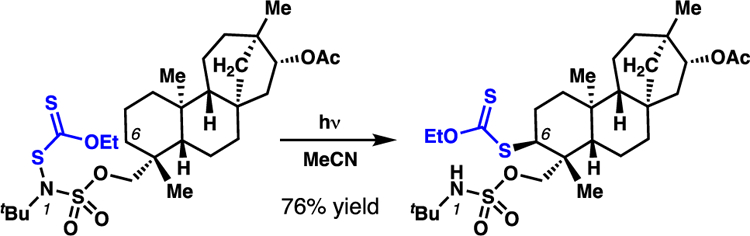
Sulfamate esters guide position-selective xanthate-transfer processes, even on structurally complex scaffolds.
Scheme 21
Scheme 21
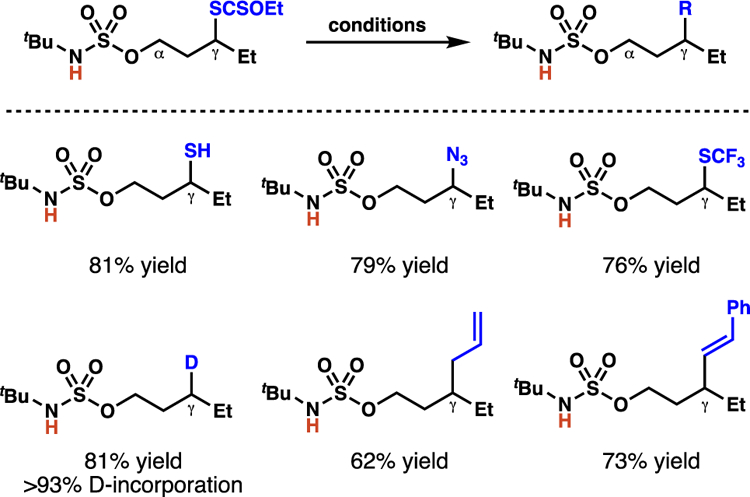
Alkyl xanthate products can undergo facile conversions to other functional motifs.
Scheme 22
Scheme 22
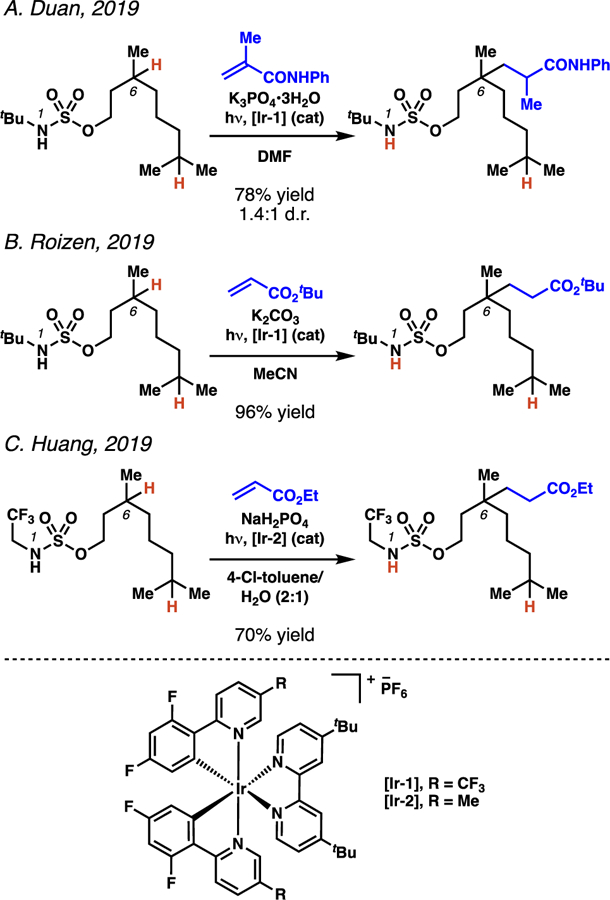
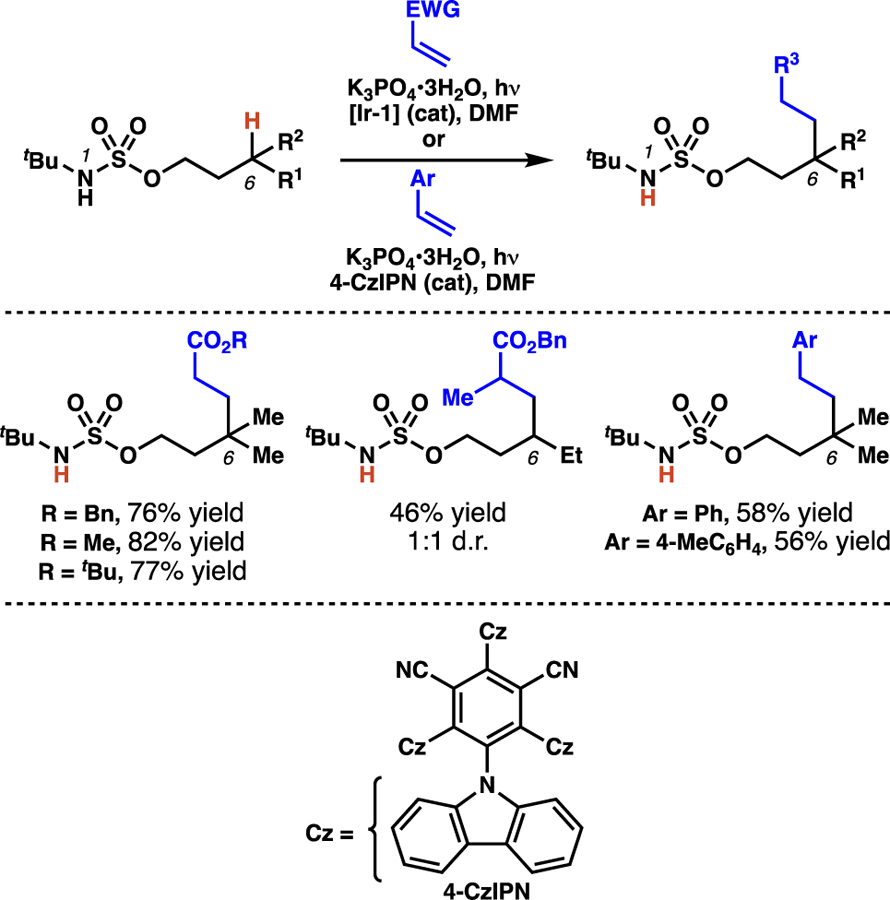
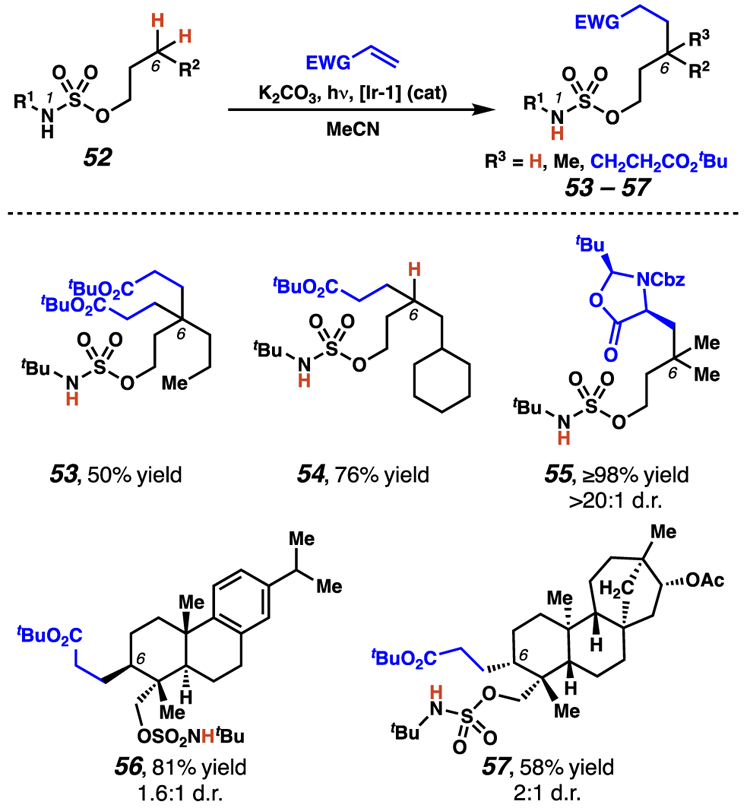
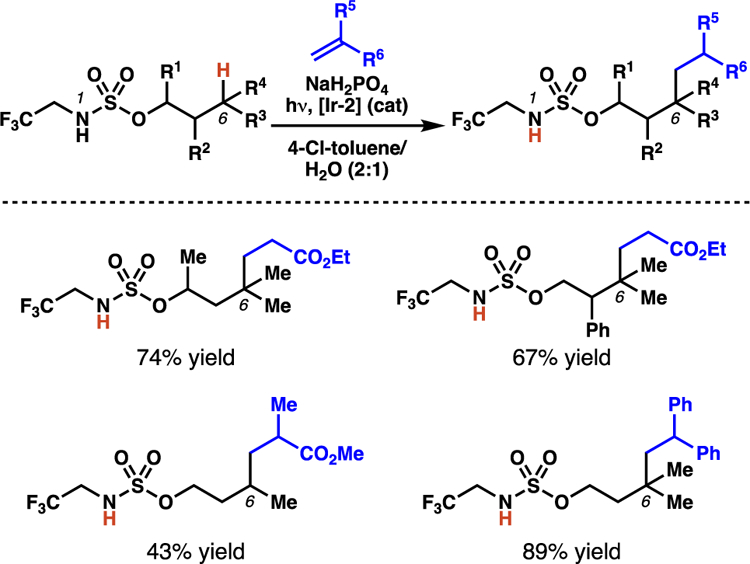
Representative examples of photocatalytic alkylation reactions guided by sulfamate esters.
Scheme 23
Scheme 23
Duan and co-workers show that, in addition to Michael acceptors, styrene derivatives are competent radical trapping agents in photoredox-mediated alkylation processes.
Scheme 24
Scheme 24
Roizen and co-workers interrogate the influence of steric encumbrance on alkylation at secondary centers.
Scheme 25
Scheme 25
Huang and co-workers employ trifluoromethyl sulfamate esters as templates for photoredox-mediated Giese reactions.
Scheme 26
Scheme 26
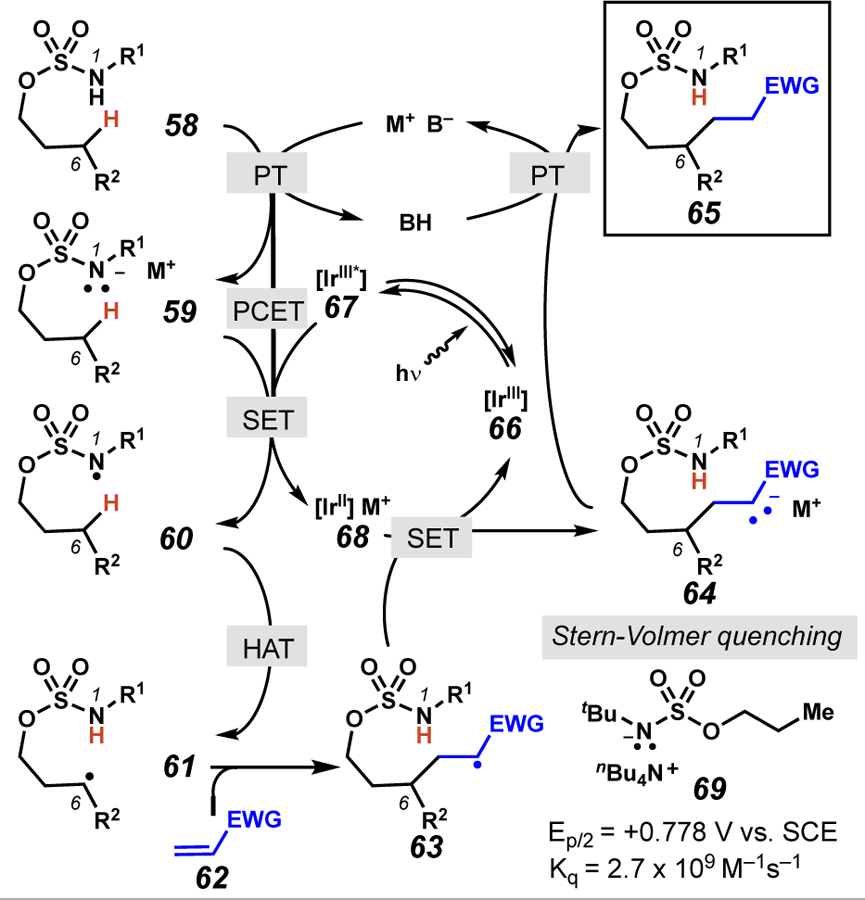
Plausible mechanistic pathways for photoredox-mediated alkylation reactions employing sulfamate ester substrates.
Scheme 27
Scheme 27
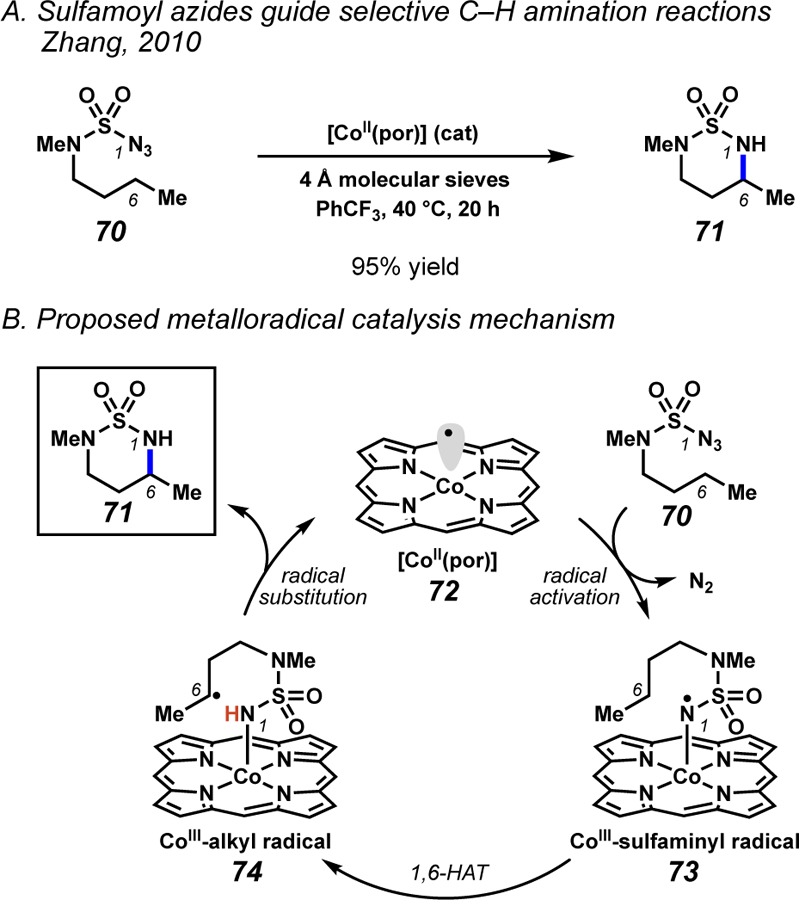
Zhang and co-workers have achieved position-selective C(sp3)–H amination reactions mediated by metalloradical 1,6-HAT processes.
Scheme 28
Scheme 28
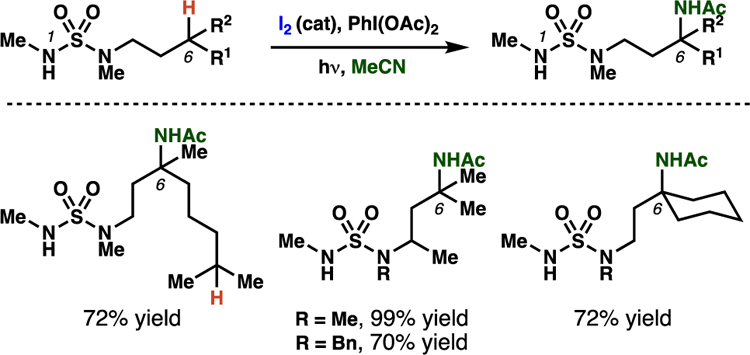
Select examples for the sulfamide-guided Ritter-type amination through an interrupted iodine-catalyzed HLF process reported by Muñiz and co-workers.
Scheme 29
Scheme 29
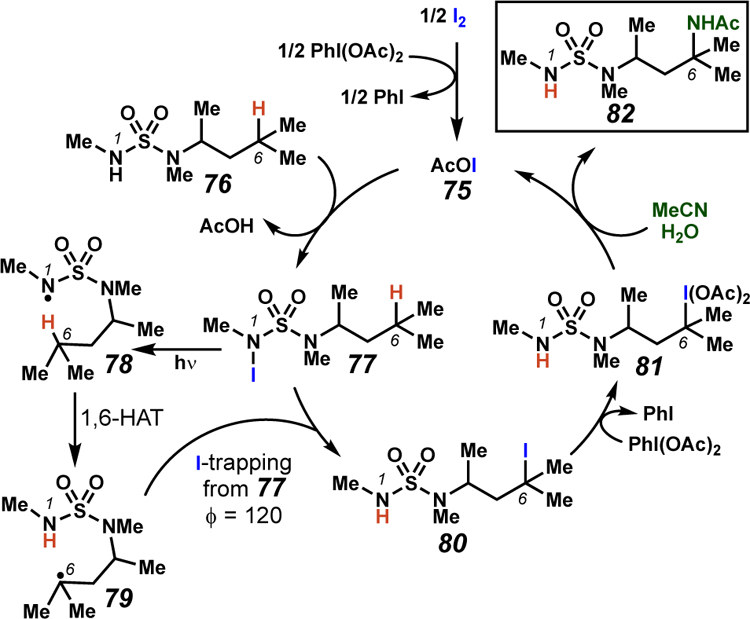
Plausible reaction mechanism for the interrupted HLF reaction employing sulfamide templates.
Scheme 30
Scheme 30
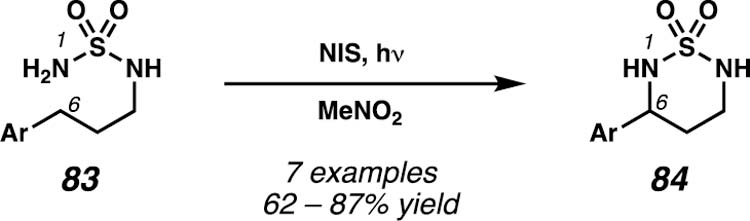
Minakata and co-workers demonstrate access to cyclic sulfamides through a metal-free approach with an electrophilic iodine oxidant.
Scheme 31
Scheme 31
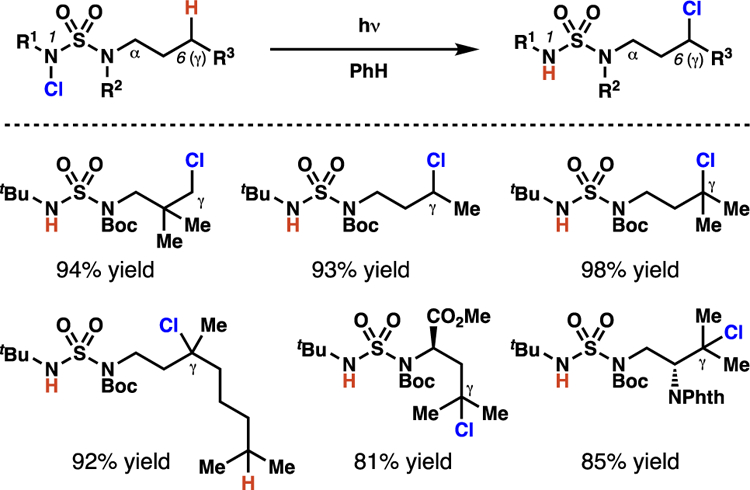
Sulfamides direct γ-selective chlorination of C(sp3)–H bonds.
Scheme 32
Scheme 32
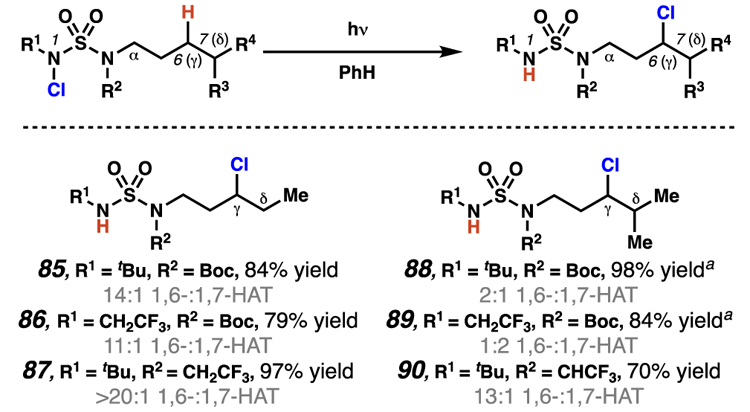
Selectivity can be modulated by the steric and electronic properties of sulfamide nitrogen substituents. Isolated yields of products from 1,6-HAT. a Isolated yields of mixture of 6- and 7-chlorinated products.

References

    1. For select reviews on C–H functionalization, see: Bergman RG Nature, 2007, 446, 391. - PubMed
    2. Davies HML; Manning JR Nature, 2008, 451, 417. - PMC - PubMed
    3. Lyons TW; Sanford MS Chem. Rev 2010, 110, 1147. - PMC - PubMed
    4. White MC Science, 2012, 335, 807. - PubMed
    5. He J; Wasa M; Chan KSL; Shao Q; Yu J-Q Chem. Rev 2017, 117, 8754. - PMC - PubMed
    6. Chu JCK; Rovis T Angew. Chem. Int. Ed 2018, 57, 62. - PMC - PubMed
    7. Karimov RR; Hartwig JF Angew. Chem. Int. Ed 2018, 57, 4234. - PMC - PubMed
    1. For a recent perspective, see: Yan M; Lo JC; Edwards JT; Baran PS J. Am. Chem. Soc 2016, 138, 12692. - PMC - PubMed
    1. For reviews focusing on the generation and use of nitrogen-centered radicals, see: Zard SZ Chem. Rev 2008, 108, 1603. - PubMed
    2. Kärkäs MD ACS Catal 2017, 7, 4999.
    3. Kärkäs MD Chem. Soc. Rev 2018, 47, 5786. - PubMed
    1. For recent, elegant innovations surrounding nitrogen-centered radicals in intermolecular C–H functionalization, see: Schmidt VA; Quinn RK; Brusoe AT; Alexanian EJ J. Am. Chem. Soc 2014, 136, 14389. - PubMed
    2. Quinn R; Könst Z; Michalak S; Schmidt Y; Szklarski A; Flores A; Nam S; Horne D; Vanderwal C; Alexanian EJ J. Am. Chem. Soc 2016. 138, 696. - PMC - PubMed
    3. Czaplyski WL; Na CG; Alexanian EJ J. Am. Chem. Soc 2016, 138, 13854. - PMC - PubMed
    4. Carestia AM; Ravelli D; Alexanian EJ Chem. Sci 2018, 9, 5360. - PMC - PubMed
    5. Tierney MM; Crespi S; Ravelli D; Alexanian EJ J. Org. Chem 2019, 84, 12983. - PMC - PubMed
    1. For a discussion of the fundamentals of HAT, see: Mayer JM. Acc. Chem. Res 2011, 44, 36. - PMC - PubMed
    2. For a recent review elaborating on the utility of HAT, see Capaldo L; Ravelli D Eur. J. Org. Chem, 2017, 2056–2071. - PMC - PubMed