Beneficial effects of an intergenerational exercise intervention on health-related physical and psychosocial outcomes in Swiss preschool children and residential seniors: a clinical trial
- PMID: 33987002
- PMCID: PMC8086583
- DOI: 10.7717/peerj.11292
Beneficial effects of an intergenerational exercise intervention on health-related physical and psychosocial outcomes in Swiss preschool children and residential seniors: a clinical trial
Abstract
Background: Intergenerational exercise possesses the potential to becoming an innovative strategy for promoting physical activity in seniors and children. Although this approach has gained attraction within the last decade, controlled trials on physical and psychosocial effects have not been performed yet.
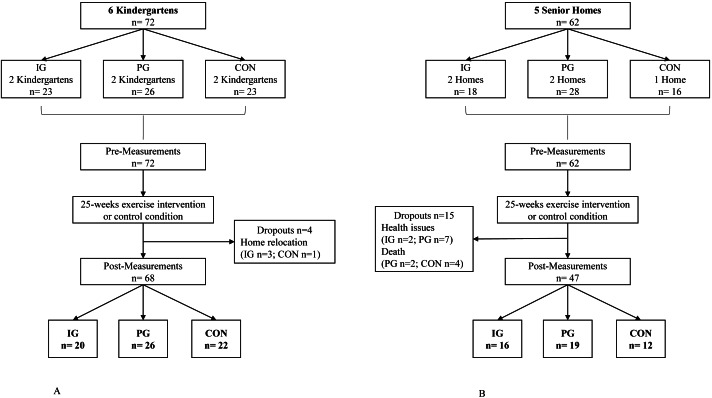
Methods: Sixty-eight healthy preschool children (age: 4.9 y (SD 0.7)) and 47 residential seniors (age: 81.7 y (7.1)) participated in this five-armed intervention study. All participants were assigned to either an intergenerational (IG), peer (PG) or a control group (CON). Children were tested on gross motor skills (TGMD-2), jump performance and handgrip strength. Social-emotional skills questionnaires (KOMPIK) were assessed by kindergarten teachers. Seniors performed the Short Physical Performance Battery (SPPB), including gait speed. Arterial stiffness parameters were also examined. Questionnaires assessing psychosocial wellbeing were filled in with staff. IG and PG received one comparable exercise session a week lasting 45 minutes for 25-weeks. CON received no intervention. Measurements were performed before and after the intervention.
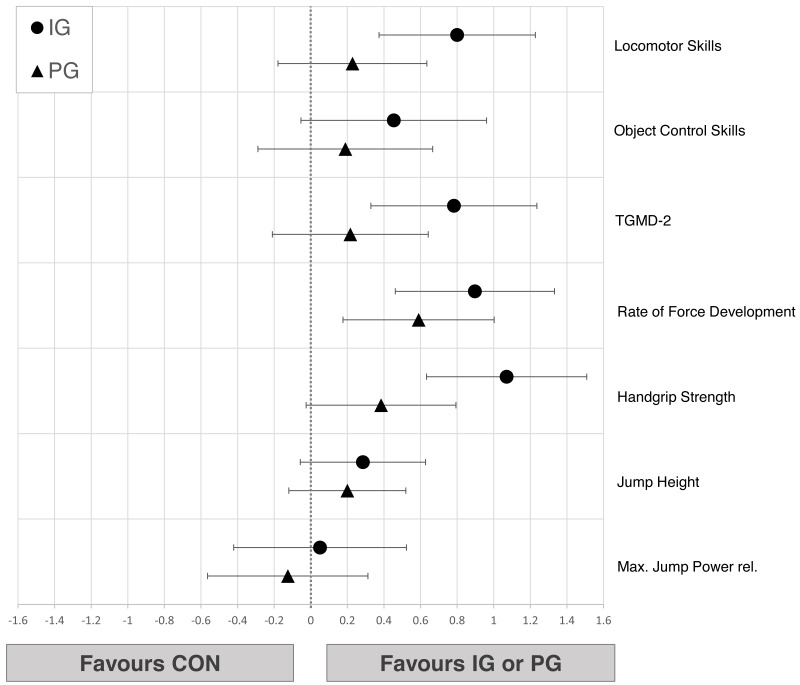
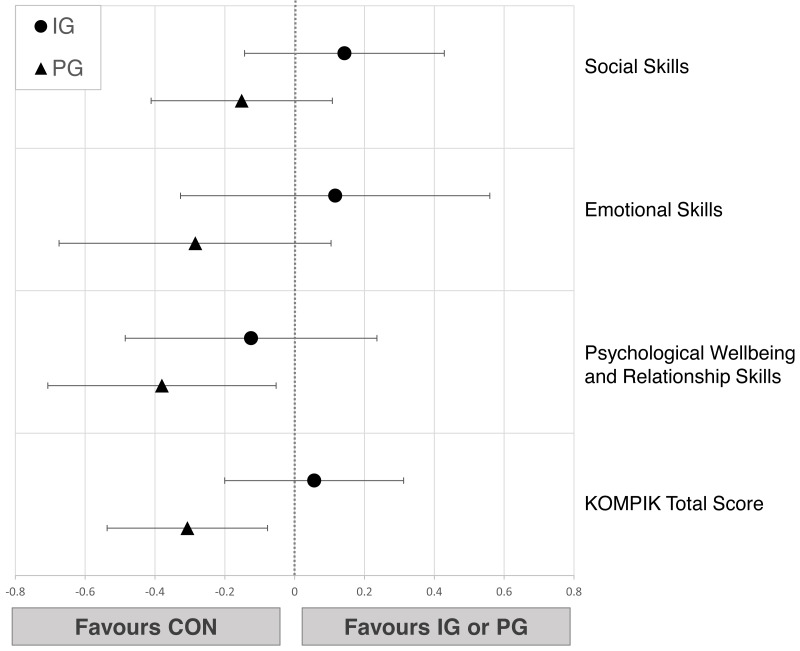
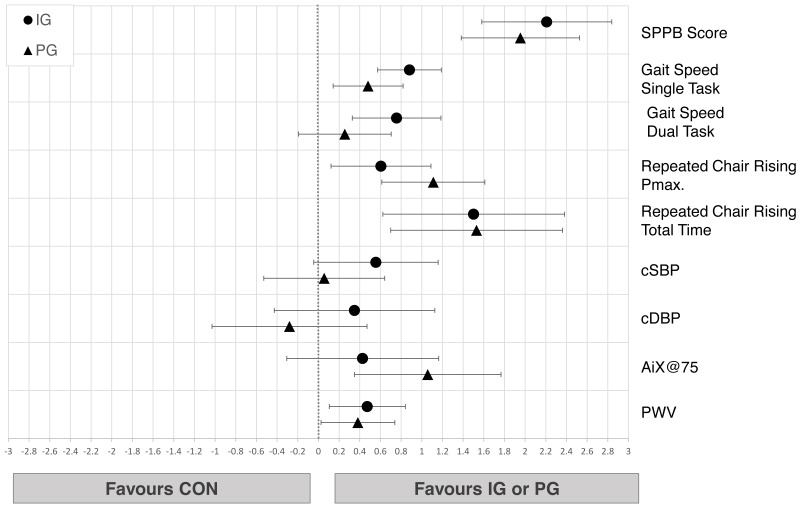
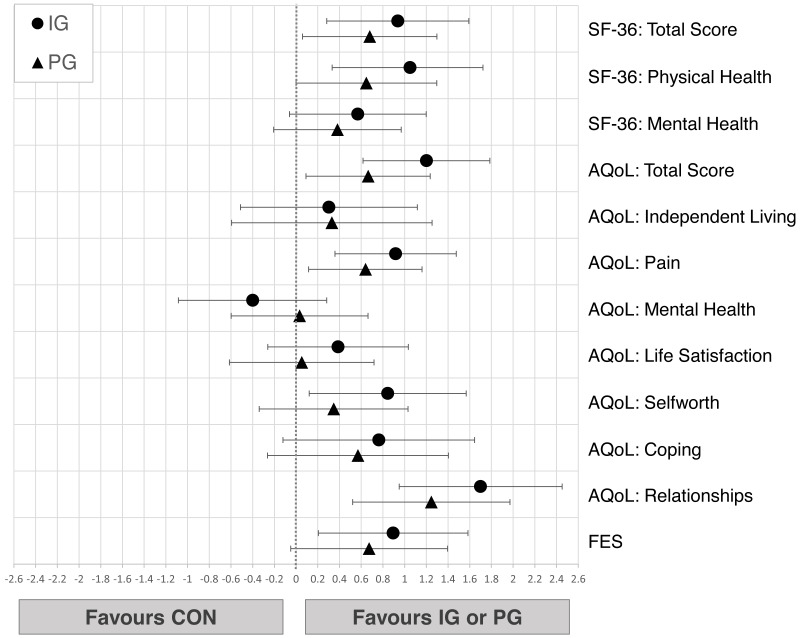
Results: In children: IG improved all measured physical parameters. When adjusted for baseline values, large effects were observed in favor of IG compared to CON in TGMD-2 (Cohen's d=0.78 [0.33;1.24]) and in handgrip strength (d = 1.07 [0.63;1.51]). No relevant differences were found in KOMPIK between groups (-0.38<d≤0.14). In seniors: IG showed moderate to very large improvements in all main physical performance (0.61<d≤2.53) and psychosocial parameters (0.89<d≤1.20) compared to CON.
Conclusion: IG children showed large benefits in motor skills compared to CON while IG seniors benefit especially in psychosocial wellbeing and functional mobility necessary for everyday life. Intergenerational exercise is comparable and in certain dimensions superior to peer group exercise and a promising strategy to integratively improve mental health as well as physical fitness in preschool children and residential seniors.
Keywords: Functionality; Homes of the elderly; Mental health; Physical performance; Quality of life; Social-emotional skills.
©2021 Minghetti et al.
Conflict of interest statement
The authors declare there are no competing interests.
Figures
Similar articles
-
Physical Performance, Cardiovascular Health and Psychosocial Wellbeing in Older Adults Compared to Oldest-Old Residential Seniors.Int J Environ Res Public Health. 2022 Jan 27;19(3):1451. doi: 10.3390/ijerph19031451. Int J Environ Res Public Health. 2022. PMID: 35162467 Free PMC article.
-
Effects of a cluster-randomized exercise intervention on cardiovascular health in preschoolers.J Child Health Care. 2023 Sep;27(3):424-434. doi: 10.1177/13674935221078368. Epub 2022 Mar 1. J Child Health Care. 2023. PMID: 35229675
-
Modification in the Motor Skills of Seniors in Care Homes Using Serious Games and the Impact of COVID-19: Field Study.JMIR Serious Games. 2022 May 10;10(2):e36768. doi: 10.2196/36768. JMIR Serious Games. 2022. PMID: 35536610 Free PMC article.
-
Effects of Virtual Reality Training (Exergaming) Compared to Alternative Exercise Training and Passive Control on Standing Balance and Functional Mobility in Healthy Community-Dwelling Seniors: A Meta-Analytical Review.Sports Med. 2016 Sep;46(9):1293-309. doi: 10.1007/s40279-016-0485-1. Sports Med. 2016. PMID: 26886474 Review.
-
An intergenerational approach in the promotion of balance and strength for fall prevention - a mini-review.Gerontology. 2011;57(4):304-15. doi: 10.1159/000320250. Epub 2010 Aug 19. Gerontology. 2011. PMID: 20720401 Review.
Cited by
-
Effects of 8 weeks of rhythmic physical activity on gross motor movements in 4-5-year-olds: A randomized controlled trial.J Exerc Sci Fit. 2024 Oct;22(4):456-462. doi: 10.1016/j.jesf.2024.10.001. Epub 2024 Oct 13. J Exerc Sci Fit. 2024. PMID: 39502159 Free PMC article.
-
Bridging Generations Through Movement: "How and Why" Intergenerational Programs Operate-A Systematic and Narrative Review.Geriatrics (Basel). 2024 Oct 22;9(6):139. doi: 10.3390/geriatrics9060139. Geriatrics (Basel). 2024. PMID: 39449376 Free PMC article. Review.
-
Factors Influencing Sport Persistence Along the Socio-Ecological Model-A Presentation of Sport Persistence Models Based on the Findings of a Representative Hungarian Sample.Sports (Basel). 2025 Mar 25;13(4):97. doi: 10.3390/sports13040097. Sports (Basel). 2025. PMID: 40278723 Free PMC article.
-
Barriers and facilitators to older adult participation in intergenerational physical activity program: a systematic review.Aging Clin Exp Res. 2024 Feb 12;36(1):39. doi: 10.1007/s40520-023-02652-z. Aging Clin Exp Res. 2024. PMID: 38345651 Free PMC article.
-
The Influence of Motor Competence on Broader Aspects of Health: A Systematic Review of the Longitudinal Associations Between Motor Competence and Cognitive and Social-Emotional Outcomes.Sports Med. 2024 Feb;54(2):375-427. doi: 10.1007/s40279-023-01939-5. Epub 2023 Nov 21. Sports Med. 2024. PMID: 37989831 Free PMC article.
References
-
- Abellan van Kan G, Rolland Y, Andrieu S, Bauer J, Beauchet O, Bonnefoy M, Cesari M, Donini LM, Gillette Guyonnet S, Inzitari M, Nourhashemi F, Onder G, Ritz P, Salva A, Visser M, Vellas B. Gait speed at usual pace as a predictor of adverse outcomes in community-dwelling older people an International Academy on Nutrition and Aging (IANA) Task Force. The Journal of Nutrition, Health & Aging. 2009;13:881–889. doi: 10.1007/s12603-009-0246-z. - DOI - PubMed
-
- Asheim GB, Tungodden B. Justifying, characterizing and indicating sustainability. Springer; Dordrecht: 2007. Resolving distributional conflicts between generations; pp. 53–62.
-
- Barbieri D, Zaccagni L. Strength training for children and adolescents: benefits and risks. Collegium Antropologicum. 2013;37(Suppl 2):219–225. - PubMed
-
- Baulmann J, Nürnberger J, Slany J, Schmieder R, Schmidt-Trucksass A, Baumgart D, Weber T. Arterielle Gefäzsteifigkeit und Pulswellenanalyse. DMW- Deutsche Medizinische Wochenschrift. 2010;135:4–14. - PubMed
-
- Beunen GTM. Muscular strength development in children and adolescents. Pediatric Exercise Science. 2000;12:174–197. doi: 10.1123/pes.12.2.174. - DOI
LinkOut - more resources
Full Text Sources