


Presenting artificial intelligence, deep learning, and machine learning studies to clinicians and healthcare stakeholders: an introductory reference with a guideline and a Clinical AI Research (CAIR) checklist proposal
- PMID: 33988081
- PMCID: PMC8519529
- DOI: 10.1080/17453674.2021.1918389
Presenting artificial intelligence, deep learning, and machine learning studies to clinicians and healthcare stakeholders: an introductory reference with a guideline and a Clinical AI Research (CAIR) checklist proposal
Abstract
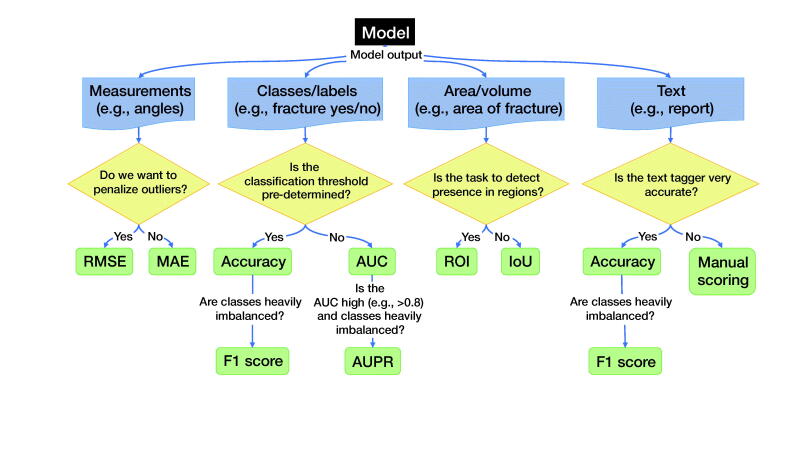
Background and purpose - Artificial intelligence (AI), deep learning (DL), and machine learning (ML) have become common research fields in orthopedics and medicine in general. Engineers perform much of the work. While they gear the results towards healthcare professionals, the difference in competencies and goals creates challenges for collaboration and knowledge exchange. We aim to provide clinicians with a context and understanding of AI research by facilitating communication between creators, researchers, clinicians, and readers of medical AI and ML research.Methods and results - We present the common tasks, considerations, and pitfalls (both methodological and ethical) that clinicians will encounter in AI research. We discuss the following topics: labeling, missing data, training, testing, and overfitting. Common performance and outcome measures for various AI and ML tasks are presented, including accuracy, precision, recall, F1 score, Dice score, the area under the curve, and ROC curves. We also discuss ethical considerations in terms of privacy, fairness, autonomy, safety, responsibility, and liability regarding data collecting or sharing.Interpretation - We have developed guidelines for reporting medical AI research to clinicians in the run-up to a broader consensus process. The proposed guidelines consist of a Clinical Artificial Intelligence Research (CAIR) checklist and specific performance metrics guidelines to present and evaluate research using AI components. Researchers, engineers, clinicians, and other stakeholders can use these proposal guidelines and the CAIR checklist to read, present, and evaluate AI research geared towards a healthcare setting.
Figures
References
-
- Adamson A S, Smith A.. Machine learning and health care disparities in dermatology. JAMA Dermatol 2018; 154(11): 1247. - PubMed
-
- Anderson P, Fernando B, Johnson M, Gould S. SPICE: Semantic Propositional Image Caption Evaluation. arXiv:160708822 [cs] [Internet] 2016. Jul 29 [cited 2020 Nov 30]. Available from: http://arxiv.org/abs/1607.08822
-
- Bandos A I, Obuchowski N A.. Evaluation of diagnostic accuracy in free-response detection-localization tasks using ROC tools. Stat Methods Med Res 2019; 28(6): 1808–25. - PubMed
-
- Banerjee S, Lavie A. METEOR: an automatic metric for mt evaluation with improved correlation with human judgments. In: Proceedings of the ACL Workshop on Intrinsic and Extrinsic Evaluation Measures for Machine Translation and/or Summarization [Internet]. Ann Arbor, MI: Association for Computational Linguistics; 2005. [cited 2020 Nov 30]. p. 65–72. Available from: https://www.aclweb.org/anthology/W05-0909
MeSH terms
LinkOut - more resources
Full Text Sources
Other Literature Sources