


Trends in U.S. Health Care Spending on Inflammatory Bowel Diseases, 1996-2016
- PMID: 33988697
- PMCID: PMC8889287
- DOI: 10.1093/ibd/izab074
Trends in U.S. Health Care Spending on Inflammatory Bowel Diseases, 1996-2016
Abstract
Background: Inflammatory bowel diseases (IBD) are rising in prevalence and are associated with high health care costs. We estimated trends in U.S. health care spending in patients with IBD between 1996 and 2016.
Methods: We used data on national health care spending developed by the Institute for Health Metrics and Evaluations for the Disease Expenditure Project. We estimated corresponding U.S. age-specific prevalence of IBD from the Global Burden of Diseases Study. From these 2 sources, we estimated prevalence-adjusted, temporal trends in U.S. health care spending in patients with IBD, stratified by age groups (<20 years, 20-44 years, 45-64 years, ≥65 years) and by type of care (ambulatory, inpatient, emergency department [ED], pharmaceutical prescriptions, and nursing care), using joinpoint regression, expressed as an annual percentage change (APC) with 95% confidence intervals.
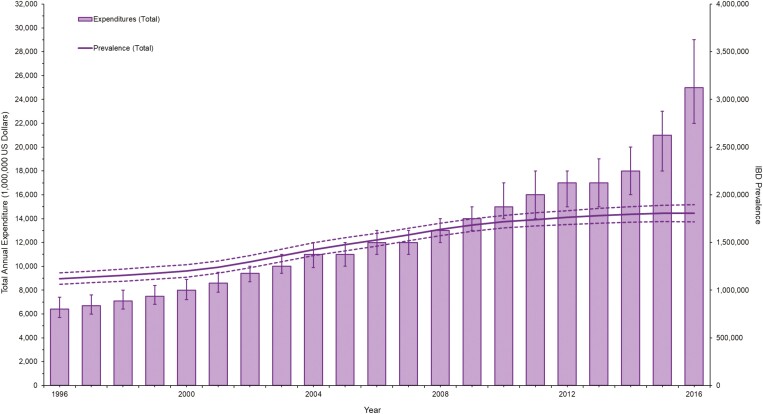
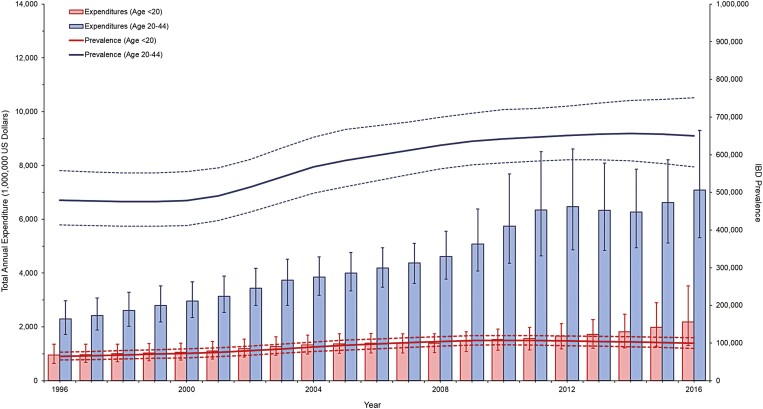
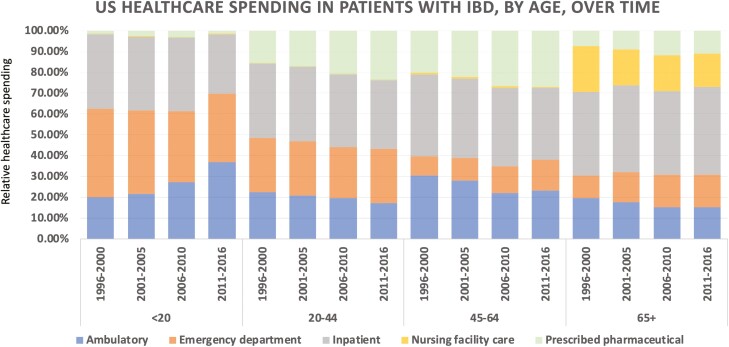
Results: Overall, annual U.S. health care spending on IBD increased from $6.4 billion (95% confidence interval, 5.7-7.4) in 1996 to $25.4 billion (95% confidence interval, 22.4-28.7) in 2016, corresponding to a per patient increase in annual spending from $5714 to $14,033. Substantial increases in per patient spending on IBD were observed in patients aged ≥45 years. Between 2011 and 2016, inpatient and ED care accounted for 55.8% of total spending and pharmaceuticals accounted for 19.9%, with variation across age groups (inpatient/ED vs pharmaceuticals: ages ≥65 years, 57.6% vs 11.2%; ages 45-64 years, 49.5% vs 26.9%; ages 20-44 years, 59.2% vs 23.6%).
Conclusions: Even after adjusting for rising prevalence, U.S. health care spending on IBD continues to progressively increase, primarily in middle-aged and older adults, with unplanned health care utilization accounting for the majority of costs.
Keywords: Crohn disease; colitis; costs; expenses; value-based care.
© 2021 Crohn’s & Colitis Foundation. Published by Oxford University Press. All rights reserved. For permissions, please e-mail: journals.permissions@oup.com.
Figures

References
-
- Dahlhamer JM, Zammitti EP, Ward BW, et al. Prevalence of inflammatory bowel disease among adults aged ≥18 years—United States, 2015. MMWR Morb Mortal Wkly Rep 2016;65:1166–1169. - PubMed
-
- Targownik LE, Kaplan GG, Witt J, et al. Longitudinal trends in the direct costs and health care utilization ascribable to inflammatory bowel disease in the biologic era: results from a Canadian population-based analysis. Am J Gastroenterol. 2020;115:128–137. - PubMed
-
- van der Valk ME, Mangen MJ, Leenders M, et al. ; COIN study group and the Dutch Initiative on Crohn and Colitis . Healthcare costs of inflammatory bowel disease have shifted from hospitalisation and surgery towards anti-TNFα therapy: results from the COIN study. Gut. 2014;63:72–79. - PubMed
Publication types
MeSH terms
Grants and funding
LinkOut - more resources
Full Text Sources
Other Literature Sources
Medical
