Pharmacotherapy for Attention-Deficit/Hyperactivity Disorder and Retention in Outpatient Substance Use Disorder Treatment: A Retrospective Cohort Study
- PMID: 33988929
- PMCID: PMC8351325
- DOI: 10.4088/JCP.20m13598
Pharmacotherapy for Attention-Deficit/Hyperactivity Disorder and Retention in Outpatient Substance Use Disorder Treatment: A Retrospective Cohort Study
Abstract
Objective: To assess the relationship between short- and longer-term retention in outpatient substance use disorder (SUD) treatment and pharmacotherapy for comorbid attention-deficit/hyperactivity disorder (ADHD).
Methods: In this retrospective cohort study conducted in a single addiction psychiatry clinic, electronic health record data from July 14, 2014, through January 15, 2020, were queried for clinical ADHD diagnosis (DSM-5 criteria), ADHD pharmacotherapy, treatment duration, demographic variables, comorbid psychiatric and SUD diagnoses, and buprenorphine therapy. Individuals with ADHD (n = 203) were grouped by ADHD pharmacotherapy status (171 receiving medication compared to 32 receiving none). Kaplan-Meier and Cox proportional hazards regression analyses were performed and assessed for significance.
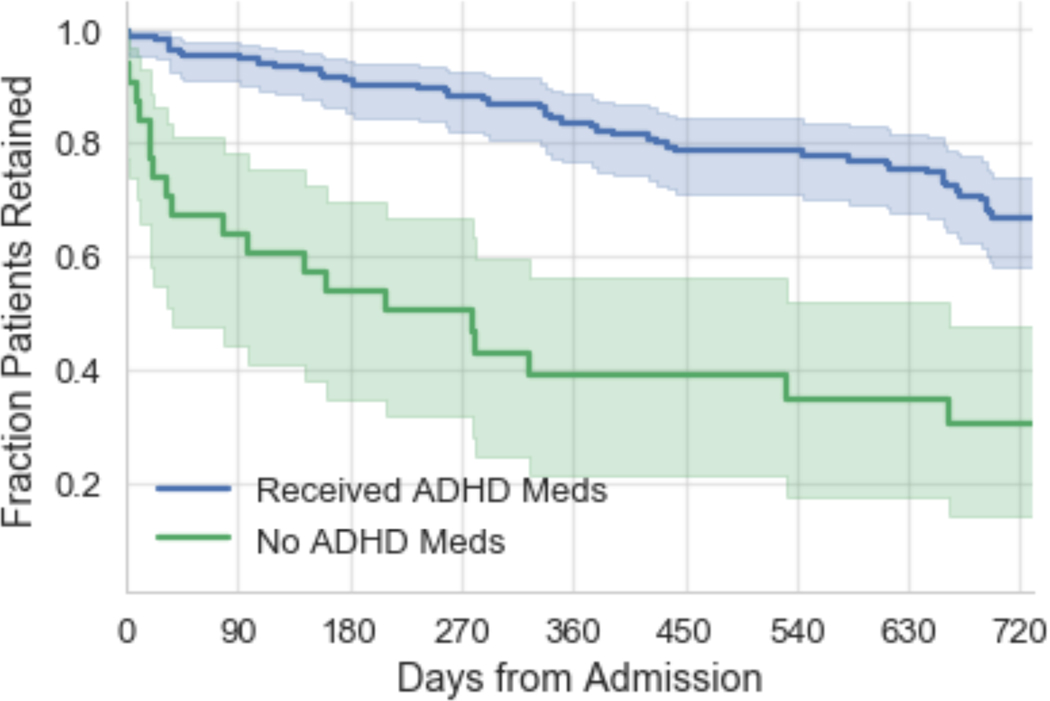
Results: ADHD was clinically diagnosed in 9.4% of outpatients and was associated with younger age, comorbid cocaine use, and private insurance (P < .001). Individuals receiving no ADHD pharmacotherapy were younger than those receiving medication (P = .003). Compared to no ADHD medication, ADHD pharmacotherapy was associated with greater long-term retention, with apparent group half-lives of 9 months and 36 months, respectively (P < .001). Individuals receiving no ADHD medication had a 4.9-fold increased likelihood of attrition within 90 days (P = .041). Regression analysis showed only ADHD pharmacotherapy to be significantly associated with treatment retention (hazard ratio = 0.59; 95% CI, 0.40-0.86; P = .008).
Conclusions: ADHD pharmacotherapy is robustly associated with improved short- and longer-term retention in outpatient SUD treatment. The retrospective, nonrandomized naturalistic study design limits causal inference. Further studies addressing unmeasured covariates and associated risks of treatment in adults with ADHD and SUD are necessary.
© Copyright 2021 Physicians Postgraduate Press, Inc.
Figures
References
-
- Onken LS, Blaine JD, Boren JJ. Beyond the Therapeutic Alliance: Keeping the Drug-Dependent Individual in Treatment. Rockville, MD: (5600 Fishers Lane, Rockville, 20857):; 1997. http://hdl.handle.net/2027/mdp.39015050792830
-
- Stark MJ. Dropping out of substance abuse treatment: A clinically oriented review. Clin Psychol Rev. 1992;12(1):93–116. doi: 10.1016/0272-7358(92)90092-M - DOI