Observational Study
. 2021 May 14;11(1):10321.
doi: 10.1038/s41598-021-89070-1.

Genomic investigation of a dengue virus outbreak in Thiès, Senegal, in 2018

Affiliations
Observational Study

Genomic investigation of a dengue virus outbreak in Thiès, Senegal, in 2018

Amy Gaye et al. Sci Rep. .

Abstract

Dengue virus is a major and rapidly growing public health concern in tropic and subtropic regions across the globe. In late 2018, Senegal experienced its largest dengue virus outbreak to date, covering several regions. However, little is known about the genetic diversity of dengue virus (DENV) in Senegal. Here we report complete viral genomes from 17 previously undetected DENV cases from the city of Thiès. In total we identified 19 cases of DENV in a cohort of 198 individuals with fever collected in October and November 2018. We detected 3 co-circulating serotypes; DENV 3 was the most frequent accounting for 11/17 sequences (65%), 4 (23%) were DENV2 and 2 (12%) were DENV1. Sequences were most similar to recent sequences from West Africa, suggesting ongoing local circulation of viral populations; however, detailed inference is limited by the scarcity of available genomic data. We did not find clear associations with reported clinical signs or symptoms, highlighting the importance of testing for diagnosing febrile diseases. Overall, these findings expand the known range of DENV in Senegal, and underscore the need for better genomic characterization of DENV in West Africa.


Conflict of interest statement

P.C.S. is a co-founder and shareholder of Sherlock Biosciences, and a Board member and shareholder of Danaher Corporation. The other authors declare no competing interests.

Figures
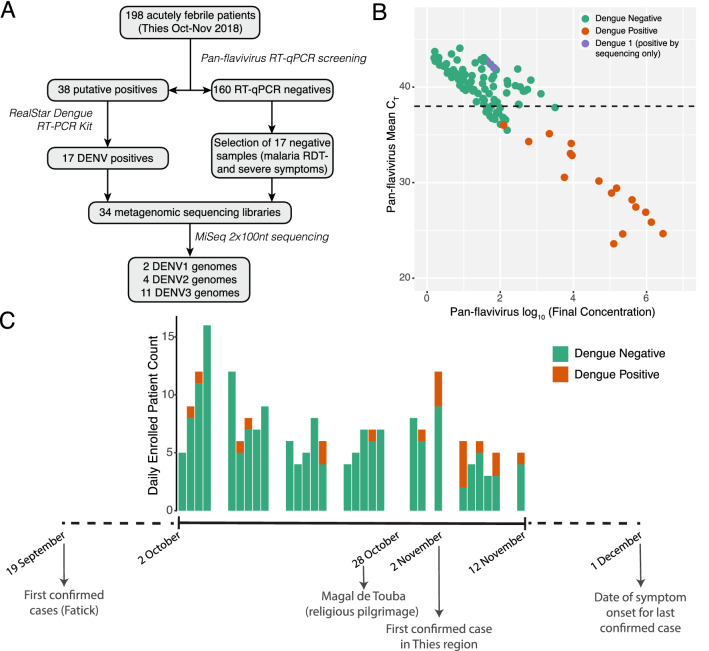
Figure 1
Figure 1
Detection of dengue virus in individuals with acute fever. (A) Flowchart of the study showing the major assays performed and numbers of samples at each step. (B) Plot showing the CT and viral concentration of all 198 samples tested. Dengue-positive samples, as determined by the RealStar assay, are colored in orange, and DENV1 samples identified by sequencing only are colored in purple. The CT cutoff used to identify putative positives for further testing is shown by a black dashed line. (C) Timeline of the 2018 dengue virus outbreak in Senegal showing the number of patients enrolled per day and the number of individuals that tested positive for dengue. Below the plot are marked several important events during the outbreak.
Figure 2
Figure 2
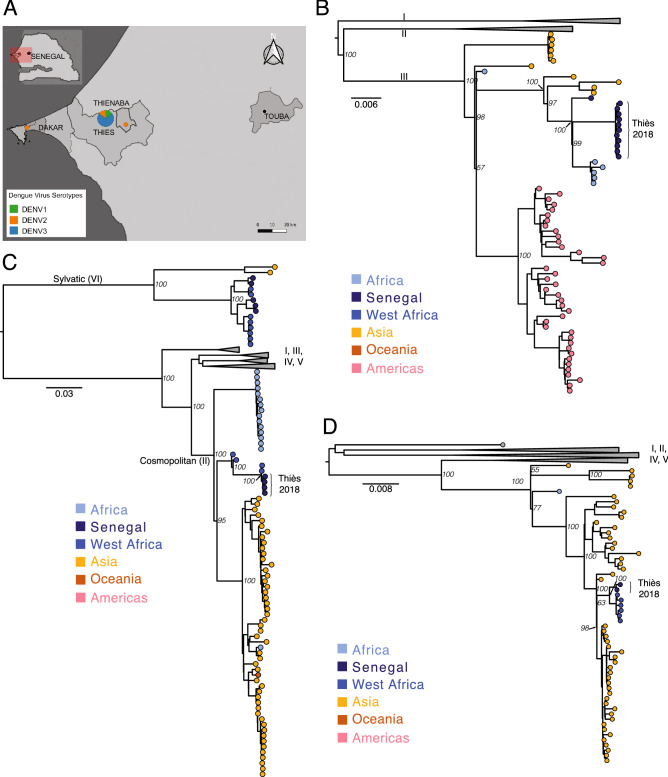
Phylogenetic analysis of dengue virus genomes from Senegal. (A) Map showing the locations of DENV cases identified in this study by virus serotype the size of the dot is proportional to the number of samples. Major cities, including Thiès—the sampling site—and Touba—the location of the Magal—are also shown. This map was created using QGIS v3.4.7 (http://www.qgis.osgeo.org). (B) DENV3 maximum likelihood (ML) phylogeny: genomes from Thiès are in genotype III and are most similar to genomes from Africa. (C) DENV2 ML phylogeny: genomes from Thiès are in the Cosmopolitan genotype and are most similar to other West African genomes. (D) DENV1 ML phylogeny: genomes from Thiès are in genotype III and are most similar to genomes from West Africa. Bootstrap values for key nodes are shown.
Figure 3
Figure 3
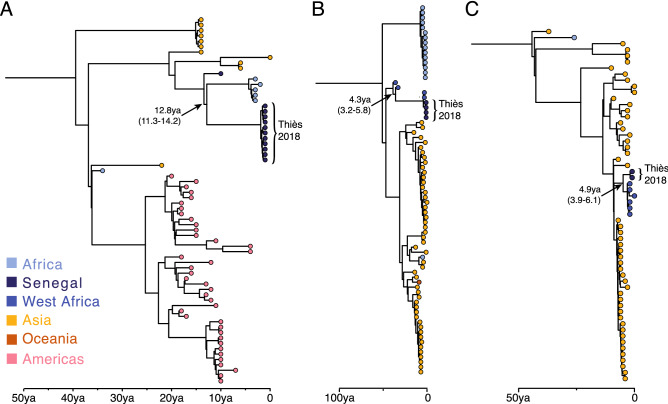
Maximum clade credibility trees for complete genomes of (A) DENV3 genotype III, (B) DENV2 Cosmopolitan genotype and (C) DENV1 genotype III. BEAST analysis was performed on the complete CDS from 136, 188 and 118 genomes for DENV1, DENV2 and DENV3, respectively. Estimated date and 95% posterior densities are given for nodes of interest described in the text.

References

    1. Bhatt S, et al. The global distribution and burden of dengue. Nature. 2013;496:504–507. doi: 10.1038/nature12060. - DOI - PMC - PubMed
    1. Murray NEA, Quam MB, Wilder-Smith A. Epidemiology of dengue: Past, present and future prospects. Clin. Epidemiol. 2013;5:299–309. - PMC - PubMed
    1. Gubler DJ. Dengue, urbanization and globalization: The unholy trinity of the 21(st) century. Trop. Med. Health. 2011;39:3–11. doi: 10.2149/tmh.2011-S05. - DOI - PMC - PubMed
    1. Katzelnick LC, et al. Antibody-dependent enhancement of severe dengue disease in humans. Science. 2017;358:929–932. doi: 10.1126/science.aan6836. - DOI - PMC - PubMed
    1. Amarasinghe A, Kuritsk JN, Letson GW, Margolis HS. Dengue virus infection in Africa. Emerg. Infect. Dis. 2011;17:1349–1354. - PMC - PubMed

Publication types

MeSH terms