Fig. 4. VTA DA neuron firing increased by NRG1, via suppressing K+ currents.
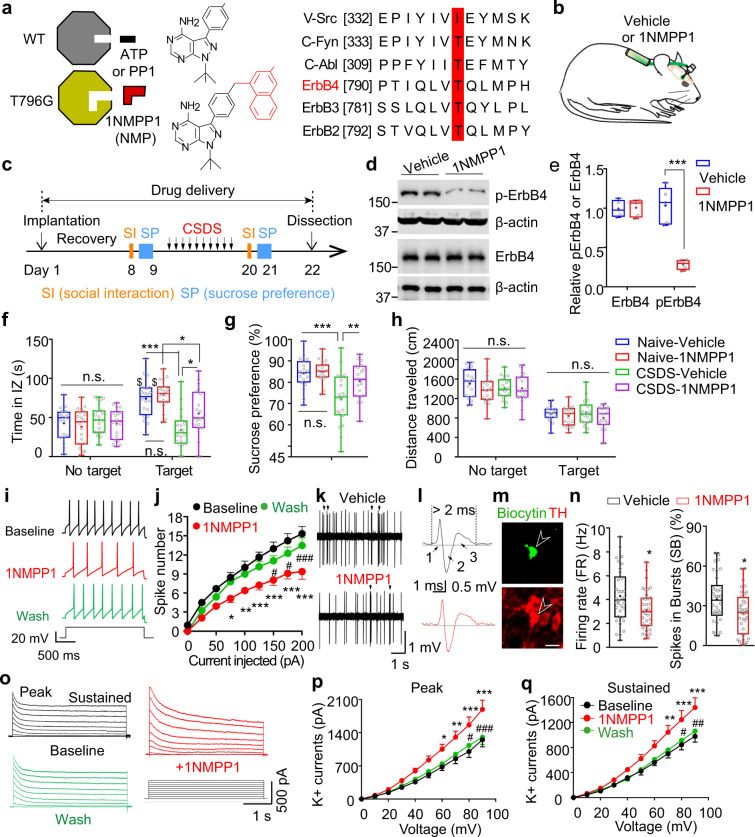
a–c In vitro recording performed in VTA slices from ErbB4-CreER;Ai9 mice showing increased VTA DA neuron firing after incubation with NRG1. a Representative images showing recorded neurons triple positive for ErbB4 (positive of tdTomato, referred to as tdT+), TH, and biocytin. Left, VTA slices with anatomic regions. SNc substantia nigra pars compacta, SNr substantia nigra pars reticulata, ml medial lemniscus, fr fasciculus retroflexus. Right, enlargement of the rectangle area in the left image. Arrowheads indicated the tdT, TH, and biocytin triple positive neurons. Scale bars, 200 μm in the left, 50 μm in the right. To avoid overexposure of fluorescent signal, low dose of tamoxifen was used to induced a small number of tdT+ cells. b Representative current injection-induced spikes. c Quantitative data in b. Data were expressed as mean ± SEM. Two-way ANOVA. Baseline vs. NRG1: F(interaction)(8, 288) = 2.081, *P = 0.0376; Sidak’s multiple comparisons test, *P(50 pA) = 0.0416, **P(100 pA) = 0.0085, **P(125 pA) = 0.0020, **P(150 pA) = 0.0012, ***P(175 pA) = 0.0008, ***P(200 pA) = 0.0003; NRG1 vs. Wash, F(interaction)(8, 288) = 1.0198, P = 0.3001; F(main effect of NRG1)(1,36) = 63.9, # # #P < 0.0001; Sidak’s multiple comparisons test, #P(125 pA) = 0.0206, #P(150 pA) = 0.0228, #P(175 pA) = 0.0279, #P(200 pA) = 0.0185; n = 19 cells from 8 mice. d–g In vivo recordings performed in WT mice showing increased firing rate (FR) and percentage of spikes in bursts (SB) after NRG1 injection into VTA. d Representative firing traces of VTA DA neurons shortly (20 min) after injection of Vehicle, or NRG1 into VTA. Arrowheads indicated some of the spikes that fired in bursts. e Representative APs of DA neurons. Arrowheads and Arabic numerals indicated the three phases. f Representative immunostaining image showing recorded neuron double positive of biocytin and TH. Scale bar, 20 µm. g Quantitative data in d, data were expressed as box-and-whisker plots. Unpaired Student’s t test: t(FR)(70) = 2.584, *P = 0.0119; t(SB)(70) = 2.861, **P = 0.0056; n = 36 cells from 12 (Vehicle) or 13 (NRG1) mice. h–j In vitro recordings performed in VTA slices from ErbB4-CreER;Ai9 mice showing inhibition of total K+ currents by NRG1. h Representative traces of total K+ currents in VTA DA neurons after NRG1 incubation. i, j Quantitative data showing inhibition of both the peak and sustained phases by NRG1. Data were expressed as mean ± SEM. Two-way ANOAVA. For the peak phase: Baseline vs. NRG1, F(interaction)(9, 414) = 3.403, ***P = 0.0005; Sidak’s multiple comparisons test, ***P(90 mV) < 0.0001, ***P(80 mV) = 0.0002, **P(70 mV) = 0.0021; NRG1 vs. Wash, F(interaction)(9, 414) = 1.851, P = 0.0577, F(main effect of NRG1)(1, 46) = 17.97, # # #P = 0.0001, Sidak’s multiple comparisons test, # #P(90 mV) = 0.0022, #P(80 mV) = 0.0260. For sustained phase: Baseline vs. NRG1, F(interaction)(9, 414) = 2.402, *P = 0.0116; Sidak’s multiple comparisons test, ***P(90 mV) = 0.0003, **P(80 mV) = 0.0012, **P(70 mV) = 0.0074; *P(60 mV) = 0.0431; NRG1 vs. Wash, F(interaction)(9, 414) = 1.449, P = 0.1649, F(main effect of NRG1)(1, 46) = 23.37, # # #P < 0.0001, Sidak’s multiple comparisons test, #P(70 mV) = 0.0417. n = 24 cells of 10 mice for each group. k–m pERK increased by NRG1, but decreased by NMP, injected into VTA. k Diagram showing acute injection of Veh, NRG1 or NMP into VTA. l Representative western blots for dissected VTA. m Quantification of l. Data were expressed as box-and-whisker plots. Unpaired Student’s t test, t(Veh vs. NRG1)(10) = 3.962, **P = 0.0027; t(Veh vs. 1NMPP1)(10) = 6.696, ***P < 0.001. n–q ERK inhibitor, PD98059 (referred to as PD), reduced the effects of NRG1 on DA neuron firing and K+ currents. n Representative traces of current injection-induced spikes in DA neurons after incubation with Veh+NRG1 or PD + NRG1. o Quantification of n showing reduced spikes in PD + NRG1-treated slices. Data were expressed as mean ± SEM. Two-way ANOVA, F(interaction)(8, 296) = 2.058, *P = 0.0398; Sidak’s multiple comparisons test, **P(100 pA) = 0.0087, **P(125 pA) = 0.0028, **P(150 pA) = 0.0054, **P(175 pA) = 0.0032, **P
(200 pA) = 0.0063; n = 20 (Veh) or 19 (PD) cells from 8 mice. p Representative traces of total K+ currents after incubation with Veh+NRG1 or PD + NRG1. q Quantification of p showing increased K+ currents in PD + NRG1-treated slices. Data were expressed as mean ± SEM. Two-way ANOVA. For peak phase: F(interaction)(9, 396) = 2.292, *P = 0.0162; Sidak’s multiple comparisons test, ***P(90 mV) = 0.0002, **P(80 mV) = 0.0011, *P(70 mV) = 0.0154. For sustained phase: F(interaction)(9, 396) = 2.195, #P = 0.0216; Sidak’s multiple comparisons test, # # #P(90 mV) = 0.0003, # #P(80 mV) = 0.0022, #P(70 mV) = 0.0207; n = 22 cells of 8 mice for each group. (Also see Supplementary Fig. S13 for quantification of ErbB4-expressing DA neurons in VTA; Supplementary Fig. S10 for the increased BDNF release at NAc after injection of NRG1 into VTA in subSD-exposed mice.).