


Sleep problems in children with cerebral palsy and their parents
- PMID: 33990937
- PMCID: PMC8597175
- DOI: 10.1111/dmcn.14920
Sleep problems in children with cerebral palsy and their parents
Abstract
Aim: To describe: (1) the frequency and types of sleep problems, (2) parent-rated satisfaction with their child's and their own sleep, and (3) child factors related to the occurrence of sleep problems in children with cerebral palsy (CP) and their parents. The secondary objective was to compare the sleep outcomes of children with CP with those from typically developing children and their parents.
Method: The Sleep section of the 24-hour activity checklist was used to assess the sleep of children with CP and their parents and the sleep of typically developing children and their parents.
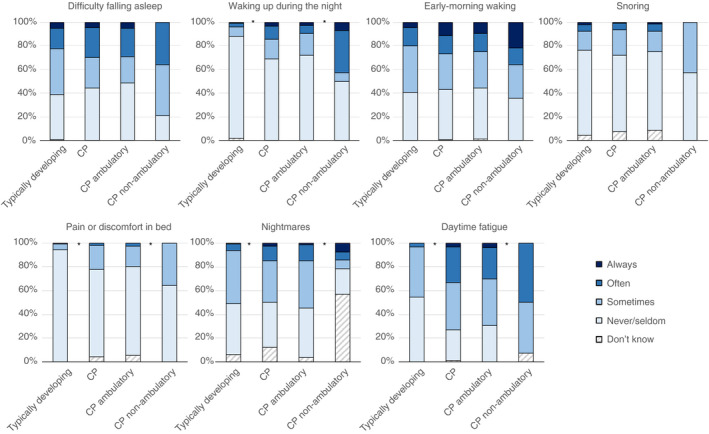
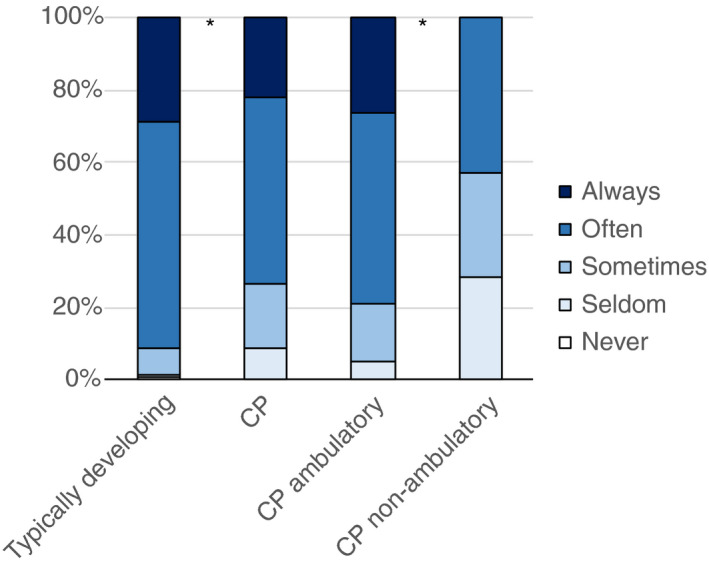
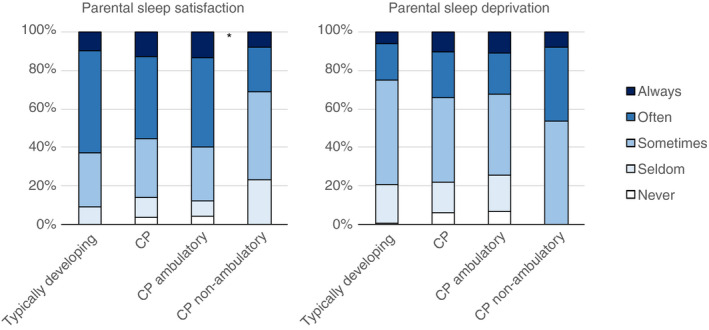
Results: The sleep outcomes of 90 children with CP (median age 5y, range 0-11y, 53 males, 37 females, 84.4% ambulatory) and 157 typically developing peers (median age 5y, range 0-12y; 79 males, 78 females) and their parents were collected. Children with CP were more likely to have a sleep problem than typically developing children. Non-ambulatory children with CP were more severely affected by sleep problems than ambulatory children. The parents of non-ambulatory children were less satisfied about their child's and their own sleep. Waking up during the night, pain/discomfort in bed, and daytime fatigue were more common in children with CP and more prevalent in children who were non-ambulatory.
Interpretation: These findings highlight the need to integrate sleep assessment into routine paediatric health care practice. What this paper adds Children with cerebral palsy (CP) are more likely to have a sleep problem than typically developing peers. Non-ambulatory children with CP are more severely affected by sleep problems. One-third of parents of children with CP report feeling sleep-deprived often or always compared to a quarter of parents of typically developing children.
© 2021 The Authors. Developmental Medicine & Child Neurology published by John Wiley & Sons Ltd on behalf of Mac Keith Press.
Figures
Comment in
-
Sleep and disabled children and their families: continuing the conversation.Dev Med Child Neurol. 2021 Nov;63(11):1247. doi: 10.1111/dmcn.14966. Epub 2021 Jun 17. Dev Med Child Neurol. 2021. PMID: 34137457 No abstract available.
-
Evaluation of Sleep in Children with Cerebral Palsy: A Must do Component for Holistic Management.Indian J Pediatr. 2023 Jun;90(6):537-538. doi: 10.1007/s12098-023-04525-9. Epub 2023 Mar 30. Indian J Pediatr. 2023. PMID: 36995645 No abstract available.
References
-
- Chaput J‐P, Gray CE, Poitras VJ, et al. Systematic review of the relationships between sleep duration and health indicators in school‐aged children and youth. Appl Physiol Nutr Metab 2016; 41: S266–82. - PubMed
-
- Odding E, Roebroeck ME, Stam HJ. The epidemiology of cerebral palsy: incidence, impairments and risk factors. Disabil Rehabil 2006; 28: 183–91. - PubMed
-
- Horwood L, Li P, Mok E, Shevell M, Constantin E. A systematic review and meta‐analysis of the prevalence of sleep problems in children with cerebral palsy: how do children with cerebral palsy differ from each other and from typically developing children? Sleep Health 2019; 5: 555–71. - PubMed
-
- Petersen S, Francis KL, Reddihough DS, Lima S, Harvey A, Newall F. Sleep problems and solution seeking for children with cerebral palsy and their parents. J Paediatr Child Health 2020; 56: 1108–13. - PubMed
MeSH terms
LinkOut - more resources
Full Text Sources
Other Literature Sources
Medical
Miscellaneous
