


Transoral surgery for superficial head and neck cancer: National Multi-Center Survey in Japan
- PMID: 33991076
- PMCID: PMC8209601
- DOI: 10.1002/cam4.3927
Transoral surgery for superficial head and neck cancer: National Multi-Center Survey in Japan
Abstract
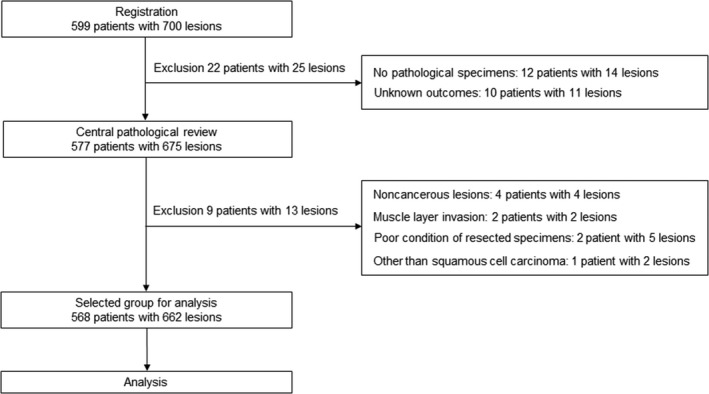
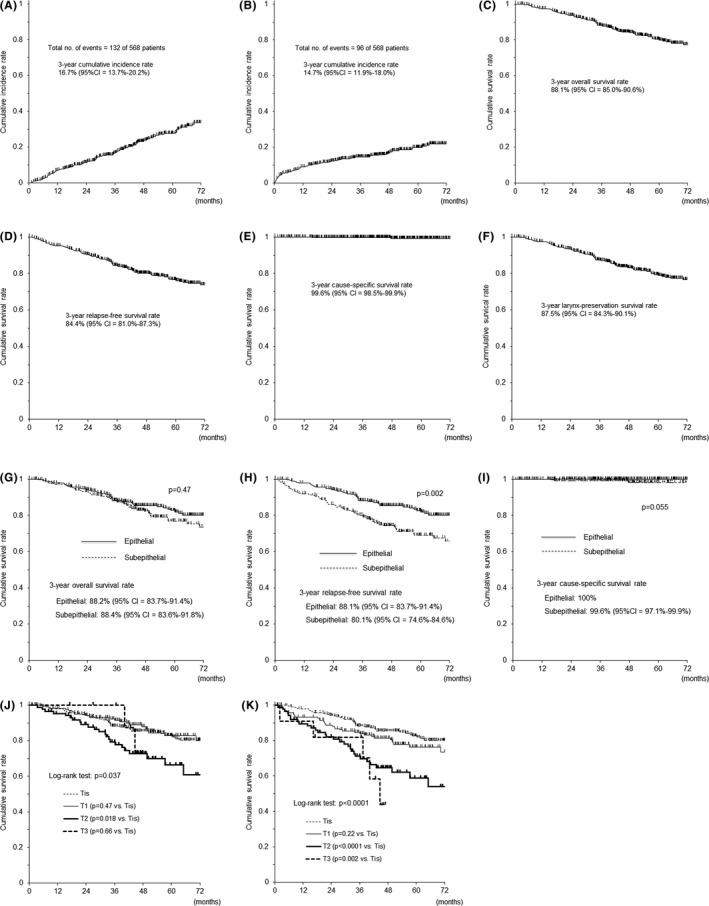
Head and neck cancers, especially in hypopharynx and oropharynx, are often detected at advanced stage with poor prognosis. Narrow band imaging enables detection of superficial cancers and transoral surgery is performed with curative intent. However, pathological evaluation and real-world safety and clinical outcomes have not been clearly understood. The aim of this nationwide multicenter study was to investigate the safety and efficacy of transoral surgery for superficial head and neck cancer. We collected the patients with superficial head and neck squamous cell carcinoma who were treated by transoral surgery from 27 hospitals in Japan. Central pathology review was undertaken on all of the resected specimens. The primary objective was effectiveness of transoral surgery, and the secondary objective was safety including incidence and severity of adverse events. Among the 568 patients, a total of 662 lesions were primarily treated by 575 sessions of transoral surgery. The median tumor diameter was 12 mm (range 1-75) endoscopically. Among the lesions, 57.4% were diagnosed as squamous cell carcinoma in situ. The median procedure time was 48 minutes (range 2-357). Adverse events occurred in 12.7%. Life-threatening complications occurred in 0.5%, but there were no treatment-related deaths. During a median follow-up period of 46.1 months (range 1-113), the 3-year overall survival rate, relapse-free survival rate, cause-specific survival rate, and larynx-preservation survival rate were 88.1%, 84.4%, 99.6%, and 87.5%, respectively. Transoral surgery for superficial head and neck cancer offers effective minimally invasive treatment. Clinical trials registry number: UMIN000008276.
Keywords: head and neck cancer; larynx preservation; pharyngeal cancer; superficial cancer; transoral surgery.
© 2021 The Authors. Cancer Medicine published by John Wiley & Sons Ltd.
Conflict of interest statement
Professor Manabu Muto received a joint research fund between Kyoto University and Olympus Corporation out of this study. Dr. Ryuichi Hayashi received a grant from the Japan Agency for Medical Research and Development (Grant No. 19ck0106510h0001). Other authors have not declared a specific grant for this study from any funding agency in the public, commercial, or not‐for‐profit sectors.
Figures
References
-
- Bray F, Ferlay J, Soerjomataram I, Siegel RL, Torre LA, Jemal A. Global cancer statistics 2018: GLOBOCAN estimates of incidence and mortality worldwide for 36 cancers in 185 countries. CA Cancer J Clin. 2018;68:394‐424. - PubMed
-
- Hoffman HT, Karnell LH, Shah JP, et al. Hypopharyngeal cancer patient care evaluation. Laryngoscope. 1997;107:1005‐1017. - PubMed
-
- Bova R, Goh R, Poulson M, Coman WB. Total pharyngolaryngectomy for squamous cell carcinoma of the hypopharynx: a review. Laryngoscope. 2005;115:864‐869. - PubMed
-
- Chao KS, Deasy JO, Markman J, et al. A prospective study of salivary function sparing in patients with head‐and‐neck cancers receiving intensity‐modulated or three‐dimensional radiation therapy: initial results. Int J Radiat Oncol Biol Phys. 2001;49:907‐916. - PubMed
Publication types
MeSH terms
Associated data
- Actions
LinkOut - more resources
Full Text Sources
Other Literature Sources
Medical
