


Association of Depressive Symptoms with Sleep Disturbance: A Co-twin Control Study
- PMID: 33991086
- PMCID: PMC8887572
- DOI: 10.1093/abm/kaab040
Association of Depressive Symptoms with Sleep Disturbance: A Co-twin Control Study
Abstract
Background: Few studies have comprehensively evaluated the association of depression with sleep disturbance using a controlled twin study design.
Purpose: To cross-sectionally evaluate the association of depression with both objective and subjective sleep disturbance.
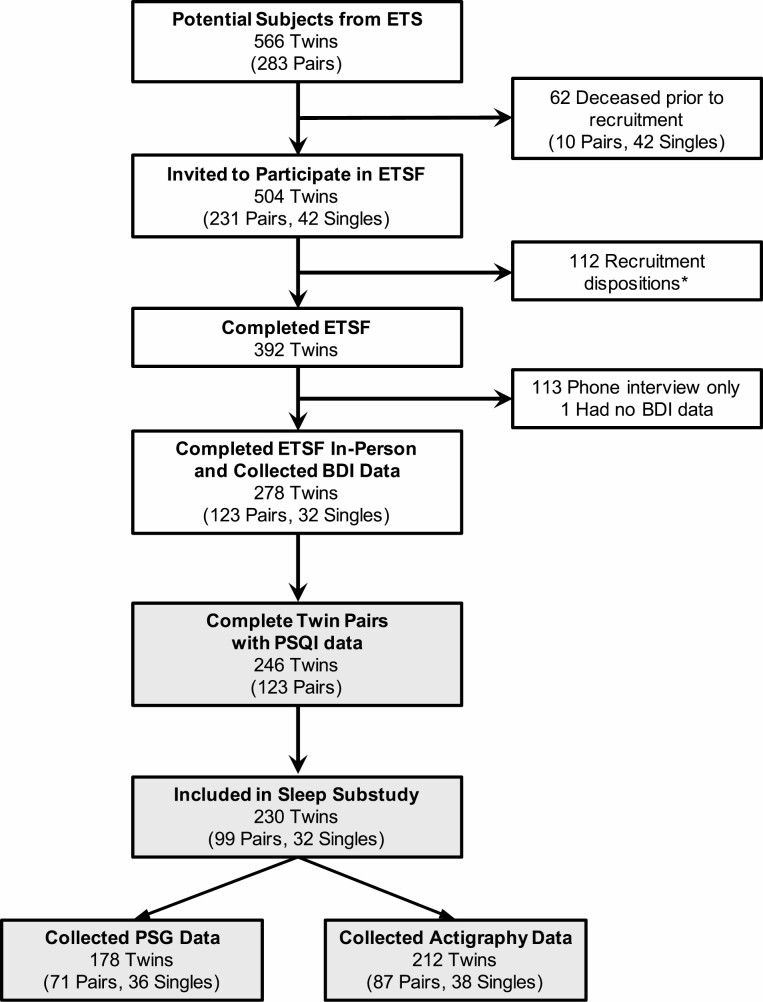
Methods: We studied 246 members of the Vietnam Era Twin Registry. We measured depressive symptoms using the Beck Depression Inventory-II (BDI) and assessed major depression using structured clinical interviews. Twins underwent one-night polysomnography and 7-day actigraphy to derive measures of objective sleep and completed the Pittsburgh Sleep Quality Index for subjective sleep. Multivariable mixed-effects models were used to examine the association.
Results: Twins were all male, mostly white (97%), with a mean (SD) age of 68 (2). The mean (SD) BDI was 5.9 (6.3), and 49 (20%) met the criteria for major depression. For polysomnography, each 5-unit higher BDI, within-pair, was significantly associated with 19.7 min longer rapid eye movement (REM) sleep latency, and 1.1% shorter REM sleep after multivariable adjustment. BDI was not associated with sleep architecture or sleep-disordered breathing. For actigraphy, a higher BDI, within-pair, was significantly associated with lower sleep efficiency, more fragmentation and higher variability in sleep duration. BDI was associated with almost all dimensions of self-reported sleep disturbance. Results did not differ by zygosity, and remained consistent using major depression instead of BDI and were independent of the presence of comorbid posttraumatic stress disorder and antidepressant use.
Conclusions: Depression is associated with REM sleep disruption in lab and sleep fragmentation and sleep variability at home, but not with sleep architecture or sleep-disordered breathing.
Keywords: Actigraphy; Depression; Polysomnography; Sleep; Twins; Veterans.
© Society of Behavioral Medicine 2021. All rights reserved. For permissions, please e-mail: journals.permissions@oup.com.
Figures
References
-
- Crawford JR, Henry JD, Crombie C, Taylor EP. Normative data for the HADS from a large non-clinical sample. Br J Clin Psychol. 2001;40:429–434. - PubMed
-
- Kessler RC, Berglund P, Demler O, et al. ; National Comorbidity Survey Replication . The epidemiology of major depressive disorder: Results from the National Comorbidity Survey Replication (NCS-R). JAMA. 2003;289:3095–3105. - PubMed
-
- Armitage R. Sleep and circadian rhythms in mood disorders. Acta Psychiatr Scand Suppl. 2007:104–115. - PubMed
Publication types
MeSH terms
Grants and funding
- R01 HL109413/HL/NHLBI NIH HHS/United States
- R01 MH056120/MH/NIMH NIH HHS/United States
- K24 HL077506/HL/NHLBI NIH HHS/United States
- R01 HL125246/HL/NHLBI NIH HHS/United States
- R01 MH120262/MH/NIMH NIH HHS/United States
- R01 HL068630/HL/NHLBI NIH HHS/United States
- UH3 DA048502/DA/NIDA NIH HHS/United States
- UG3 DA048502/DA/NIDA NIH HHS/United States
- T32 MH067547/MH/NIMH NIH HHS/United States
- R01 HL136205/HL/NHLBI NIH HHS/United States
- K01 HL138211/HL/NHLBI NIH HHS/United States
- R01 AG026255/AG/NIA NIH HHS/United States
- K24 MH076955/MH/NIMH NIH HHS/United States
- R01 HL088726/HL/NHLBI NIH HHS/United States
LinkOut - more resources
Full Text Sources
Other Literature Sources
Medical
Miscellaneous
