Review
. 2022 Nov:28 Suppl 2:2326-2336.
doi: 10.1111/odi.13916. Epub 2021 May 31.

Coronavirus disease 2019 (COVID-19) vaccines: A concise review

Affiliations
Review

Coronavirus disease 2019 (COVID-19) vaccines: A concise review

Lakshman Perera Samaranayake et al. Oral Dis. 2022 Nov.

Abstract

The development of a successful vaccine against severe acute respiratory syndrome coronavirus-2 (SARS-CoV-2), the agent of coronavirus disease 2019 (COVID-19), in an unmatched period of ten months, is a tribute to human ingenuity in the face of a vicious pandemic. A return to pre-pandemic "normalcy" depends on the successful delivery of the vaccine to a majority (~70%) so as to develop herd immunity critical to arrest the community spread of infection. Vaccination against COVID-19 is particularly important for dentistry as the dental team works in an environment replete with aerosol-generating procedures (AGP) that facilitate virus spread. Hence, a COVID-19 vaccine is likely to be an obligatory requirement for the dental practice, and the latest addition to the extensive list of vaccines required for dental professionals for the safe delivery of dental care. Here, we review the currently available major candidate vaccines against SARS-CoV-2 and their benefits and risks. These include the vaccines developed on next-generation platforms (mRNA, DNA, and viral vector vaccines), and the classic platforms (the live-attenuated virus, and the protein subunit vaccines) The review concludes with a summary of impending issues and challenges facing the provision of COVID-19 vaccines for all stakeholders in dentistry.

Keywords: challenges; coronavirus disease 2019; impact; platforms; severe acute respiratory syndrome coronavirus 2; vaccines.


Conflict of interest statement

The authors declare no conflict of interest.

Figures
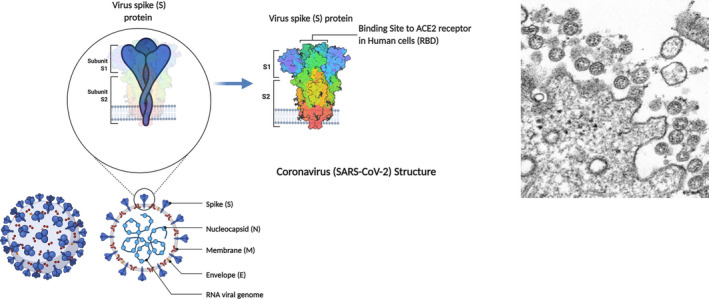
FIGURE 1
FIGURE 1
SARS‐CoV‐2 and its structural components: Showing the (blown up) spike (S) protein and receptor‐binding domain (RBD) that are key antigenic components of COVID‐19 vaccines; also illustrated are the N (nucleocapsid), M (membrane), and S (spike) proteins of the virus, which are the key components of the subunit vaccines; Inset: Transmission electron microscope image of SARS‐CoV‐2: spherical viral particles emerging from an infected cell (Image courtesy US Centres for Disease Control Image Library)
FIGURE 2
FIGURE 2
A composite figure depicting the mechanisms of activity of five different strains of COVID‐19 vaccines (simplified). The central square delineates the systemic immune response evoked by the spike (S) antigens of SARS‐CoV‐2 produced on various vaccine platforms. (a) Specialized antigen‐presenting cells (APCs: dendritic cells, macrophages, B cells and Langerhans cells (Purple) engulf the S protein antigens produced on different vaccine platforms (described below) and display portions of it on their cell surfaces to activate and recruit T cells; (b) The recruited T cells, so‐called killer T cells (red), then destroy SARS‐CoV‐2‐infected cells; (c) APC also recruit B cells (green) that are primed to produce neutralizing antibodies to the viral S proteins, preventing viral attachment to host cells and abating the infection. (d) Long‐lived memory B and T cells (light brown) are also produced simultaneously that can patrol the body for any incoming viruses for months/years and rekindle an identical B‐ and T‐cell response, described above. I: mRNA Vaccines; The vaccine containing mRNA of SARS‐CoV‐2 with the code for the Spike (S) protein enclosed within lipid particles (to facilitate cell entry) is administered. Once injected, the lipid particles are “ingested” by vaccinees APCs to produce the immune response (as described in (a‐d) above). IIa and IIb: Live attenuated and inactivated vaccines; The vaccine containing either the inactivated or the attenuated SARS‐CoV‐2 is administered to the vaccinee. Once injected, the non‐infective virus particles are ingested by the antigen‐presenting cells (APC ) to produce the immune response (as described in (a‐d) above). III: Protein subunit SARS‐CoV‐2 vaccines: The vaccine containing the N (nucleocapsid), M (membrane), and S (spike) protein antigens of the virus is administered to the vaccinee. Once injected, the non‐infective antigens are ingested by the antigen‐presenting cells (APC) (purple) to produce the immune response (as described in (a‐d) above). IV: Viral vector‐based recombinant vaccines: A non‐infectious virus such as an adenovirus, engineered to combine with SARS‐CoV‐2 Spike (S) protein (recombinant) DNA is used as a vector vehicle in the vaccine. Once injected, the non‐infective adenoviruses multiply in host cells, recognised as foreign, and ingested by the antigen‐presenting cells (APC; purple) to produce the immune response (as described in (a‐d) above); V: DNA vaccines: These vaccines contain pieces of DNA called plasmids found in bacteria to encode spike (S) antigens of SARS‐CoV‐2. The plasmids with a code to produce S antigens, once ingested by APC are integrated into their nucleus (purple) to produce the immune response (as described in (a‐d) above; Figure produced using Biorender.com)

Similar articles

Cited by

References

    1. CDC (2020). Summary of infection prevention practices in dental settings. Centers for Disease Control and Prevention (CDC), https://www.cdc.gov/oralhealth/infectioncontrol/pdf/safe‐care2.pdf, 1‐44.
    1. CDC (2021a). About COVID‐19 Vaccination. Centers for Disease Control and Prevention. https://www.CDC.gov/coronavirus/2019‐ncov/vaccines/faq.html. 1‐3
    1. CDC . (2021b). Emerging SARS‐CoV‐2 Variants. Centers for Disease Control and Prevention (CDC). https://www.CDC.gov/coronavirus/2019‐ncov/more/science‐and‐research/scie.... 1‐3 - PubMed
    1. CDC . (2021c). How to protect yourself and others. Centers for Disease Control and Prevention, March 8 2021. 1‐2.
    1. Clementini, M. , Raspini, M. , Barbato, L. , Bernardelli, F. , Braga, G. , Di Gioia, C. , Littarru, C. , Oreglia, F. , Brambilla, E. , Iavicoli, I. , Pinchi, V. , Landi, L. , Marco Sforza, N. , Cavalcanti, R. , Crea, A. , & Cairo, F. . (2020). Aerosol transmission for SARS‐CoV‐2 in the dental practice. A review by SIdP Covid‐19 task‐force. Oral Diseases. 10.1111/odi.13649 - DOI - PubMed
