


Associations of developmental imbalance between sensation seeking and premeditation in adolescence and heavy episodic drinking in emerging adulthood
- PMID: 33991389
- PMCID: PMC8254779
- DOI: 10.1111/acer.14604
Associations of developmental imbalance between sensation seeking and premeditation in adolescence and heavy episodic drinking in emerging adulthood
Abstract
Background: Dual systems theories suggest that greater imbalance between higher reward sensitivity and lower cognitive control across adolescence conveys risk for behaviors such as heavy episodic drinking (HED). Prior research demonstrated that psychological analogues of these systems, sensation seeking and premeditation, change from childhood through emerging adulthood, and each has been independently linked with HED. However, few studies have assessed whether change over time in these developing analogues is prospectively associated with HED. Moreover, we know of no research that has shown whether within-person differences between higher sensation seeking and relatively lower premeditation across the adolescent period predict HED in emerging adulthood.
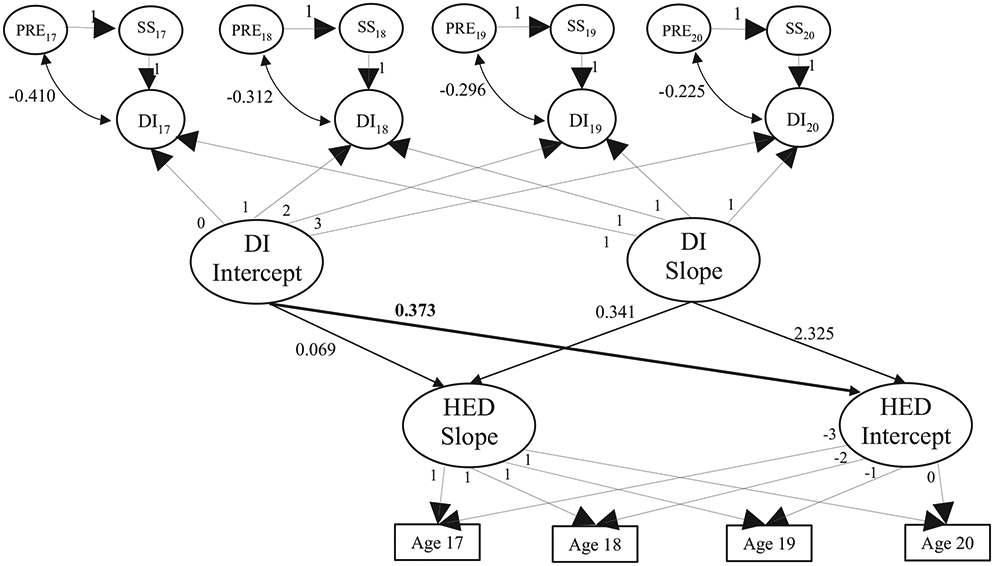
Methods: Prospective data from the National Consortium on Alcohol and NeuroDevelopment in Adolescence study (n = 715) were used to examine the association of sensation seeking and premeditation with HED among adolescents ages 16 to 20 years. We used novel applications of latent difference score modeling and growth curve analysis to test whether increasing sensation seeking, premeditation, and their imbalance over time are associated with HED across the study period, and whether these associations differed by sex.
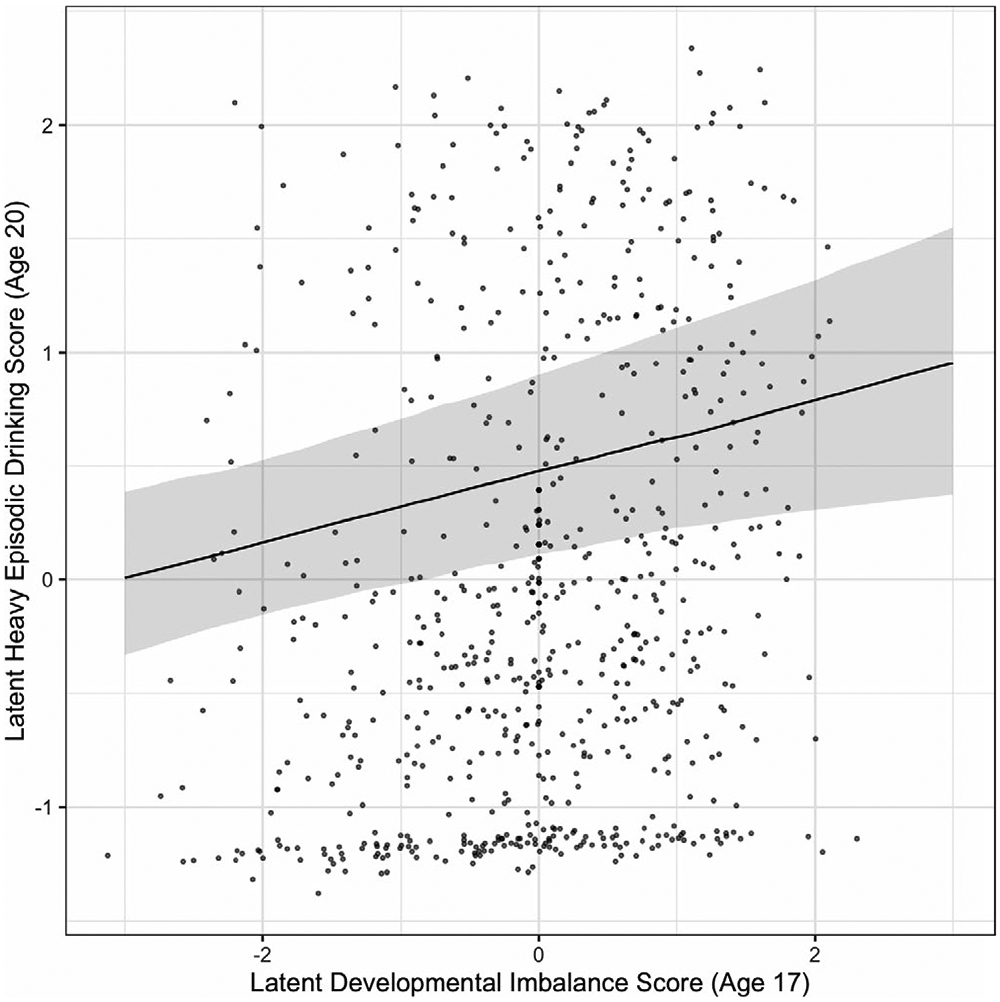
Results: Whereas premeditation increased linearly from adolescence through emerging adulthood across sexes, males reported growth and females reported decline in sensation seeking. Sensation seeking in adolescence (and not premeditation) was associated with higher levels of HED by emerging adulthood. Importantly, greater imbalance between sensation seeking and premeditation was associated with higher levels of HED by emerging adulthood though we note that variability capturing this imbalance correlated highly (r = 0.86) with baseline levels of sensation seeking.
Conclusions: Developmental imbalance between higher sensation seeking and lower premeditation in late adolescence may be a risk factor for greater HED in emerging adulthood.
Keywords: adolescence; alcohol use; dual systems; impulse control; sensation seeking.
© 2021 by the Research Society on Alcoholism.
Conflict of interest statement
CONFLICT OF INTEREST
The authors declare no conflicts of interest.
Figures
References
-
- Baraldi AN & Enders CK (2010) An introduction to modern missing data analyses. Journal of School Psychology, 48, 5–37. - PubMed
-
- Brown SA, Myers MG, Lippke L, Tapert SF, Stewart DG & Vik PW (1998) Psychometric evaluation of the customary drinking and drug use record (CDDR): a measure of adolescent alcohol and drug involvement. Journal of Studies on Alcohol, 59, 427–438. - PubMed
Publication types
MeSH terms
Grants and funding
- P50 DA046346/DA/NIDA NIH HHS/United States
- U01 AA021696/AA/NIAAA NIH HHS/United States
- U01 AA021691/AA/NIAAA NIH HHS/United States
- U01 AA021681/AA/NIAAA NIH HHS/United States
- U01 AA021695/AA/NIAAA NIH HHS/United States
- U01 AA021692/AA/NIAAA NIH HHS/United States
- T32 AA013525/AA/NIAAA NIH HHS/United States
- U01 AA021690/AA/NIAAA NIH HHS/United States
- U24 AA021695/AA/NIAAA NIH HHS/United States
- U01 AA021697/AA/NIAAA NIH HHS/United States
- K23 AA026869/AA/NIAAA NIH HHS/United States
- U24 AA021697/AA/NIAAA NIH HHS/United States
LinkOut - more resources
Full Text Sources
Other Literature Sources
Medical
