


REM sleep latency as an independent risk for cardiovascular events in hemodialysis patients
- PMID: 33991438
- PMCID: PMC8123536
- DOI: 10.14814/phy2.14837
REM sleep latency as an independent risk for cardiovascular events in hemodialysis patients
Abstract
Background: Clinical significance of objectively measured poor sleep quality (SQ) as a risk for cardiovascular disease (CVD) events is not well known in hemodialysis (HD) patients, independently of sleep-related breathing disorders (SRBDs) and sleep-related metabolic abnormality.
Methods: The present study investigated baseline levels of objective sleep architecture together with obstructive sleep apnea (OSA) and central sleep apnea (CSA) using polysomnography in 88 HD study participants (M/F, 56/32; age 68.4 ± 9.3). Then, HD study participants were monitored for the occurrence of new-onset CVD events with a median (range) follow-up period of 33 (1-64) months.
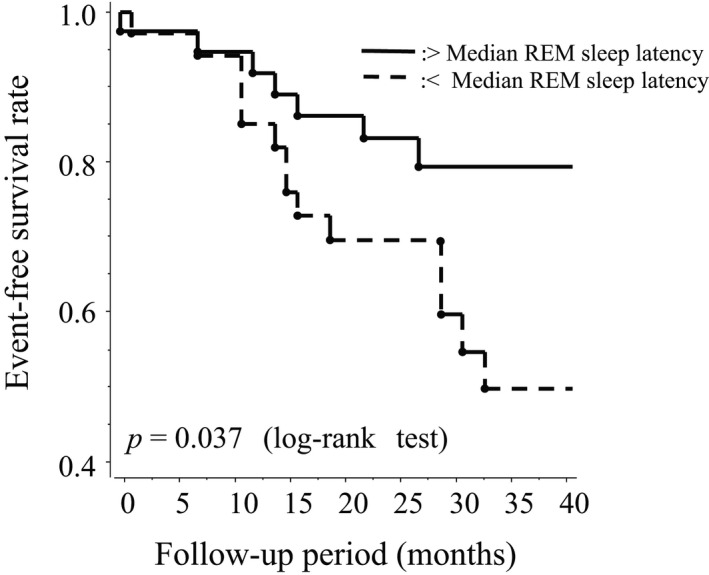
Results: Among various measures of SQ, log (REM sleep latency [REM-SL]) (interval between sleep-onset and the first REM period) alone correlated in negative manners with triglycerides and non-HDL-C in all study participants and with fasting plasma glucose and HbA1c in study participants with type-2 diabetes mellitus. In the Kaplan-Meier analysis, HD study participants with shorter REM-SL had a significantly higher rate of new-onset CVD events than those with longer REM-SL. Stepwise logistic regression analysis and multivariate Cox proportional hazard regression analysis identified shorter REM-SL as an independent risk factor for the development of a new-onset CVD events, independent of mean oxygen saturation, log (AHI+1), log (central AHI+1), diabetes mellitus, CVD history, systolic blood pressure, statins use, and non-HDL-C.
Conclusions: The present study demonstrated that reduction of REM-SL is independently associated with a higher rate of new-onset of CVD events, independent of SRBDs (OSA and CSA) and diabetes mellitus, non-HDL-C in HD study participants, suggesting impaired SQ as a potential CVD risk factor, and thus a definite treatment target to protect against CVD specifically in HD study participants. REM-SL might be a new risk factor of CVD events in HD patients with SRBDs.
Keywords: REM sleep latency; cardiovascular event; hemodialysis; sleep apnea; sleep quality.
© 2021 The Authors. Physiological Reports published by Wiley Periodicals LLC on behalf of The Physiological Society and the American Physiological Society.
Conflict of interest statement
We declare that we have no conflicts of interest to disclose.
Figures


References
-
- Aeschbach, D. , & Borbely, A. A. (1993). All‐night dynamics of the human sleep EEG. Journal of Sleep Research, 2, 70–81. - PubMed
-
- Berry, R. B. , Budhiraja, R. , Gottlieb, D. J. , Gozal, D. , Iber, C. , Kapur, V. K. , Marcus, C. L. , Mehra, R. , Parthasarathy, S. , Quan, S. F. , Redline, S. , Strohl, K. N. P. , Ward, S. L. D. , & Tangredi, M. M. (2012). Rules for scoring respiratory events in sleep: Update of the 2007 AASM manual for the scoring of sleep and associated events. Journal of Clinical Sleep Medicine, 8, 597–619. - PMC - PubMed
-
- Bruehl, H. , Rueger, M. , Dziobek, I. , Sweat, V. , Tirsi, A. , Javier, E. , Arentoft, A. , Wolf, O. T. , & Convit, A. (2007). Hypotheramic‐pituitary‐adrenal axis dysregulation and memory impairments in type 2 diabetes. Journal of Clinical Endocrinology and Metabolism, 92, 2439–2445. - PubMed
-
- Campbell, P. J. , Bolli, G. B. , Cryer, P. E. , Gerich, J. E. (1985). Sequence of events during development of the dawn phenomenon in insulin‐dependent bdiabetes mellitus. Metabolism, 34, 1100–1104. - PubMed
-
- Carskadon, M. A. , & Dement, W. C. (1985). Sleep loss in elderly volunteers. Sleep, 8, 207–221. - PubMed
MeSH terms
Substances
LinkOut - more resources
Full Text Sources
Other Literature Sources
Medical
