


Phosphorylation of Akt at Thr308 regulates p-eNOS Ser1177 during physiological conditions
- PMID: 33993653
- PMCID: PMC8255840
- DOI: 10.1002/2211-5463.13194
Phosphorylation of Akt at Thr308 regulates p-eNOS Ser1177 during physiological conditions
Abstract
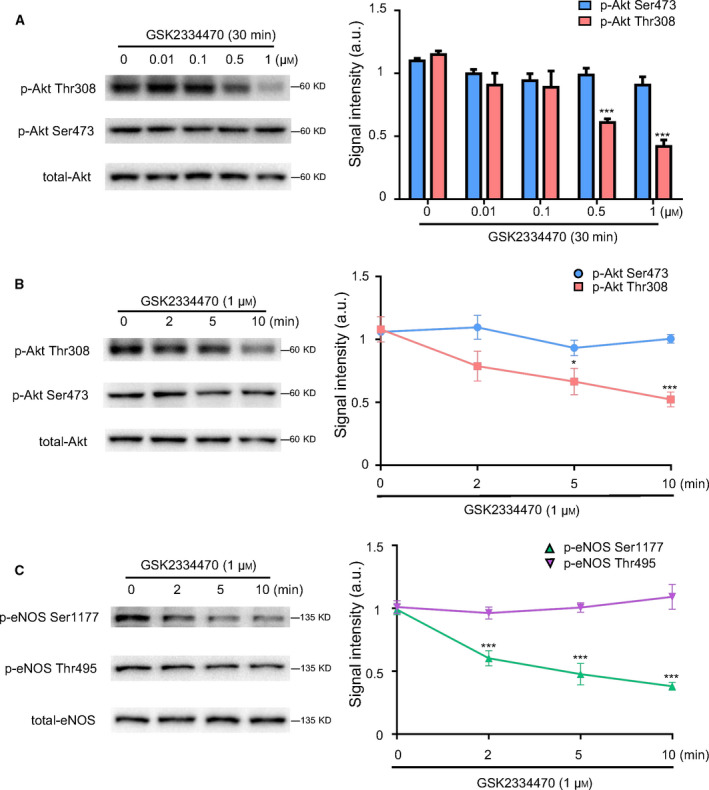
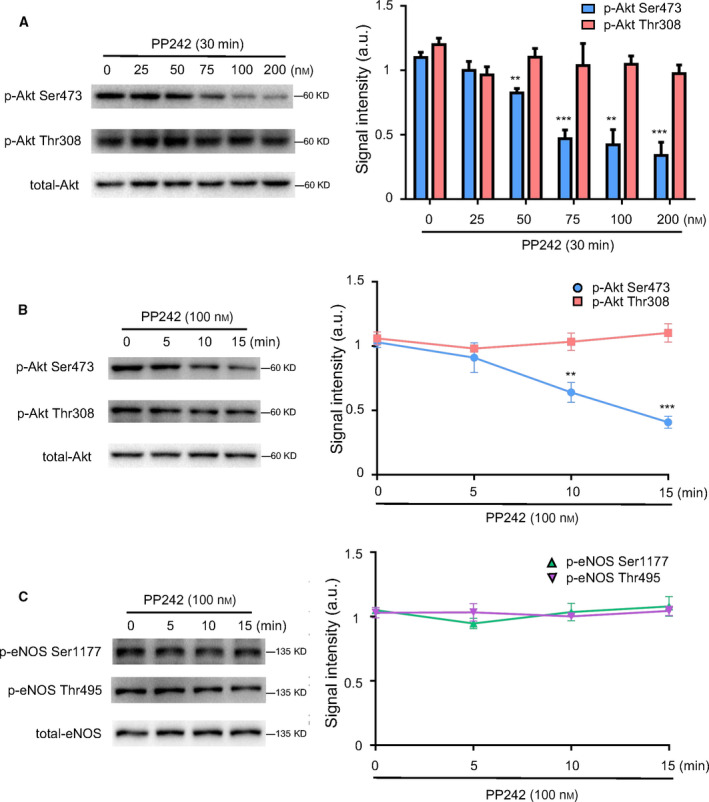
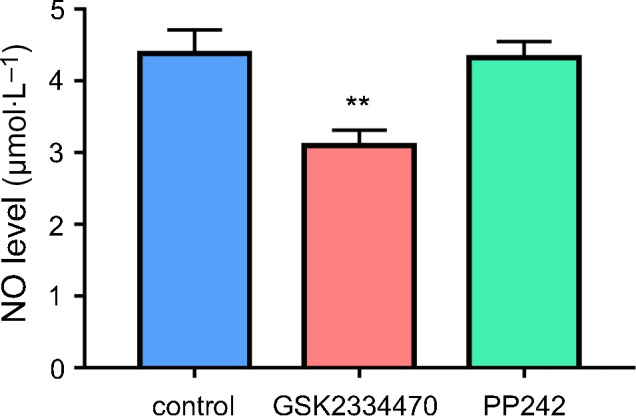
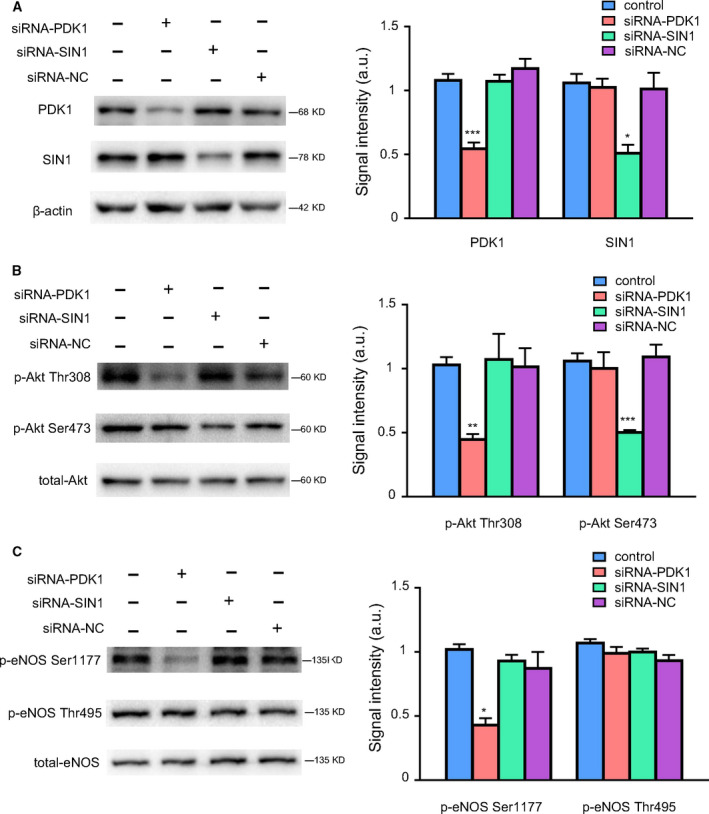
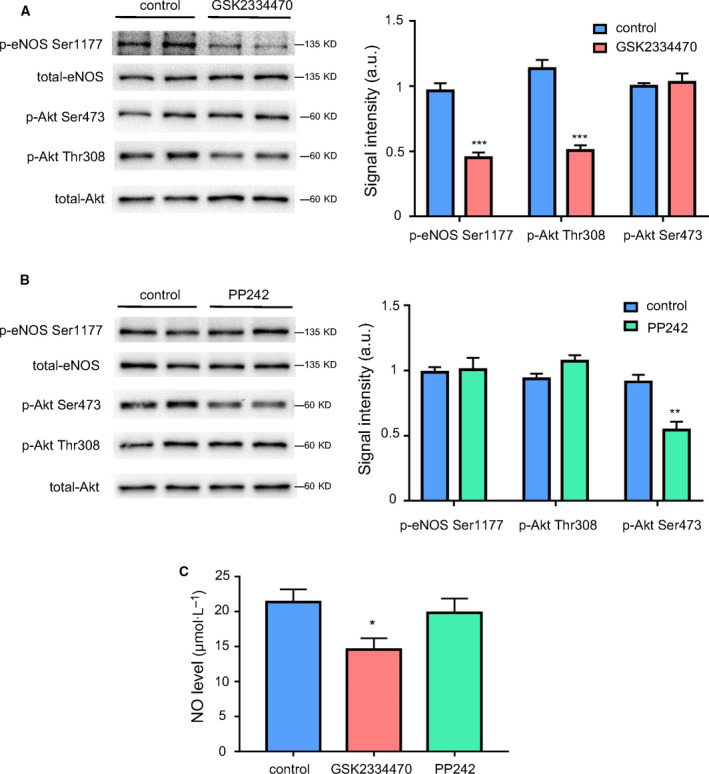
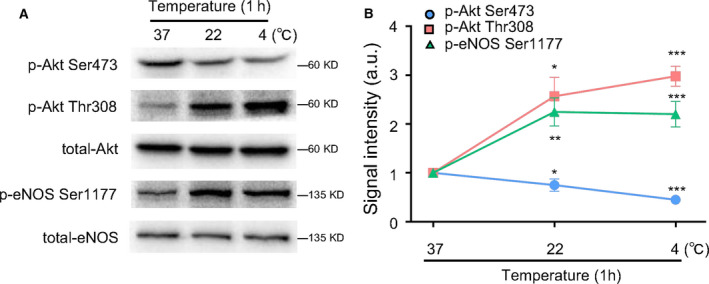
Endothelial nitric oxide synthase (eNOS)-derived nitric oxide (NO) plays a crucial role in maintaining vascular homeostasis. As a hallmark of eNOS activation, phosphorylation of eNOS at Ser1177 induced by activated protein kinase B (PKB/Akt) is pivotal for NO production. The complete activation of Akt requires its phosphorylation of both Thr308 and Ser473. However, which site plays the main role in regulating phosphorylation of eNOS Ser1177 is still controversial. The purpose of the present study is to explore the specific regulatory mechanism of phosphorylated Akt in eNOS activation. Inhibition of Akt Thr308 phosphorylation by a specific inhibitor or by siRNA in vitro led to a decrease in eNOS phosphorylation at Ser1177 and to lower NO concentration in the cell culture medium of HUVECs. However, inhibiting p-Akt Ser473 had no effect on eNOS phosphorylation at Ser1177. Next, we administered mice with inhibitors to downregulate p-Akt Ser473 or Thr308 activity. Along with the inhibition of p-Akt Thr308, vascular p-eNOS Ser1177 protein was simultaneously downregulated in parallel with a decrease in plasma NO concentration. Additionally, we cultured HUVECs at various temperature conditions (37, 22, and 4 °C). The results showed that p-Akt Ser473 was gradually decreased in line with the reduction in temperature, accompanied by increased levels of p-Akt Thr308 and p-eNOS Ser1177. Taken together, our study indicates that the phosphorylation of Akt at Thr308, but not at Ser473, plays a more significant role in regulating p-eNOS Ser1177 levels under physiological conditions.
Keywords: Akt; endothelial nitric oxide synthase; nitric oxide; phosphorylation.
© 2021 The Authors. FEBS Open Bio published by John Wiley & Sons Ltd on behalf of Federation of European Biochemical Societies.
Conflict of interest statement
Xiao‐xue LIANG, Rui‐yu WANG, Yong‐zheng GUO, Zhe CHENG, Ding‐yi LV, Ming‐hao LUO, An HE, Su‐xin LUO and Yong XIA declare that they have no conflict of interest.
Figures
References
-
- Gross SS and Wolin MS (1995) Nitric oxide: pathophysiological mechanisms. Annu Rev Physiol 57, 737–769. - PubMed
-
- Kapadia MR, Eng JW, Jiang Q, Stoyanovsky DA and Kibbe MR (2009) Nitric oxide regulates the 26S proteasome in vascular smooth muscle cells. Nitric Oxide 20, 279–288. - PubMed
-
- Scott‐Burden T, Schini VB, Elizondo E, Junquero DC and Vanhoutte PM (1992) Platelet‐derived growth factor suppresses and fibroblast growth factor enhances cytokine‐induced production of nitric oxide by cultured smooth muscle cells. Effects on cell proliferation. Circ Res 71, 1088–1100. - PubMed
-
- Gkaliagkousi E and Ferro A (2011) Nitric oxide signalling in the regulation of cardiovascular and platelet function. Front Biosci (Landmark Ed) 16, 1873–1897. - PubMed
Publication types
MeSH terms
Substances
LinkOut - more resources
Full Text Sources
Other Literature Sources
Molecular Biology Databases
Research Materials
Miscellaneous
