


The cultural evolution of cultural evolution
- PMID: 33993760
- PMCID: PMC8126465
- DOI: 10.1098/rstb.2020.0051
The cultural evolution of cultural evolution
Abstract
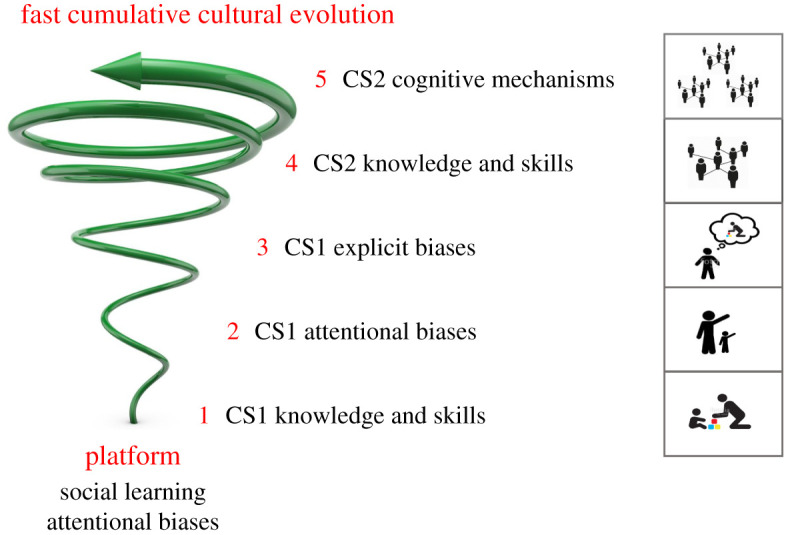
What makes fast, cumulative cultural evolution work? Where did it come from? Why is it the sole preserve of humans? We set out a self-assembly hypothesis: cultural evolution evolved culturally. We present an evolutionary account that shows this hypothesis to be coherent, plausible, and worthy of further investigation. It has the following steps: (0) in common with other animals, early hominins had significant capacity for social learning; (1) knowledge and skills learned by offspring from their parents began to spread because bearers had more offspring, a process we call CS1 (or Cultural Selection 1); (2) CS1 shaped attentional learning biases; (3) these attentional biases were augmented by explicit learning biases (judgements about what should be copied from whom). Explicit learning biases enabled (4) the high-fidelity, exclusive copying required for fast cultural accumulation of knowledge and skills by a process we call CS2 (or Cultural Selection 2) and (5) the emergence of cognitive processes such as imitation, mindreading and metacognition-'cognitive gadgets' specialized for cultural learning. This self-assembly hypothesis is consistent with archaeological evidence that the stone tools used by early hominins were not dependent on fast, cumulative cultural evolution, and suggests new priorities for research on 'animal culture'. This article is part of the theme issue 'Foundations of cultural evolution'.
Keywords: cognitive gadgets; cultural evolution; evolution of cognition; learning bias; metacognition; social learning strategy.
Figures
References
-
- Whitehead H, Rendell L. 2014. The cultural lives of whales and dolphins. Chicago, IL: University of Chicago Press.
-
- Sargeant BL, Mann J. 2009. Developmental evidence for foraging traditions in wild bottlenose dolphins. Anim. Behav. 78, 715-721. ( 10.1016/j.anbehav.2009.05.037) - DOI
Publication types
MeSH terms
Associated data
LinkOut - more resources
Full Text Sources
Other Literature Sources
Miscellaneous
