


Vascularized Scapular Bone Grafting: Indications, Techniques, Clinical Outcomes, and Alternatives
- PMID: 33994875
- PMCID: PMC8110353
- DOI: 10.1055/s-0041-1723833
Vascularized Scapular Bone Grafting: Indications, Techniques, Clinical Outcomes, and Alternatives
Abstract
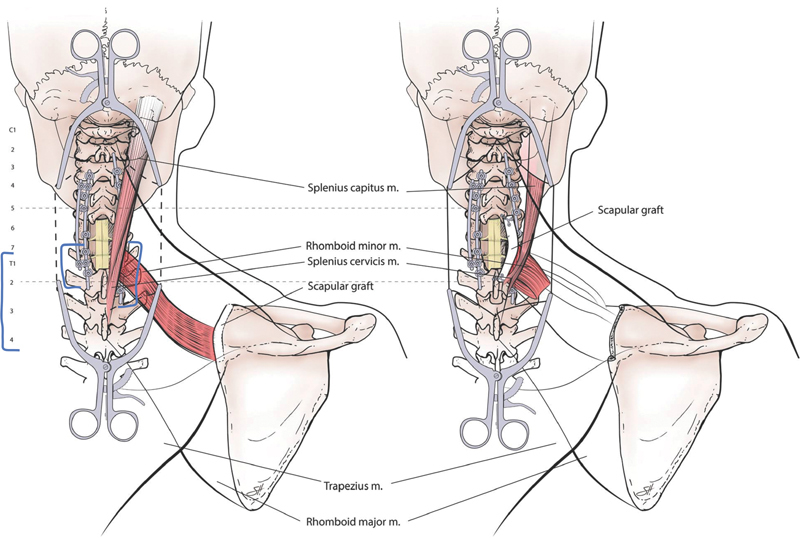
Spinal fusion can be challenging to obtain in patients with complex spinal pathology. Medial scapular vascularized bone grafts (S-VBGs) are a novel approach to supplement cervicothoracic arthrodesis in patients at high risk of failed spinal fusion. In this article, we discuss the benefits of using VBGs compared with both nonvascularized bone grafts and free vascularized bone flaps and the surgical technique, feasibility, and limitations specific to the S-VBG.
Keywords: autograft; medial scapula graft; pseudoarthrosis; spinal fusion; spinoplastic reconstruction; vascularized bone graft.
Thieme. All rights reserved.
Conflict of interest statement
Conflict of Interest Dr. Ropper receives consulting fees from Globus Medical and Stryker, but have no conflict with this article.
Figures
References
-
- Menezes A H. Craniocervical fusions in children. J Neurosurg Pediatr. 2012;9(06):573–585. - PubMed
-
- Reece E M, Vedantam A, Lee S. Pedicled, vascularized occipital bone graft to supplement atlantoaxial arthrodesis for the treatment of pseudoarthrosis. J Clin Neurosci. 2020;74:205–209. - PubMed
-
- Shin A Y, Dekutoski M B.The role of vascularized bone grafts in spine surgery Orthop Clin North Am 2007380161–72., vi, vi. - PubMed
-
- Singh K, Nandyala S V, Marquez-Lara A. Clinical sequelae after rhBMP-2 use in a minimally invasive transforaminal lumbar interbody fusion. Spine J. 2013;13(09):1118–1125. - PubMed
Publication types
LinkOut - more resources
Full Text Sources
Other Literature Sources
