Observational Study
. 2021 Apr 29:12:675678.
doi: 10.3389/fimmu.2021.675678. eCollection 2021.

Respiratory Impairment Predicts Response to IL-1 and IL-6 Blockade in COVID-19 Patients With Severe Pneumonia and Hyper-Inflammation

Affiliations
Observational Study

Respiratory Impairment Predicts Response to IL-1 and IL-6 Blockade in COVID-19 Patients With Severe Pneumonia and Hyper-Inflammation

Emanuel Della-Torre et al. Front Immunol. .

Abstract

Background: Restraining maladaptive inflammation is considered a rationale strategy to treat severe coronavirus disease-19 (COVID-19) but available studies with selective inhibitors of pro-inflammatory cytokines have not provided unequivocal evidence of survival advantage. Late administration is commonly regarded as a major cause of treatment failure but the optimal timing for anti-cytokine therapy initiation in COVID-19 patients has never been clearly established.

Objectives: To identify a window of therapeutic opportunity for maximizing the efficacy of interleukin (IL)-1 and IL-6 blockade in COVID-19.

Methods: Survival at the longest available follow-up was assessed in severe hyper-inflamed COVID-19 patients treated with anakinra, tocilizumab, sarilumab, or standard of care, stratified according to respiratory impairment at the time of treatment initiation.

Results: 107 patients treated with biologics and 103 contemporary patients treated with standard of care were studied. After a median of 106 days of follow-up (range 3-186), treatment with biologics was associated with a significantly higher survival rate compared to standard therapy when initiated in patients with a PaO2/FiO2 ≥ 100 mmHg (p < 0.001). Anakinra reduced mortality also in patients with PaO2/FiO2 < 100 mmHg (p = 0.04).

Conclusions: IL-1 and IL-6 blocking therapies are more likely to provide survival advantage in hyper-inflamed COVID-19 patients when initiated before the establishment of severe respiratory failure.

Keywords: COVID-19; SARS-CoV-2; anakinra; interleukin-1; interleukin-6; sarilumab; tocilizumab.


Conflict of interest statement

The authors declare that the research was conducted in the absence of any commercial or financial relationships that could be construed as a potential conflict of interest.

Figures
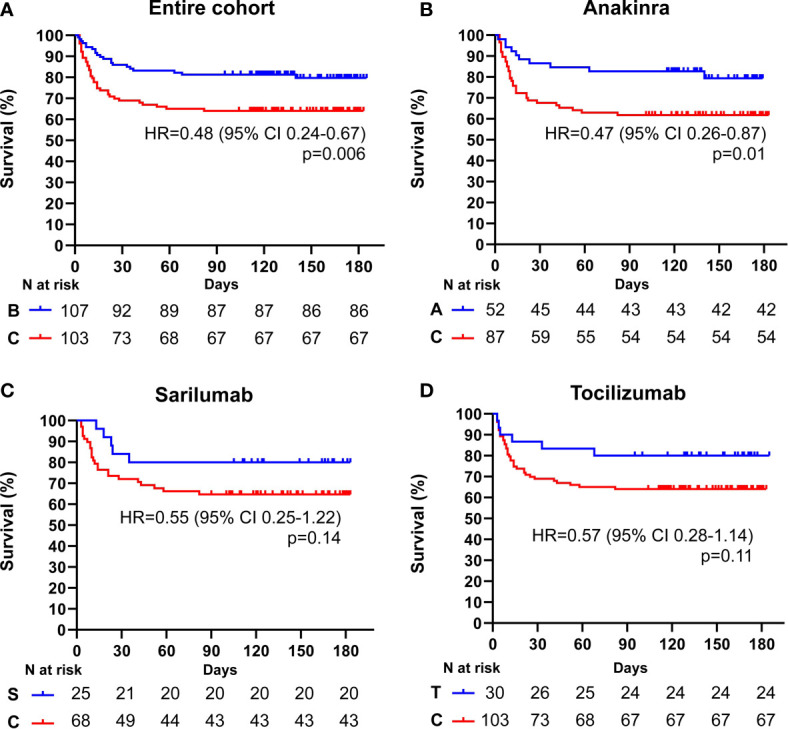
Figure 1
Figure 1
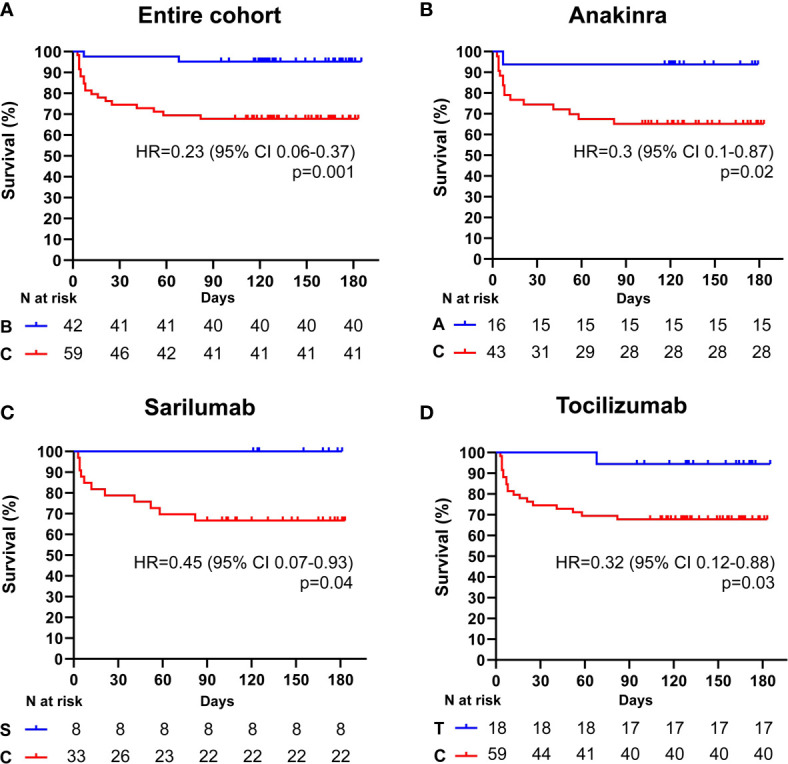
Cumulative incidence of long-term survival of patients treated with biologic drugs compared to patients treated with standard of care: entire patient cohort. Kaplan-Meier curves showing the cumulative incidence of overall survival up to 186 days of the entire cohort of patients treated with biologic drugs (A), anakinra (B), sarilumab (C), and tocilizumab (D) compared to patients treated with standard of care. Time to death is expressed in days from the day of enrolment. A, anakinra; B, biologic drugs; C, comparators treated with standard of care; S, sarilumab; T, tocilizumab; HR, hazard ratio; CI, confidence interval. Statistically significant p value < 0.05.
Figure 2
Figure 2
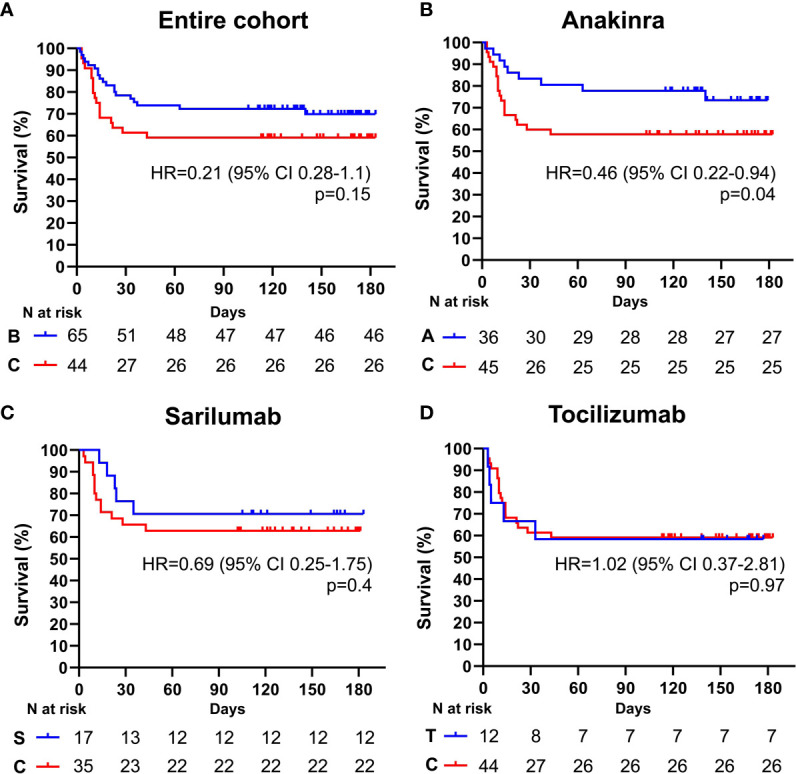
Cumulative incidence of long-term survival of patients treated with biologic drugs compared to patients treated with standard of care (PaO2/FiO2 ratio ≥ mmHg). Kaplan-Meier curves showing the cumulative incidence of overall survival up to 186 days of patients presenting with a PaO2/FiO2 ratio ≥ mmHg and treated with biologic drugs (A), anakinra (B), sarilumab (C), and tocilizumab (D), compared to standard of care. Time to death is expressed in days from the day of enrolment. A, anakinra; B, biologic drugs; C, comparators treated with standard of care; S, sarilumab; T, tocilizumab; HR, hazard ratio; CI, confidence interval. Statistically significant p value < 0.05.
Figure 3
Figure 3
Cumulative incidence of long-term survival of patients treated with biologic drugs compared to patients treated with standard of care (PaO2/FiO2 ratio < mmHg). Kaplan-Meier curves showing the cumulative incidence of overall survival up to 186 days of patients presenting with a PaO2/FiO2 ratio < mmHg and treated with biologic drugs (A), anakinra (B), sarilumab (C), and tocilizumab (D), compared to standard of care. Time to death is expressed in days from the day of enrolment. A, anakinra; B, biologic drugs; C, comparators treated with standard of care; S, sarilumab; T, tocilizumab; HR, hazard ratio; CI, confidence interval. Statistically significant p value < 0.05.

References

    1. Mehta P, McAuley DF, Brown M, Sanchez E, Tattersall RS, Manson JJ, et al. Covid-19: Consider Cytokine Storm Syndromes and Immunosuppression. Lancet (2020) 395:1033–4. 10.1016/S0140-6736(20)30628-0 - DOI - PMC - PubMed
    1. Blanco-Melo D, Nilsson-Payant BE, Liu WC, Uhl S, Hoagland D, Moller R, et al. Imbalanced Host Response to SARS-CoV-2 Drives Development of COVID-19. Cell (2020) 181:1036–45.e9. 10.1016/j.cell.2020.04.026 - DOI - PMC - PubMed
    1. Campochiaro C, Della-Torre E, Cavalli G, De Luca G, Ripa M, Boffini N, et al. Efficacy and Safety of Tocilizumab in Severe COVID-19 Patients: A Single-Centre Retrospective Cohort Study. Eur J Intern Med (2020) 76:43–9. 10.1016/j.ejim.2020.05.021 - DOI - PMC - PubMed
    1. Della-Torre E, Campochiaro C, Cavalli G, De Luca G, Napolitano A, La Marca S, et al. Interleukin-6 Blockade With Sarilumab in Severe COVID-19 Pneumonia With Systemic Hyperinflammation: An Open-Label Cohort Study. Ann Rheum Dis (2020) 79:1277–85. 10.1136/annrheumdis-2020-218122 - DOI - PMC - PubMed
    1. Salvarani C, Dolci G, Massari M, Merlo DF, Cavuto S, Savoldi L, et al. Effect of Tocilizumab vs Standard of Care on Clinical Worsening in Patients Hospitalized With COVID-19 Pneumonia: A Randomized Clinical Trial. JAMA Intern Med (2021) 181:24–31. 10.1001/jamainternmed.2020.6615 - DOI - PMC - PubMed

Publication types

MeSH terms