. 2021 Apr 19:2021:6634837.
doi: 10.1155/2021/6634837. eCollection 2021.

Total Flavonoids of Rhizoma Drynariae Restore the MMP/TIMP Balance in Models of Osteoarthritis by Inhibiting the Activation of the NF- κB and PI3K/AKT Pathways

Affiliations

Total Flavonoids of Rhizoma Drynariae Restore the MMP/TIMP Balance in Models of Osteoarthritis by Inhibiting the Activation of the NF- κB and PI3K/AKT Pathways

Guang-Yao Chen et al. Evid Based Complement Alternat Med. .

Abstract

Total flavonoids of Rhizoma Drynariae (TFRD) have been shown to have beneficial effects on osteoarthritis (OA) clinically, but the mechanisms have not been elucidated. In this study, we investigated the effect of TFRD on articular cartilage in an OA rat model established by the Hulth method and in SW1353 chondrocytes induced by the proinflammatory factor interleukin-1β (IL-1β). The results showed that TFRD could alleviate the pathological changes in knee cartilage in OA model rats. In vivo, the qPCR analysis indicated that the mRNA levels of matrix metalloproteinases, MMP-1, MMP-3, and MMP-13, were decreased, while tissue inhibitor of matrix metalloproteinases- (TIMP-) 4 was increased in cartilage, and these changes could be partially prevented by TFRD. In vitro experiments showed that IL-1β could significantly increase the expression of MMP-1, MMP-3, and MMP-13 and decrease the expression of TIMP-4 in SW1353 cells at the mRNA and protein levels. TFRD could increase the expression of MMP-3 and MMP-13 and decrease the expression of TIMP-4. Transfection of siRNA and addition of pathway inhibitors were used to clarify that inhibition of NF-κB and PI3K/AKT pathway decreased MMP-1, MMP-3, and MMP-13 and increased TIMP-4 expression. We also found that in IL-1β-induced SW1353 cells, TFRD pretreatment had a modest inhibitory effect on p-AKT (Ser473) and reversed the increase of nuclear factor kappa-B (NF-κB) p65 in nuclear fraction and the decrease of inhibitor of NF-κB(IκB)-α in the cytosolic fraction. Further immunofluorescence confirmed that TFRD can inhibit IL-1β-induced NF-κB p65 translocation to the nucleus to some extent. In conclusion, TFRD showed chondroprotective effects by restoring the MMP/TIMP balance in OA models by suppressing the activation of the NF-κB and PI3K/AKT pathways.


Conflict of interest statement

All authors declare no conflicts of interest.

Figures
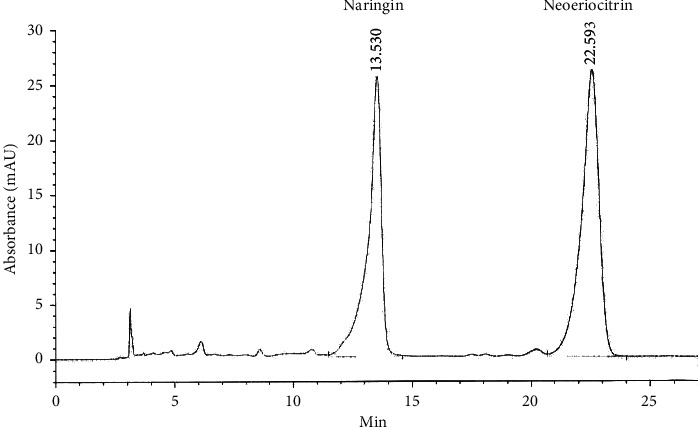
Figure 1
Figure 1
Chromatographic fingerprint of TFRD.
Figure 2
Figure 2
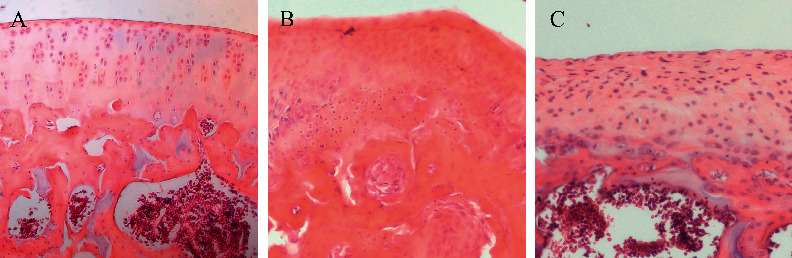
Pathological changes in the different groups (hematoxylin-eosin staining). (a) Blank control group; (b) OA model group (established with the Hulth method); (c) TFRD-treated group (treated with total flavonoids of Rhizoma Drynariae (TFRD) after model induction with the Hulth method).
Figure 3
Figure 3
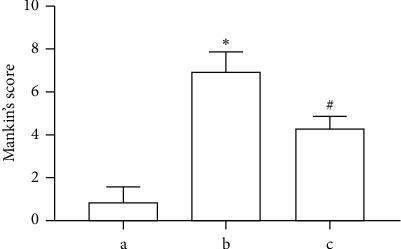
Mankin's scoring was based on the hematoxylin-eosin (HE) staining results. (a) Blank control group; (b) OA model group (established with the Hulth method); (c) TFRD-treated group (treated with total flavonoids of Rhizoma Drynariae (TFRD) after model induction with the Hulth method. The data are expressed as the mean ± standard deviation (p < 0.01 compared with Group a; #p < 0.01 compared with Group b).
Figure 4
Figure 4
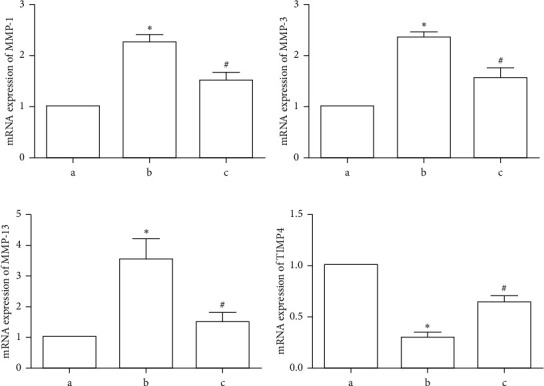
Effects of total flavonoids of Rhizoma Drynariae (TFRD) on MMP-1, MMP-3, MMP-13, and TIMP-4 mRNA expression in articular cartilage in the different groups. Group a, blank control group; Group b, OA model group (established with the Hulth method); Group c, TFRD-treated group (treated with TFRD after model induction with the Hulth method). The data are derived from six independent experiments and expressed as the mean ± standard deviation (p < 0.05 compared with Group a; #p < 0.05 compared with Group b).
Figure 5
Figure 5
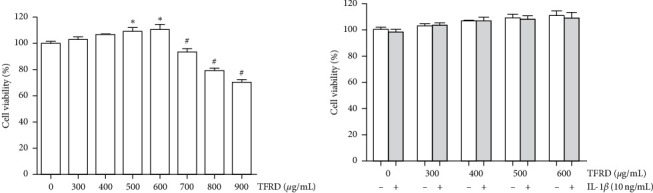
The viability of SW1353 cells after treatment with different concentrations of total flavonoids of Rhizoma Drynariae (TFRD) and 10 ng/mL IL-1β. (a) SW1353 cells were treated with different concentrations of TFRD alone for 12 h. (b) SW1353 cells were treated with different concentrations of TFRD with or without 10 ng/mL IL-1β for 12 h. The data are derived from six independent experiments and expressed as the mean ± standard deviation (p < 0.05: cell viability increased compared with the control group; #p < 0.05: cell viability decreased compared with the control group).
Figure 6
Figure 6
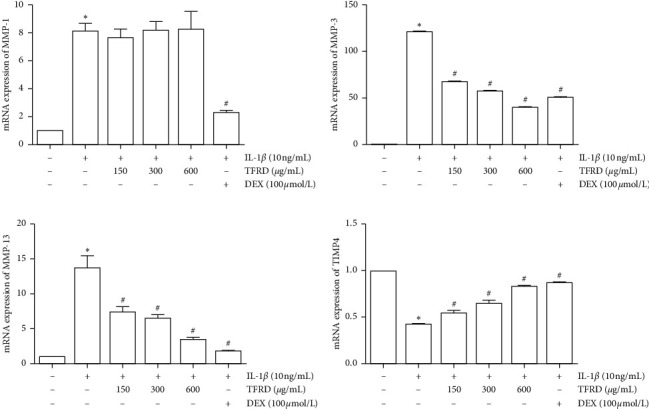
Inhibition of MMP-3 and MMP-13 and promotion of TIMP-4 mRNA expression in IL-1β-induced SW1353 cells by total flavonoids of Rhizoma Drynariae (TFRD). Cells were pretreated with 150, 300, or 600 μg/mL TFRD or 100 μmol/L dexamethasone (DEX) for 1 h and then stimulated with 10 ng/mL IL-1β for 12 h. The data are derived from three independent experiments and expressed as the mean ± standard deviation. (p < 0.05 compared with the control group; #p < 0.05 compared with the IL-1β-treated group).
Figure 7
Figure 7
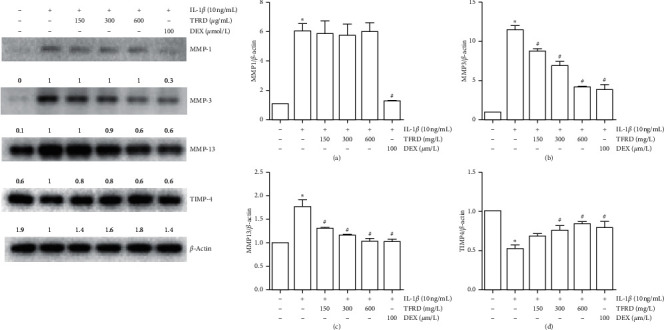
Inhibition of MMP-3 and MMP-13 and promotion of TIMP-4 protein expression in IL-1β-induced SW1353 cells by total flavonoids of Rhizoma Drynariae (TFRD). Before stimulation with 10 ng/mL IL-1β for 12 h, cells were pretreated with 150, 300, or 600 μg/mL TFRD or 100 μmol/L dexamethasone (DEX) for 1 h. The cells were lysed, and MMP-1, MMP-3, MMP-13, and TIMP-4 levels were measured by Western blotting. The data are derived from three independent experiments and expressed as the mean ± standard deviation. (p < 0.05 compared with the control group; #p < 0.05 compared with the IL-1β-treated group).
Figure 8
Figure 8
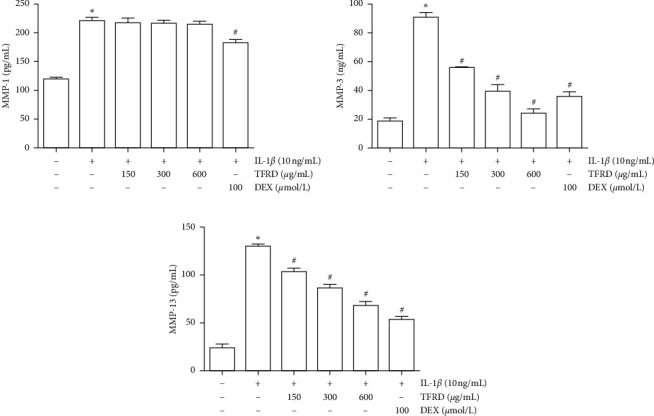
Inhibition of MMP-3 and MMP-13 protein expression in IL-1β-induced SW1353 cells by total flavonoids of Rhizoma Drynariae (TFRD). Before stimulation with 10 ng/mL IL-1β for 12 h, cells were pretreated with 150, 300, or 600 μg/mL TFRD or 100 μmol/L dexamethasone (DEX) for 1 h. Subsequently, the supernatants of the cultured cells were collected, and MMP-1, MMP-3, and MMP-13 levels were measured by ELISA. The data are derived from three independent experiments and expressed as the mean ± standard deviation (p < 0.01 compared with the control group; #p < 0.05 compared with the IL-1β-treated group).
Figure 9
Figure 9
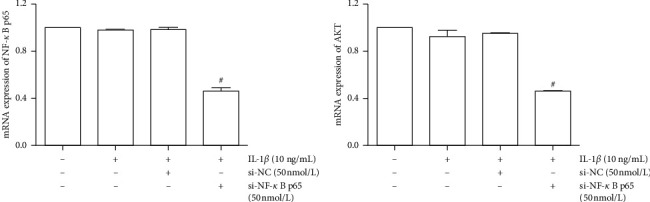
Inhibition of NF-κB p65 and AKT mRNA expression in IL-1β-induced SW1353 cells by si-NF-κB and si-AKT. The data are derived from three independent experiments and expressed as the mean ± standard deviation (#p < 0.01 compared with the IL-1β-treated group).
Figure 10
Figure 10
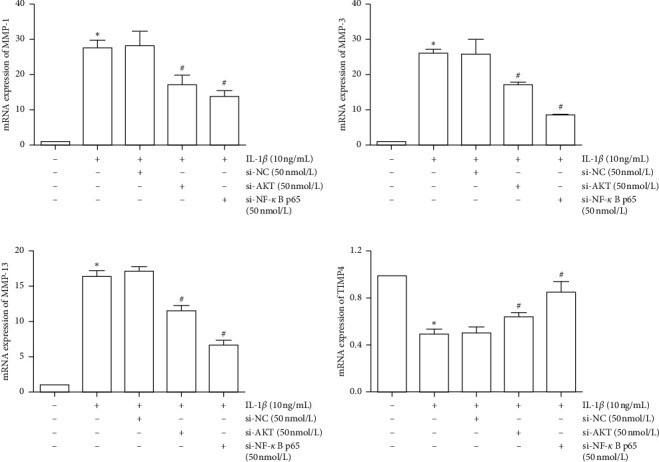
Inhibition of MMP-1, MMP-3, MMP-13, and TIMP4 mRNA expression in IL-1β-induced SW1353 cells by si-AKT and si-NF-κB. The data are derived from three independent experiments and expressed as the mean ± standard deviation (p < 0.01 compared with the control group; #p < 0.05 compared with the IL-1β-treated group).
Figure 11
Figure 11
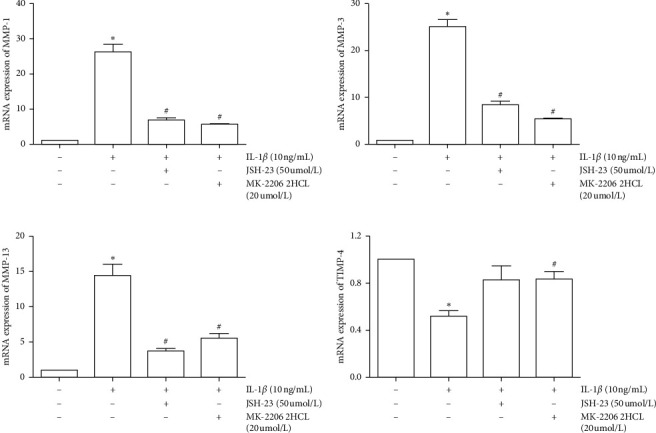
Inhibition of MMP-1, MMP-3, MMP-13, and TIMP4 mRNA expression in IL-1β-induced SW1353 cells by JSH-23 and MK-2206. The data are derived from three independent experiments and expressed as the mean ± standard deviation (p < 0.05 compared with the control group; #p < 0.05 compared with the IL-1β-treated group).
Figure 12
Figure 12
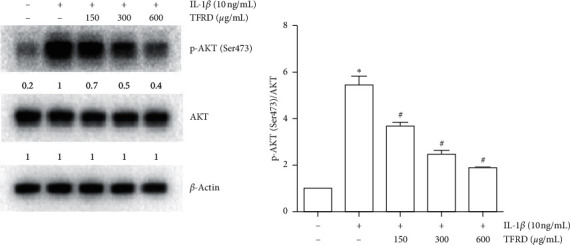
Inhibition of p-AKT levels in IL-1β-induced SW1353 cells by total flavonoids of Rhizoma Drynariae (TFRD). Before stimulation with 10 ng/mL IL-1β for 12 h, cells were pretreated with 150, 300, or 600 μg/mL TFRD for 1 h. Subsequently, the cells were lysed, and AKT and p-AKT (Ser473) were measured by Western blotting. The data are derived from three independent experiments and expressed as the mean ± standard deviation. (p < 0.01 compared with the control group; #p < 0.05 compared with the IL-1β-treated group).
Figure 13
Figure 13
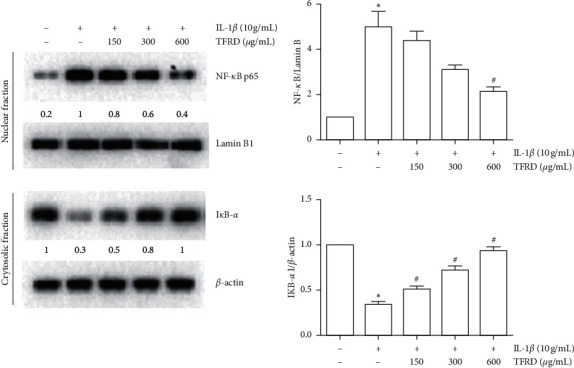
Effects of total flavonoids of Rhizoma Drynariae (TFRD) on NF-κB p65 and IκB-α levels in IL-1β-induced SW1353 cells. Before stimulation with 10 ng/mL IL-1β for 30 min, cells were pretreated with 150, 300, or 600 μg/mL TFRD for 1 h. Total cytosolic and nuclear proteins were extracted. IκB-α in the cytosol and NF-κB p65 in the nucleus were measured by Western blotting. Lamin B and β-actin were used as internal references for the nuclear and cytoplasmic fractions, respectively. The data are derived from three independent experiments and expressed as the mean ± standard deviation. (p < 0.05 compared to the control group; #p < 0.05 compared to the IL-1β-treated group).
Figure 14
Figure 14
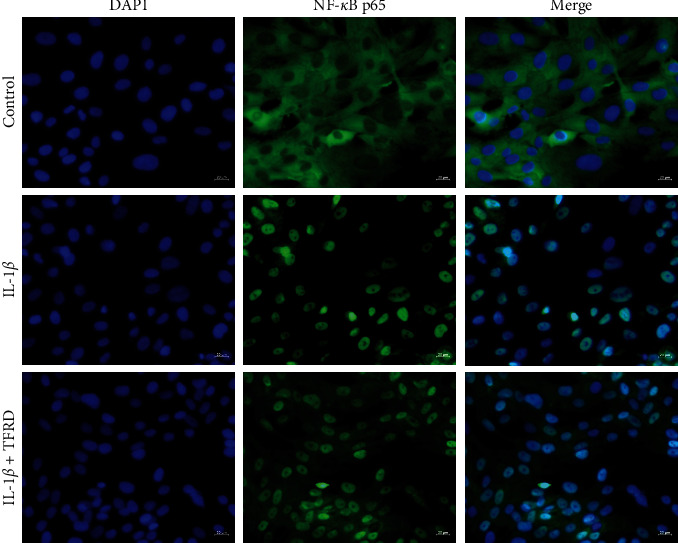
The cells were pretreated with TFRD (600 µg/ml) for 1 h before IL-1β treatment (10 ng/ml). After 30 min of incubation, the localization of NF-κB p65 was visualized with fluorescence microscopy after immunofluorescence stained with anti-NF-κB p65 antibody (green). The cells were also stained with DAPI to visualize the nuclei (blue).

References

    1. Hunter D. J., Bierma-Zeinstra S. Osteoarthritis. The Lancet. 2019;393(10182):1745–1759. doi: 10.1016/s0140-6736(19)30417-9. - DOI - PubMed
    1. Frasca D., Blomberg B. B., Paganelli R. Aging, obesity, and inflammatory age-related diseases. Frontiers in Immunology. 2019;8:p. 1745. - PMC - PubMed
    1. Wallace I. J., Worthington S., Felson D. T., et al. Knee osteoarthritis has doubled in prevalence since the mid-20th century. Proceedings of the National Academy of Sciences. 2017;114(35):9332–9336. doi: 10.1073/pnas.1703856114. - DOI - PMC - PubMed
    1. Mishra A., Awasthi S., Raj S., et al. Identifying the role of ASPN and COMP genes in knee osteoarthritis development. Journal of Orthopaedic Surgery and Research. 2019;14(1):p. 337. doi: 10.1186/s13018-019-1391-7. - DOI - PMC - PubMed
    1. El-Sayed M. E., Asmaa K. F., Samar E. S. The role of matrix metalloproteinases in osteoarthritis pathogenesis: an updated review. Life Sciences. 2019;234 doi: 10.1016/j.lfs.2019.116786.116786 - DOI - PubMed

LinkOut - more resources