Review
. 2021 May 15;12(5):616-629.
doi: 10.4239/wjd.v12.i5.616.

Role of insulin and insulin resistance in androgen excess disorders

Affiliations
Review

Role of insulin and insulin resistance in androgen excess disorders

Kursad Unluhizarci et al. World J Diabetes. .

Abstract

Insulin has complex effects on cell growth, metabolism and differentiation, and these effects are mediated by a cell-surface bound receptor and eventually a cascade of intracellular signaling events. Among the several metabolic and growth-promoting effects of insulin, insulin resistance is defined as an attenuated effect of insulin on glucose metabolism, primarily the limited export of blood glucose into skeletal muscle and adipose tissue. On the other hand, not all the signaling pathways and insulin-responsive tissues are equally affected, and some effects other than the metabolic actions of insulin are overexpressed. Ovaries and the adrenal glands are two examples of tissues remaining sensitive to insulin actions where insulin may contribute to increased androgen secretion. Polycystic ovary syndrome (PCOS) is the most common form of androgen excess disorder (AED), and its pathogenesis is closely associated with insulin resistance. Patients with idiopathic hirsutism also exhibit insulin resistance, albeit lower than patients with PCOS. Although it is not as evident as in PCOS, patients with congenital adrenal hyperplasia may have insulin resistance, which may be further exacerbated with glucocorticoid overtreatment and obesity. Among patients with severe insulin resistance syndromes, irrespective of the type of disease, hyperinsulinemia promotes ovarian androgen synthesis independently of gonadotropins. It is highly debated in whom and how insulin resistance should be diagnosed and treated among patients with AEDs, including PCOS. It is not suitable to administer an insulin sensitizer relying on only some mathematical models used for estimating insulin resistance. Instead, the treatment decision should be based on the constellation of the signs, symptoms and presence of obesity; acanthosis nigricans; and some laboratory abnormalities such as impaired glucose tolerance and impaired fasting glucose.

Keywords: Androgen excess; Hyperandrogenism; Hyperinsulinemia; Insulin; Insulin resistance.


Conflict of interest statement

Conflict-of-interest statement: The authors declare that there are no conflicts of interest to disclose.

Figures
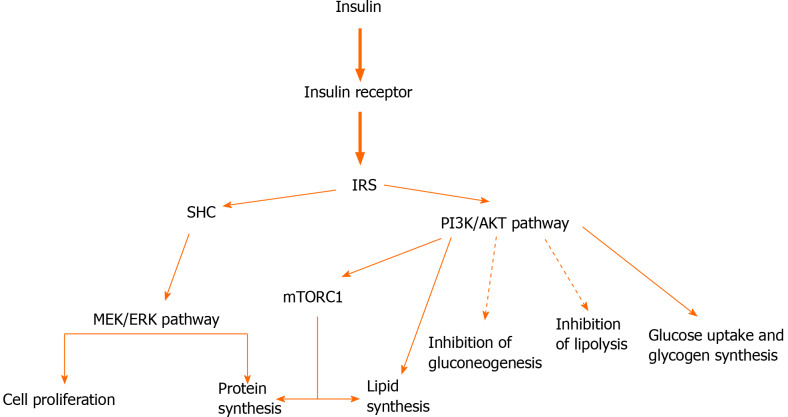
Figure 1
Figure 1
A brief scheme of the insulin signaling pathway under physiological conditions. After insulin binds to its own receptor, several pathways are activated/inactivated, resulting in an anabolic state of insulin. The autophosphorylation of insulin receptor tyrosine kinase is followed by tyrosine phosphorylation of insulin receptor substrate. The phosphatidylinositol-3-kinase/serine/threonine-specific protein kinase B (AKT) signaling pathway promotes glucose uptake and glycogen and lipid synthesis while inhibiting hepatic gluconeogenesis and lipolysis. Moreover, AKT kinases activate mechanistic target of rapamycin complex 1, which promotes de novo synthesis of proteins and lipids. An additional insulin signaling pathway via Src homology 2 domain-containing transforming proteins and the mitogen-activated protein kinase/extracellular signal-related kinase pathway promotes cell proliferation and protein synthesis. Dotted lines represent inhibition, and solid lines represent stimulation/activation. IRS: Insulin receptor substrate; SHC: Src homology 2 domain-containing transforming proteins; MEK: Mitogen-activated protein kinase; ERK: Extracellular signal-related kinase; PI3K: Phosphatidylinositol-3-kinase; AKT: Serine/threonine-specific protein kinase B; mTORC: Mechanistic target of rapamycin complex.
Figure 2
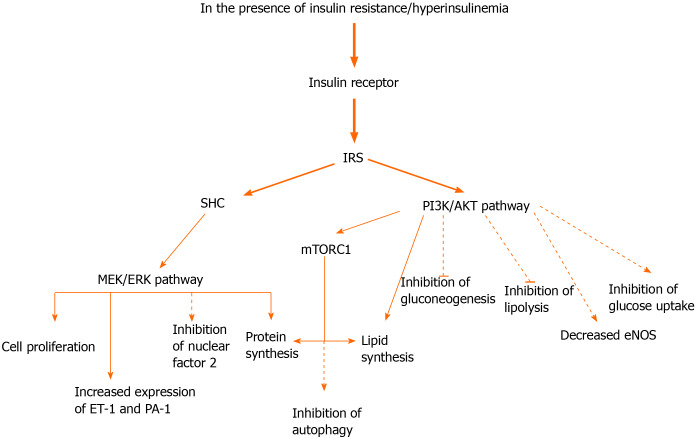
Figure 2
A brief scheme of the insulin signaling pathway in the presence of insulin resistance. Not all insulin signaling pathways are equally affected, and selective insulin resistance is observed. (Partial) resistance in the phosphatidylinositol-3-kinase/serine/threonine-specific protein kinase B pathway results in decreased glucose uptake mediated by insufficient translocation of glucose transporter 4 and decreased inhibition of lipolysis and gluconeogenesis. Additionally, deficient activation of endothelial nitric oxide synthase is also observed. Insulin-resistance-associated hyperinsulinemia promotes anabolic cell activities via the mitogen-activated protein kinase (MEK)/extracellular signal-related kinase (ERK) pathway and via mechanistic target of rapamycin complex 1. In addition to the anabolic actions of signaling via the MEK/ERK pathway, there is also enhanced expression of plasminogen 1 and endothelin 1. The inhibition of nuclear factor 2 compromises cell defense mechanisms against radical stress. Dotted lines represent inhibition, and solid lines represent stimulation/activation. IRS: Insulin receptor substrate; SHC: Src homology 2 domain-containing transforming proteins; MEK: Mitogen-activated protein kinase; ERK: Extracellular signal-related kinase; PI3K: Phosphatidylinositol-3-kinase; AKT: Serine/threonine-specific protein kinase B; mTORC: Mechanistic target of rapamycin complex 1; GLUT4: Glucose transporter 4; ET-1: Endothelin 1; eNOS: endothelial nitric oxide synthase; PAI: Plasminogen activator.

References

    1. Taniguchi CM, Emanuelli B, Kahn CR. Critical nodes in signalling pathways: insights into insulin action. Nat Rev Mol Cell Biol. 2006;7:85–96. - PubMed
    1. Gehart H, Kumpf S, Ittner A, Ricci R. MAPK signalling in cellular metabolism: stress or wellness? EMBO Rep. 2010;11:834–840. - PMC - PubMed
    1. Haeusler RA, McGraw TE, Accili D. Biochemical and cellular properties of insulin receptor signalling. Nat Rev Mol Cell Biol. 2018;19:31–44. - PMC - PubMed
    1. Björnholm M, He AR, Attersand A, Lake S, Liu SC, Lienhard GE, Taylor S, Arner P, Zierath JR. Absence of functional insulin receptor substrate-3 (IRS-3) gene in humans. Diabetologia. 2002;45:1697–1702. - PubMed
    1. Boucher J, Kleinridders A, Kahn CR. Insulin receptor signaling in normal and insulin-resistant states. Cold Spring Harb Perspect Biol. 2014;6:a009191. - PMC - PubMed

LinkOut - more resources