


Health promotion interventions post-stroke for improving self-management: A systematic review
- PMID: 33996032
- PMCID: PMC8082985
- DOI: 10.1177/20480040211004416
Health promotion interventions post-stroke for improving self-management: A systematic review
Abstract
Background: It is well-documented that women tend to be worse off post-stroke. They are often frailer, have less independence, lower functionality, increased rates of depression, and overall a lower quality of life. People who have had strokes benefit from rehabilitative support to increase their independence and reduce the risk of stroke reoccurrence. Despite the gender differences in the effects of stroke, interventions explicitly aimed at helping women have not been identified.
Purpose: This systematic review aimed to summarize the effectiveness of the health promoting behavioural interventions for reducing risk factors and improved self-management in women post-stroke, compared to usual care.
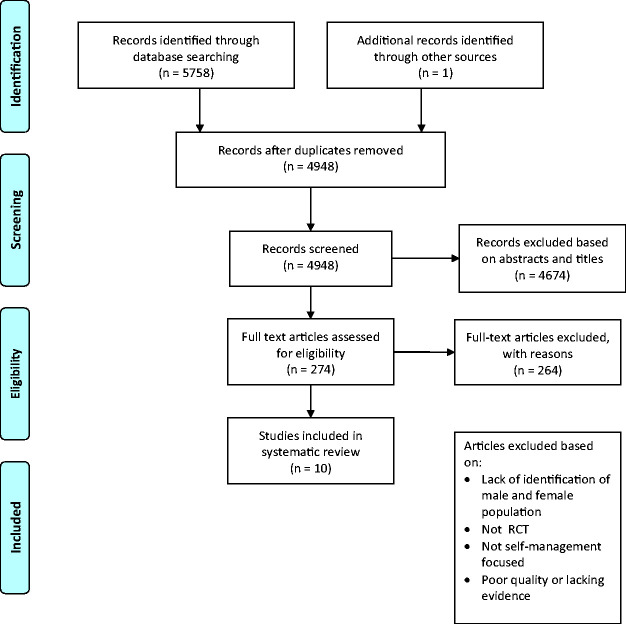
Method: Seven databases, Medline (Ovid), CINAHL, PsychInfo, Embase, PubMed, Scopus, and Google Scholar, were reviewed for randomized controlled trials covering post-stroke interventions. The following keywords were used: health promotion, secondary prevention, woman, women, female, sex difference, gender difference, after stroke, and post-stroke.
Results: Ten randomised controlled trials were found. These demonstrated common successful approaches for rehabilitation, but none specifically described health promotion strategies for women. Core components of successful programs appeared to be a structured approach, tailored to clientele and formalised support systems through their carer, family networks, or community engagement. Comprehensive reminder systems were successful for stroke risk reduction.
Conclusion: Women are disproportionately affected by stroke and are often in the frail category. Tailored structured health promotion programs with family and caregiver support combined with a comprehensive reminder system would appear to enable women post-stroke.
Keywords: After-stroke; cardiology; female; health promotion; secondary prevention; treatment.
© The Author(s) 2021.
Conflict of interest statement
Declaration of conflicting interests: The author(s) declared no potential conflicts of interest with respect to the research, authorship, and/or publication of this article.
Figures
References
-
- World Health Organization. The top ten causes of death, www.who.int/news-room/fact-sheets/detail/the-top-10-causes-of-death (2019, accessed 7 March 2020).
-
- Stroke Foundation NZ. Reducing your risk of stroke, www.stroke.org.nz/reducing-stroke-risk (2019, accessed 7 March 2020).
-
- Slark J, Bentley P, Majeed A, et al.. Awareness of stroke symptomatology and cardiovascular risk factors amongst stroke survivors. J Stroke Cerebrovasc 2012; 21: 358–362. - PubMed
-
- Nicholson SL, Donaghy M, Johnston M, et al.. A qualitative theory guided analysis of stroke survivors’ perceived barriers and facilitators to physical activity. Disabil Rehabil 2014; 36: 1857–1868. - PubMed
-
- Poltawski L, Boddy K, Forster A, et al.. Motivators for uptake and maintenance of exercise: perceptions of long-term stroke survivors and implications for design of exercise programmes. Disabil Rehabil 2015; 37: 795–801. - PubMed
Publication types
LinkOut - more resources
Full Text Sources
