


Survival and predictors of mortality among patients admitted to the intensive care units in southern Ethiopia: A multi-center cohort study
- PMID: 33996053
- PMCID: PMC8091884
- DOI: 10.1016/j.amsu.2021.102318
Survival and predictors of mortality among patients admitted to the intensive care units in southern Ethiopia: A multi-center cohort study
Abstract
Background: The burden of life-threatening conditions requiring intensive care units has grown substantially in low-income countries related to an emerging pandemic, urbanization, and hospital expansion. The rate of ICU mortality varied from region to region in Ethiopia. However, the body of evidence on ICU mortality and its predictors is uncertain. This study was designed to investigate the pattern of disease and predictors of mortality in Southern Ethiopia.
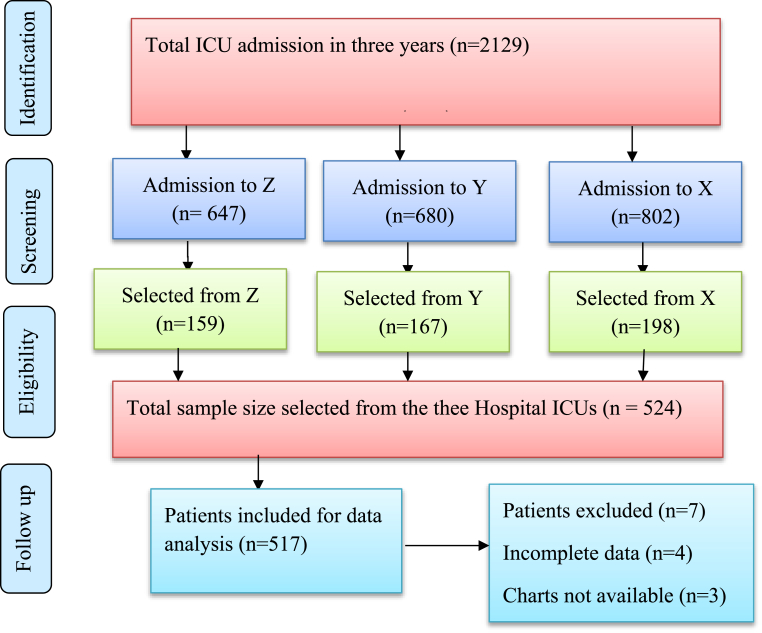
Methods: After obtaining ethical clearance from the Institutional Review Board (IRB), a multi-center cohort study was conducted among three teaching referral hospital ICUs in Ethiopia from June 2018 to May 2020. Five hundred and seventeen Adult ICU patients were selected. Data were entered in Statistical Package for Social Sciences version 22 and STATA version 16 for analysis. Descriptive statistics were run to see the overall distribution of the variables. Chi-square test and odds ratio were determined to identify the association between independent and dependent variables. Multivariate analysis was conducted to control possible confounders and identify independent predictors of ICU mortality.
Results: The mean (±SD) of the patients admitted in ICU was 34.25(±5.25). The overall ICU mortality rate was 46.8%. The study identified different independent predictors of mortality. Patients with cardiac arrest were approximately 12 times more likely to die as compared to those who didn't, AOR = 11.9(95% CI:6.1 to 23.2).
Conclusion: The overall mortality rate in ICU was very high as compared to other studies in Ethiopia as well as globally which entails a rigorous activity from different stakeholders.
Keywords: ACLS, advanced cardiac life support; AOR, Adjusted Odds Ratio; APACHE, Acute Physiologic and Chronic Health Evaluation; ARDS, Acute Respiratory Distress Syndrome; BMI, Body Mass Index; CI, Confidence Interval; CT, Computerized Tomography; DURH, Dilla University referral hospital; GCS, Glasgow Coma Scale; HURH, Hawassa university referral hospital; Hospital; ICU, Intensive Care Unit; IQR, Inter Quartile e Range; IRB, Institutional Review Board; Intensive care unit; LOS, Length of Stay; Mortality; Predictor; SAPS, Simplified Acute Physiology Score; SD, Standard Deviation; SOFA, Sequential Organ Failure Assessment; STROBE, Strengthening the Reporting of Observational Studies in Epidemiology; WURH, Wolaita Sodo referral hospital.
© 2021 The Authors.
Conflict of interest statement
The authors declare that there are no competing interests.
Figures
References
-
- Berthelsen P., Cronqvist M. The first intensive care unit in the world: Copenhagen 1953. Acta Anaesthesiol. Scand. 2003;47(10):1190–1195. - PubMed
-
- Brilli R.J., Spevetz A., Branson R.D., Campbell G.M., Cohen H., Dasta J.F. Critical care delivery in the intensive care unit: defining clinical roles and the best practice model. Crit. Care Med. 2001;29(10):2007–2019. - PubMed
-
- Marshall J.C., Bosco L., Adhikari N.K., Connolly B., Diaz J.V., Dorman T. What is an intensive care unit? A report of the task force of the World Federation of Societies of Intensive and Critical Care Medicine. J. Crit. Care. 2017;37:270–276. - PubMed
LinkOut - more resources
Full Text Sources
Other Literature Sources
